The shape of the night
After Hours is a tightly wound comic nightmare set over one night in SoHo, 1985 — a film that treats urban alienation as farce and paranoia as physics. It does not aim to explain Paul Hackett’s descent, nor to resolve it; instead, it sustains a logic of escalating absurdity where every exit becomes an entrance to worse trouble. Scorsese departs from his usual historical or psychological weight and works within the constraints of a low-budget, high-velocity script by Joseph Minion — a Columbia student project expanded into a studio-adjacent indie. The film’s ambition is structural and tonal: to compress Kafkaesque obstruction, screwball timing, and noir fatalism into ninety-seven minutes without pause, without exposition, without mercy. It refuses realism not as evasion but as method — every character speaks in non-sequiturs, every location feels slightly misaligned, every coincidence carries the weight of inevitability. This is not satire of yuppie anxiety so much as its literal enactment: the office worker does not imagine disaster; he walks into it, repeatedly, and cannot stop walking.
The pace of it
The story moves like a pinball machine rigged by fate: Paul’s $20 bill escapes the taxi; subway fare jumps at midnight; a flooded bathroom triggers a chain of mistaken identities; plaster hardens on his skin mid-chase. Michael Ballhaus’s cinematography keeps the frame tight and the lighting theatrical — streetlamps flare like halos, interiors glow with sodium-orange menace, Club Berlin pulses under strobes that flatten depth. Thelma Schoonmaker edits with surgical precision: cuts land on the beat before laughter or dread arrives, never after. Griffin Dunne plays Paul with minimal inflection — a man whose bewilderment is his only consistent trait — while Rosanna Arquette, Verna Bloom, Teri Garr and Catherine O’Hara each occupy their scenes like performers in a rotating cabaret of menace and misdirection. Howard Shore’s score alternates between nervous woodwinds and deadpan orchestral stings, punctuating chaos with classical restraint. There are no slow moments because the film has no interest in letting Paul — or the viewer — catch breath.
The rhythm of it
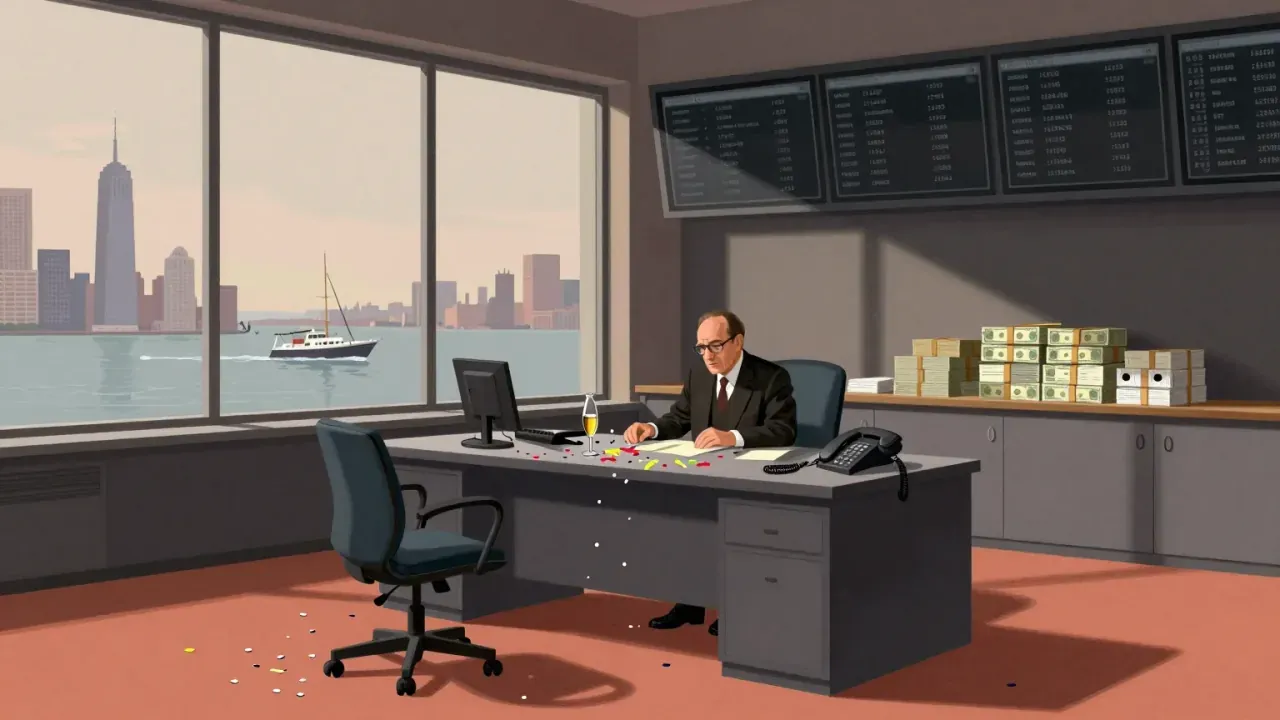
What lands is the relentlessness. The film’s rhythm never falters: each setback compounds the last, each escape opens a new trap, each minor victory dissolves before it registers. The doorman’s monologue at Club Berlin — a direct echo of Kafka’s ‘Before the Law’ — lands not as literary reference but as bureaucratic punchline, delivered with weary finality. The plaster hardening on Paul’s body is both grotesque and absurd, a physical metaphor made literal without explanation. Even small details land with weight: the shark-and-penis graffiti, the mouse trap snapping shut, the way Julie’s handmade posters appear overnight like fungal growth. The ending — Paul staggering into his office at dawn, the computer booting up as if nothing happened — lands because it refuses catharsis or irony. It lands as exhaustion made visible, as the sheer inertia of routine reasserting itself over chaos. Nothing is resolved, nothing is learned; the system absorbs the anomaly and carries on. That is the joke, and it holds.
The character of it
What does not land is any attempt to read Paul as psychologically coherent. His motivations shift without cause — he pursues Marcy, abandons her, returns to Kiki’s apartment, flees again — not from character logic but from narrative necessity. The film’s refusal to anchor him makes empathy difficult, and some viewers will find his passivity alienating rather than archetypal. The psychoanalytic readings cited in the sheet — castration anxiety, emasculation, mythic descent — feel grafted on rather than earned; the film shows the symptoms but offers no internal life to justify them. Some supporting turns verge on caricature: Tommy Chong and Cheech Marin’s thieves lack texture beyond their function as plot devices, and Bronson Pinchot’s performance as the sculptor’s assistant leans too heavily on camp without counterweight. The film’s commitment to surface means it sacrifices interiority — a choice, not a flaw — but one that leaves certain emotional payoffs unearned for viewers expecting psychological continuity.
The city in it
The themes that matter are urban disorientation, the collapse of social contracts, and the illusion of control in late-capitalist routine. After Hours treats New York not as a character but as a mechanism — indifferent, automated, responsive only to rules that shift without warning. The subway fare change, the doorman’s gatekeeping, the police’s silence: these are not malice but system failure made personal. The film also explores how identity unravels under sustained pressure — Paul loses money, clothes, dignity, and finally his skin, becoming first a suspect, then a sculpture, then cargo. There is no grand statement about class or gender, but a steady accumulation of micro-humiliations that suggest power operates through trivial, unchallengeable acts: a withheld key, a misread glance, a poster pasted on a lamppost. The recurring motif of plaster — malleable, then rigid, then shattered — mirrors the film’s view of selfhood: provisional, easily moulded, and ultimately fragile.
The audience for it
This film is for viewers who value pacing over psychology, structure over subtext, and discomfort over comfort — particularly those familiar with 1980s New York as a place of grit, flux, and unspoken rules. It rewards attention to composition, editing rhythm, and sonic detail, and suits those who enjoy films where tone is the primary carrier of meaning. It is not for viewers who require character motivation, emotional resolution, or moral framing — anyone expecting Paul to grow, learn, or rebel will leave unsatisfied. Those put off by repetitive escalation, surreal logic, or the absence of warmth may find it exhausting rather than exhilarating. A viewer who prefers Scorsese’s later, more reflective work — such as The Departed or Silence — may find After Hours too lean, too jagged, too unwilling to pause. Its appeal lies in its refusal to accommodate; change that, and it ceases to be itself.
The time in it
Yes, it is worth your evening — provided you watch it whole, undistracted, and without expectation of solace. Its ninety-seven minutes pass with the velocity of a dropped coin rolling down stairs: inevitable, kinetic, impossible to halt. It is not relaxing, nor uplifting, nor explanatory — but it is exact. Every shot serves the rhythm; every line serves the escalation; every performer commits to the film’s internal grammar. Those who dislike it tend to cite its cruelty or its lack of heart — fair objections, but ones that mistake the film’s purpose. After Hours is not about kindness or insight. It is about what happens when the city stops listening and starts reacting. To watch it is to experience that reaction firsthand. If you want a film that matches your pulse to its own — fast, irregular, unyielding — this is one of the few that still does it cleanly. Ninety minutes well spent, if you arrive prepared to be unsettled, not soothed.