The voice of it
Barry Lyndon is a historical drama adapting William Makepeace Thackeray’s 1844 novel The Luck of Barry Lyndon, transposing its picaresque satire of social climbing into a visually exacting, narratively detached chronicle of an Irishman’s rise and fall in eighteenth-century Europe. It does not seek to animate the novel’s ironic first-person voice but replaces it with an omniscient, measured narration — delivered by Michael Hordern — that frames Redmond Barry’s ambition, opportunism and self-deception as inevitable outcomes of rigid hierarchy and inherited privilege. Kubrick treats the period not as backdrop but as system: every costume, gesture, architectural detail and compositional choice reinforces the weight of social determinism. The film avoids psychological exposition, moralising or narrative acceleration; instead, it observes Barry’s trajectory — from soldier, gambler and seducer to husband, aristocrat and ruin — as if recording a natural phenomenon. Its aim is structural clarity, not emotional identification: to show how character is shaped less by will than by circumstance, decorum and the slow, unblinking gaze of history. It is a film about surfaces because surfaces — rank, dress, light, posture — are where power resides and is legible.
The look of it
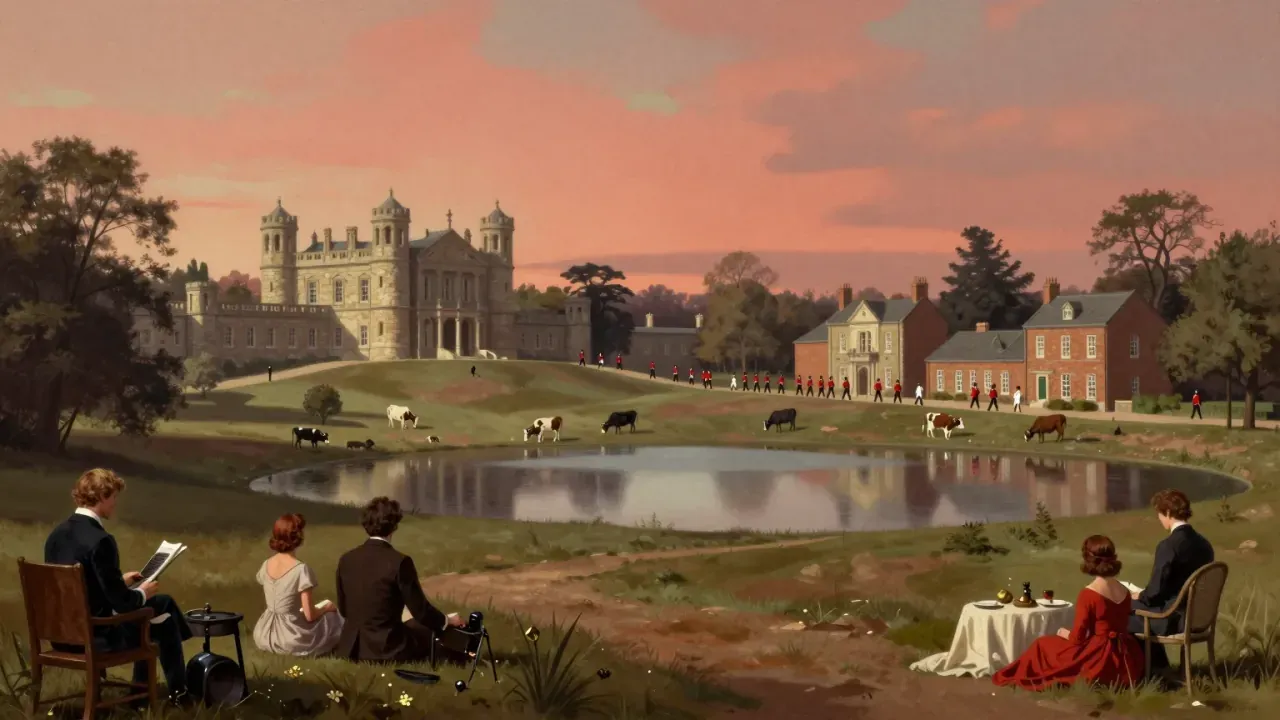
The story unfolds across three decades and several nations, anchored by Ryan O’Neal’s restrained, almost affectless performance as Barry — a deliberate flattening of the novel’s boastful narrator. Marisa Berenson matches this stillness as Lady Lyndon, her face often held in profile or half-shadow, her agency circumscribed by law and custom. John Alcott’s cinematography defines the film’s craft: candlelit interiors shot with specially adapted f/0.7 Zeiss lenses, long lateral tracking shots through stately homes, and slow backward zooms that withdraw from scenes like a historian closing a ledger. Ken Adam and Roy Walker’s production design renders each location — Powerscourt House, Castle Howard, Blenheim Palace — as both authentic setting and painted allegory, echoing Hogarth and Gainsborough without quotation. Leonard Rosenman’s score adapts period sources with surgical precision, avoiding sentimentality. Tony Lawson’s editing sustains Kubrick’s signature rhythm: long takes, minimal cutting, no reaction shots to cue feeling. Every element serves the same principle: remove the hand of the filmmaker so the world appears to observe itself.
The pace of it
What lands is the film’s cumulative authority — its ability to make the eighteenth century feel materially real and socially inescapable. The candlelight sequences do not merely impress; they reorient perception, forcing the eye to adjust, to read faces by flicker and silhouette, to accept limitation as condition. The pacing, often mistaken for inertia, functions as discipline: it denies catharsis, so that Barry’s downfall feels neither tragic nor redemptive but ordinary — the quiet unraveling of a man who mistook access for belonging. The costumes, awarded an Oscar, are not decorative but diagnostic: each stitch, lace trim and waistcoat cut signals lineage, debt or pretension. Even minor roles — Patrick Magee’s irascible Chevalier, Leonard Rossiter’s brittle Captain Potzdorf — register with forensic economy. The film’s refusal to explain, to underline or to judge creates space for sustained attention to detail: the way light falls on marble, how a sword duel obeys ritual before violence, how silence between characters carries more weight than dialogue. This is not immersion. It is induction.
The distance of it
What does not land is emotional access — deliberately, but not without cost. Some viewers find Barry emotionally impenetrable, his motivations under-articulated, his suffering muted to the point of abstraction. The narration, though precise, can feel detached to the point of indifference, especially in the second half, where Barry’s decline lacks the visceral momentum of his ascent. Scenes of domestic tension — particularly those involving his son Bryan — rely on implication rather than confrontation, which may register as evasion rather than restraint. The film’s resistance to conventional dramatic arcs means it offers no release, no pivot, no moment where the system cracks open to let feeling through. Those expecting psychological depth or moral reckoning will find neither. The duelling sequence, added by Kubrick, works formally but risks feeling schematic — a formal capstone rather than organic climax. And while the historical fidelity is rigorous, it occasionally borders on austerity: the very qualities that lend the film its gravitas can also produce distance, making empathy feel like a choice the film declines to invite.
The weight of it
The themes that matter are inheritance, performance and entropy. Barry does not forge identity; he borrows, mimics and occupies it — first as a soldier, then a fortune-hunter, finally a titled nonentity. His marriage to Lady Lyndon is less love than leasehold: he acquires her name, estate and status, but none of the legitimacy that comes with blood or birthright. The film treats class not as ideology but as physics — a force with mass, inertia and immutable laws. Every frame reinforces how appearance governs reality: Barry’s clothes precede his credibility; his posture precedes his authority; his title precedes his competence. Entropy appears in the slow decay of bodies, fortunes and marriages — Bryan’s illness, the crumbling of Barry’s composure, the fading of candlelight at the end of a scene. There is no progress here, only circulation: wealth moves, titles pass, men rise and vanish. Kubrick strips away romantic notions of self-determination. What remains is structure — architectural, social, optical — and the quiet tragedy of believing you can outwit it.
The demand of it
It is for viewers who value composition over catharsis, duration over drive, and historical texture over psychological immediacy. It rewards patience, visual literacy and tolerance for ambiguity — those who watch films to inhabit worlds rather than follow arcs. It is not for those who require narrative propulsion, emotional cues or moral resolution; those who need characters to articulate inner life or whose attention depends on rhythmic variation will find it testing. Some critics of the 1970s objected to its ‘coldness’ — a charge that still holds, though it misidentifies the film’s method as flaw rather than intention. A viewer who values emotional transparency over structural rigour would fairly reject it. Nothing in the film would change that verdict — not a tighter edit, not added exposition, not warmer lighting. Its power lies precisely in its refusal to accommodate such expectations.
The return of it
Yes, it is worth your evening — but only if you approach it as a sustained act of attention, not passive consumption. Its 184 minutes ask for commitment, not endurance: the length is functional, not indulgent — each scene calibrated to build the world’s density and logic. You will not leave stirred, but you may leave recalibrated: aware of how light defines space, how costume encodes power, how silence structures meaning. It repays rewatching not for plot revelation but for perceptual refinement — noticing how a servant’s placement in frame signals hierarchy, or how Rosenman’s music pauses just before a cut to deepen anticipation. Those who treat film as spectacle may find it inert; those who treat it as architecture will find it foundational. Its value is not in what it gives, but in what it trains you to see — and that training begins the moment the first candle flame steadies on screen.