The shape of the story
Gods of the Plague is Rainer Werner Fassbinder’s second feature, a black-and-white West German drama made in late 1969 and released at the start of 1970. It sets out to rework film noir conventions through a deliberately flattened affect, minimal dialogue, and a structural emphasis on repetition, delay, and spatial disorientation. The plot follows Franz Walsch, recently released from prison, as he drifts between criminal associates, two women — Joanna and Margarethe — and Günther, the friend who shot his brother. But narrative propulsion is subordinated to mood, gesture, and visual framing: characters speak in clipped, often non-sequitur lines; scenes linger without resolution; motivations remain opaque. Fassbinder and co-director Michael Fengler treat genre not as scaffolding but as material to be stripped bare — less a crime story than a study in how genre shapes expectation, then withholds fulfilment. The film operates within the logic of early New German Cinema: low budget, rapid production, ensemble acting drawn from Fassbinder’s regular collaborators, and an insistence on exposing the artifice of cinematic representation. It is not trying to tell a story well, but to ask what happens when storytelling is made hesitant, hollowed out, and reassembled in monochrome austerity. (158 words)
The look of it
The story unfolds in sparse, static shots, often centred and tightly composed, with Dietrich Lohmann’s cinematography holding interiors in deep shadow and exteriors in flat, overcast light. Performances are restrained to the point of vacancy: Harry Baer’s Franz moves with deliberate listlessness, Hanna Schygulla’s Joanna is watchful but unyielding, Margarethe von Trotta’s Margarethe performs identity through posture and gaze rather than exposition. Rainer Werner Fassbinder appears briefly as a gangster, and Günther Kaufmann — cast against type and later central to Fassbinder’s personal and artistic life — brings a physical presence that unsettles the film’s emotional neutrality. Peer Raben’s score is sparse, mostly piano motifs that recur without development. Editing by Fassbinder and Thea Eymèsz favours long takes and abrupt cuts, denying rhythm or emphasis. There is no conventional scoring of emotion: tension is built not through music or pacing but through duration, framing, and the weight of silence. The camera rarely moves, yet the compositions feel unstable — doorways bisect faces, mirrors reflect absence, posters dominate walls like icons. Every technical decision serves a dramaturgy of withholding: meaning is deferred, desire is unmoored, and causality remains implied but unconfirmed. (159 words)
What holds it together
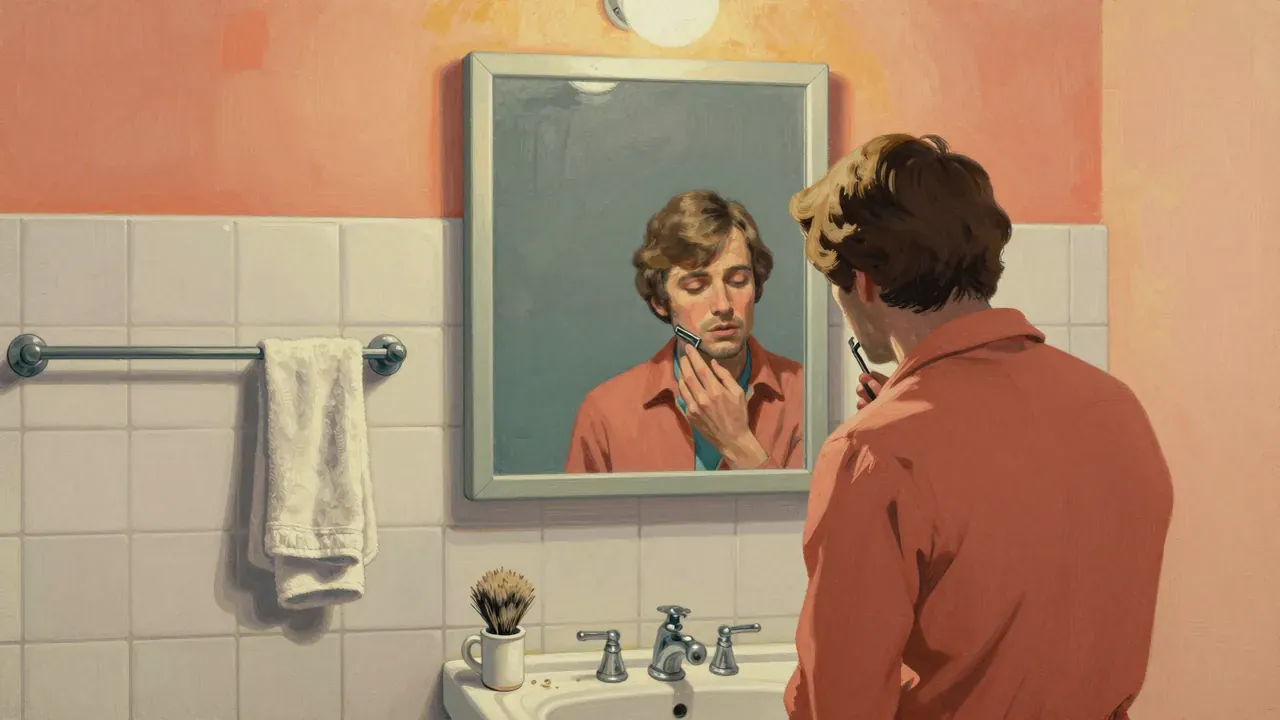
What lands most firmly is the film’s sustained tonal control: its refusal of catharsis, its commitment to visual austerity, and its quiet subversion of genre expectations. The repeated use of mirrors, posters, and reflective surfaces creates a consistent motif of fractured or mediated identity — particularly in Margarethe’s fixation on a blown-up advertisement image, which becomes less a symbol than a structural principle. The homoerotic undercurrent, made visible in shared nudity and lingering proximity between Baer and Kaufmann, gains force precisely because it is never named or resolved — it exists as atmosphere, not plot. The ensemble’s discipline is palpable: each actor inhabits their role with a stillness that reads not as blankness but as resistance to psychological exposition. Lohmann’s high-contrast monochrome renders Munich’s postwar architecture both familiar and alien, turning ordinary rooms into stage sets where every object feels placed for semantic weight. Even minor details — a cigarette held too long, a glance held a beat past comfort — accrue significance through repetition. This is not a film that wins viewers over with charm or momentum, but one that compels through consistency of method and precision of effect. Its power lies in what it refuses to give. (157 words)
Where it slips
What does not land is any sense of narrative necessity: the plot functions more as pretext than engine, and its thinness becomes a liability for viewers expecting coherence or consequence. Characters act without clear motivation — Franz’s return to crime, Margarethe’s shifting allegiance, Günther’s violence — and the film offers no exposition, flashback, or internal monologue to bridge the gaps. The deliberate flatness of delivery occasionally reads as under-rehearsed rather than stylised, especially in secondary roles where line readings verge on monotone without irony or intention behind them. Some scenes — particularly those involving extended silences or static tableaux — risk monotony when viewed outside the context of Fassbinder’s broader project. The film’s minimalism does not always generate tension; sometimes it produces inertia. Its rejection of conventional dramatic arcs may frustrate viewers accustomed to cause-and-effect storytelling or emotional payoff. The homoerotic charge, while formally integrated, remains implicit to the point of obscurity for those unfamiliar with Fassbinder’s biography or the film’s critical reception. And though the black-and-white photography is controlled, its consistency can dull contrast over time: greys accumulate, shadows deepen, and visual variety recedes. It is a film that demands patience, and not all patience is rewarded equally. (159 words)
What it is really about
The themes that matter are the instability of identity, the mediation of desire, and the exhaustion of genre forms. Margarethe’s relationship to her own image — seen in posters, mirrors, and reflected glances — frames identity not as interior essence but as external projection, constantly negotiated and never settled. Franz’s status as ex-convict places him outside social continuity: he returns to a world that has moved on, and his attempts to re-enter it are marked by hesitation, misrecognition, and failed connection. The criminal milieu is neither glamorous nor brutal, but banal — a series of transactions, silences, and half-spoken threats that erode the myth of underworld agency. Death is present not as climax but as ambient fact: the brother’s murder hangs over the film like weather, unspoken but structurally decisive. Romance is rendered futile not through betrayal or passion, but through mutual incomprehension and emotional withdrawal. The film treats love, loyalty, and vengeance as habits rather than convictions — repeated gestures emptied of original meaning. Its existential weight comes not from grand statements but from the cumulative effect of characters moving through spaces they no longer recognise, speaking lines they do not fully own. (155 words)
Who it is for
This film is for viewers already engaged with Fassbinder’s early work, or with the formal concerns of 1960s European art cinema — those who value compositional rigour, narrative restraint, and the politics of cinematic silence. It rewards attention to framing, editing rhythm, and the physicality of performance over plot resolution. It is also for students of film history interested in how genre conventions are dismantled from within, or in how low-budget constraints shape aesthetic choice. It is not for viewers seeking narrative clarity, emotional accessibility, or stylistic variation: its pace is deliberate, its tone unrelenting, its pleasures austere. Those who find minimalism alienating or who require psychological motivation for character action will likely disengage. Some critics have called it a ‘fairly good watch’ or ‘memorable’, but those assessments assume a baseline familiarity with its methods. Without that, the film risks feeling like an exercise rather than an experience. A viewer new to Fassbinder might find more entry points in Love Is Colder Than Death or Ali: Fear Eats the Soul — this one assumes its audience has already begun the conversation. (158 words)
Whether it is worth your evening
Yes, it is worth your evening — but only if you approach it as a precise, self-contained object of study rather than entertainment. Its ninety-one minutes unfold with such consistency of tone and technique that even its apparent flaws — the thin plot, the affectless performances — become part of its argument. It repays close viewing not because it reveals hidden depths, but because it sustains a single, unwavering proposition: that genre, identity, and desire are all systems of repetition, and that breaking them requires not explosion but erosion. Someone who values narrative propulsion or emotional warmth will find little here to hold them; they would disagree, and rightly so — this film does not seek their assent. What would change the verdict? A different context: watching it alone versus in sequence with Fassbinder’s other 1969–70 films, or after reading critical work on his use of Lacanian structure. But on its own terms, it holds up — not as a masterpiece, but as a rigorously realised statement, lean and unblinking. Its value lies in its refusal to soften. (159 words)