The shape of the school
If…. is a satirical film about English public school life in the late 1960s, structured as an escalating confrontation between a group of non-conformist sixth-formers and the institution’s hierarchy. It does not aim for realism in the documentary sense, nor for broad comedy: its method is allegorical, using the boarding school as a microcosm of authoritarian structures — social, pedagogical, sexual, military. Lindsay Anderson and David Sherwin treat the setting not as backdrop but as architecture of control: the corridors, dormitories, chapel, and parade ground are all calibrated to enforce obedience through ritual, surveillance, and sanctioned violence. The film’s ambition is not to diagnose public schools alone but to trace how power circulates when delegated to intermediaries — prefects, housemasters, chaplains — and how rebellion emerges not from ideology but from accumulated humiliation. Its tone is deliberately unstable, shifting between deadpan observation, surreal fantasy, and abrupt brutality. It asks what happens when the logic of discipline becomes indistinguishable from the logic of war — and when the line between discipline and sadism dissolves.
The look of it
The story unfolds in three phases: assimilation, provocation, insurrection. Mick Travis, Wallace, and Knightly move from minor transgressions — hiding a moustache, stealing a motorbike — to acts that expose the system’s fragility: a shared bed, a vodka-fuelled monologue on violence, then live fire during a CCF drill. Malcolm McDowell’s performance is physically contained yet charged with watchful stillness; he rarely raises his voice, but his gaze never yields. Christine Noonan and David Wood give unshowy, grounded turns as the café girl and younger boy who join the revolt. Miroslav Ondříček’s cinematography alternates black-and-white and colour not for effect but function: the chapel scenes are in black-and-white because time was short, but the contrast becomes structural — reality bleeds into dream, authority into farce, discipline into slaughter. Marc Wilkinson’s score blends liturgical chant with percussive tension, while David Gladwell’s editing tightens rhythm as the film moves toward its climax. There are no establishing shots of the school’s exterior until the final rooftop sequence — the institution is experienced from within, claustrophobic and inescapable.
What stays
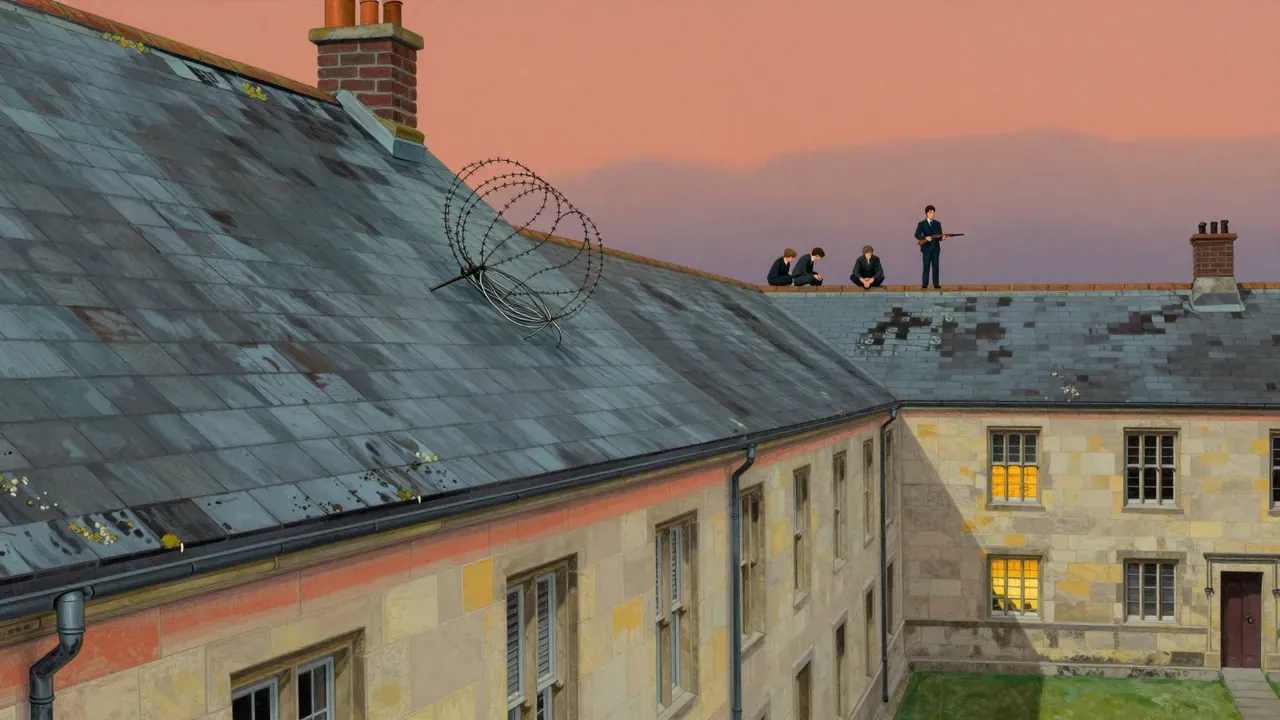
What lands is the precision of its institutional critique. The Whips’ casual cruelty — their discussion of junior boys as objects, their use of ‘service’ as cover for domination — feels drawn from lived observation, not caricature. The sweat room, the Long Room dormitory, the School House changing rooms: these locations are rendered with tactile specificity, making the satire land not as abstraction but as indictment. The shift from black-and-white to colour is never explained, yet it works: it marks transitions between states of consciousness — memory, fantasy, escalation — without exposition. The final rooftop battle avoids catharsis or triumph; it is chaotic, disorienting, and unresolved, ending on Mick’s face mid-fire, expressionless. That refusal to moralise or resolve gives the film its enduring weight. It does not ask whether rebellion is justified, only how inevitably it follows certain conditions — and how easily authority responds not with reform but with counter-violence. The film’s formal restlessness — jump cuts, sudden silences, abrupt shifts in tone — mirrors the instability of adolescence under rigid control.
Where it slips
What does not land is the coherence of the revolt’s internal logic. The trio’s transition from passive resentment to armed uprising lacks psychological scaffolding: their motivations remain rhetorical rather than rooted in character. The café girl’s arrival at the storeroom feels narratively convenient, not earned; her role in the climax — shooting the headmaster — arrives without prior indication of agency or grievance. Some surreal sequences, particularly the black-and-white nude walk through the school, operate more as stylistic signatures than narrative extensions; they assert mood but do not deepen theme. The film’s refusal to explain its own symbolism can tip into opacity: the mortars and automatic weapons discovered beneath the hall exist outside any plausible school context, and their presence reads less as metaphor than as plot device. A viewer expecting cause-and-effect causality will find gaps — not in the world-building, but in the characters’ inner lives. The satire sharpens the institution, but blurs the individuals inside it, especially beyond the central trio. This is not carelessness, but a choice — yet it costs the film some emotional purchase.
What it’s really about
The themes that matter are not rebellion per se, but the reproduction of hierarchy: how institutions train their subjects to police one another, how authority delegates cruelty to avoid accountability, and how ritual — Speech Day, CCF drills, chapel services — masks coercion as tradition. Class operates not through economics but through proximity: the Whips are not richer than the juniors, but closer to power, and thus entitled to humiliate. Sexuality is present not as desire but as instrument — the Whips discuss boys as objects, Mick fantasises wrestling the café girl, Wallace shares a bed with Bobby Philips without naming it. These moments are not explorations of identity but demonstrations of control’s elasticity. The film treats education not as transmission of knowledge but as calibration of submission — the headmaster’s final plea for reason is met with a bullet because reason has already been evacuated from the system. Time is another theme: the film’s structure mirrors the academic year, but also the slow accrual of rage that makes violence feel inevitable rather than impulsive. It is less about youth than about what happens when institutions stop listening — and what fills the silence left behind.
Who it’s for
It is for viewers who value formal rigour over narrative comfort, who read institutions before individuals, and who find political resonance in aesthetic choices — the black-and-white chapel, the asymmetrical framing of authority figures, the deliberate flatness of McDowell’s delivery. It is not for those who require psychological continuity, clear motivation, or moral resolution. A viewer expecting a coming-of-age story will be frustrated; this is not about growth but rupture. Those who dislike ambiguity in tone or resist satire that refuses to name its targets explicitly will find it evasive. The film assumes familiarity with British public school codes — the meaning of ‘Whips’, the weight of Speech Day, the unspoken rules of the CCF — and offers no glossary. It rewards attention to texture over plot, and patience with repetition: the same corridor appears in different lights, the same chant recurs in altered contexts. Its audience is narrow by design — not because it is obscure, but because it demands that the viewer meet it on its own terms, not theirs.
Is it worth your evening
Yes, it is worth your evening — not as entertainment but as encounter. Its 111 minutes unfold with deliberate, unhurried gravity, refusing to flatter the viewer with clarity or catharsis. You will not leave understanding Mick Travis better, but you may understand how institutions calcify, how power delegates itself, and how violence becomes legible when language fails. It is not for someone seeking narrative propulsion or emotional release, nor for those who prefer satire that names its targets directly. A viewer who values historical specificity over universalism, or who finds resonance in form as argument, will find it urgent. Those who expect character arcs or thematic closure will not. Its value lies not in what it resolves but in how precisely it maps the fault lines — between discipline and punishment, order and terror, tradition and inertia — that still run beneath British institutions today.