The shape of the day
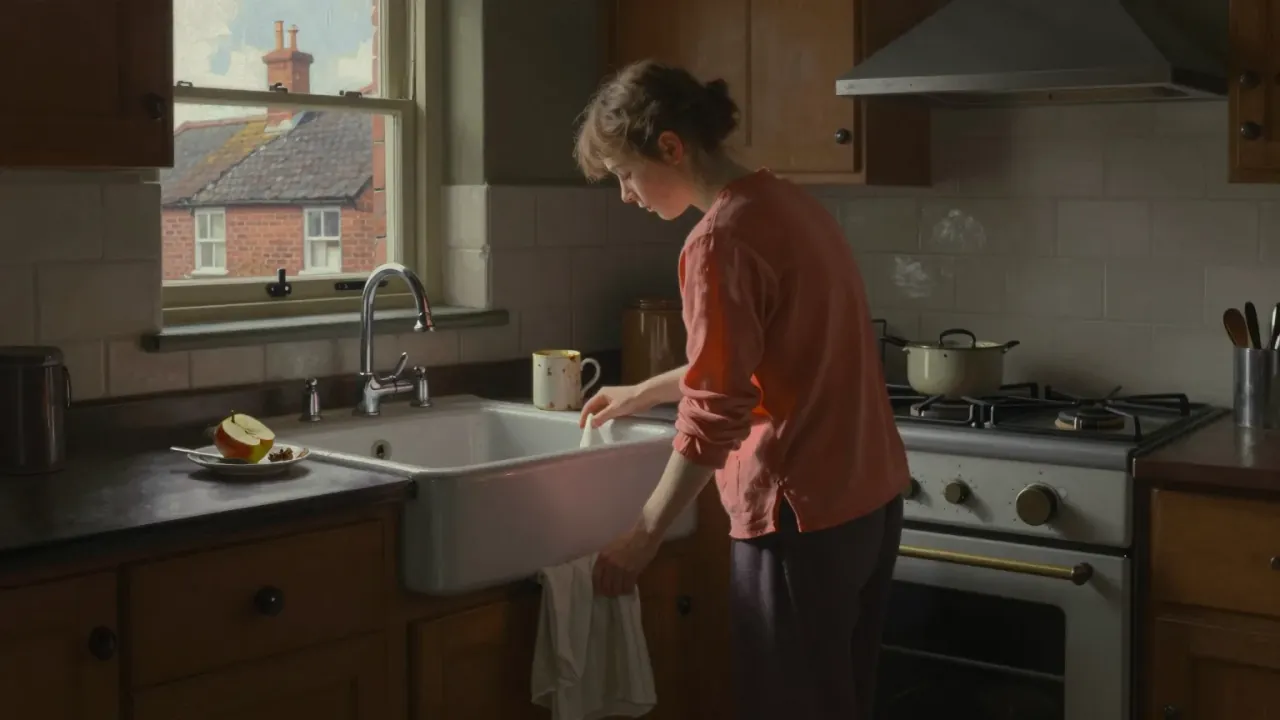
The Deep Blue Sea is a 2011 adaptation of Terence Rattigan’s 1952 play, directed by Terence Davies and set in post-war London. It attempts to render the interior life of a woman caught between two forms of love — one stable and unexciting, the other volatile and consuming — not through exposition but through duration, silence, and physical detail. The film narrows its frame to a single day in Hester Collyer’s flat, using that confinement as both structural device and psychological register. It does not seek to explain her choices but to hold them in sustained, unsentimental attention: the weight of a coat hung on a hook, the way light falls across a bare floorboard, the pause before a sentence is finished. Its fidelity is to emotional truth over narrative momentum, and to the texture of mid-century English restraint — the kind that muffles desire rather than releases it. This is not a film about events but about the residue they leave behind: exhaustion, tenderness, shame, and the quiet shock of self-recognition. It assumes the audience will tolerate stillness, and rewards that patience with precision. (148 words)
The look of it
The story unfolds in fractured chronology, anchored by Rachel Weisz’s performance as Hester — physically contained, emotionally porous, her face registering shifts in feeling before her voice catches up. Tom Hiddleston gives Freddie a restless physicality, all sharp angles and sudden laughter, while Simon Russell Beale makes Sir William’s kindness feel like a kind of gravity, steady and inescapable. Florian Hoffmeister’s cinematography keeps interiors dim and grainy, favouring shallow focus and tight framing that mirror Hester’s narrowing world. Samuel Barber’s Violin Concerto No. 1 underscores key moments without dictating mood; its lyrical anguish complements rather than comments on the action. David Charap’s editing avoids conventional rhythm, letting scenes breathe or cut abruptly — as memory does. The production design, shot at 3 Mills Studios and locations in Buckinghamshire and London, renders 1950s austerity not as backdrop but as pressure: thin walls, damp plaster, furniture that has outlived its comfort. Every craft decision serves the central paradox: that passion can be both oxygen and suffocation. (156 words)
The weight of stillness
What lands most firmly is the film’s refusal to resolve Hester’s dilemma. Her choice is not between right and wrong, but between two kinds of absence — the hollow warmth of security and the exhilarating void of obsession. Weisz’s performance lands because it never flinches from ambiguity: her Hester is neither victim nor heroine, but a woman whose body remembers what her mind cannot reconcile. The visual language reinforces this — Hoffmeister’s camera lingers on hands, on doorways, on empty chairs, making absence palpable. The use of Barber’s concerto works precisely because it does not ‘score’ emotion but echoes it: the violin’s long, aching lines mirror Hester’s unspoken yearning, while its dissonant passages reflect Freddie’s instability. The flashbacks do not clarify motive but deepen mystery — each fragment feels less like exposition and more like a shard of glass catching light at a new angle. Even minor roles land with quiet authority: Barbara Jefford as Collyer’s mother conveys generations of stoicism in a single glance; Karl Johnson as Mr. Miller offers dry, unvarnished observation without judgment. Nothing here gestures. Everything accrues. (152 words)
The edge of restraint
What does not land is the film’s occasional drift into mannerism — moments where restraint tips into withholding. Some viewers may find the pacing too deliberate, the silences too long, the emotional temperature too low for the stakes involved. The structure, though faithful to Rattigan’s original conceit, risks monotony when the flat’s confines begin to feel less like psychological realism and more like theatrical constraint translated without adjustment. Freddie’s wartime trauma remains sketchily rendered: his volatility reads as temperament rather than consequence, and Hiddleston’s charisma sometimes overshadows the character’s damage. The script, co-written by Davies and Rattigan, retains the play’s formal elegance but loses some of its rhetorical force in translation — the dialogue’s clipped cadences work on stage, but on screen they occasionally flatten into affectation. A few supporting characters — Jackie Jackson, Mrs Elton — exist primarily to articulate thematic points rather than inhabit them. And while the period detail is exact, it rarely feels lived-in beyond surface texture: there is little sense of the wider city, the political climate, or even the weather beyond what serves mood. These are not flaws in ambition, but limits in execution. (154 words)
The grammar of longing
The themes that matter are those bound to embodiment: how desire reshapes posture, breath, gait; how grief lives in the throat before it reaches the eyes; how class and gender condition the very grammar of longing. The film treats passion not as liberation but as reorientation — a force that scrambles moral coordinates without offering new ones. It examines the cost of honesty in a society that prizes composure, and the loneliness of choosing authenticity over accommodation. Hester’s suicide attempt is not a cry for help but a logical endpoint of a life lived in contradiction — the film refuses to pathologise it or redeem it. Memory here is non-linear and unreliable, less archive than echo chamber. The post-war setting matters not for its historical specificity but for its atmosphere of suspended time: rationing has ended, but emotional austerity lingers. The title’s nautical metaphor — caught between devil and deep blue sea — is not about binary choice but about being stranded in the space between certainties, where no option promises relief, only different kinds of endurance. This is a film about the weight of feeling when there is no vocabulary for it. (149 words)
Who it is for
This film is for viewers who value sustained attention to interior life over plot propulsion, who find resonance in stillness and meaning in gesture. It suits those familiar with Rattigan’s theatrical idiom or Davies’ earlier work — films that treat time as material, not measure. It is not for viewers who require narrative clarity, psychological exposition, or cathartic release. Those who expect Freddie’s trauma to be unpacked, or Hester’s marriage to be morally adjudicated, will leave unsatisfied. People who rely on music or editing to signal emotional shifts may find the film’s restraint alienating. It also assumes a tolerance for British reserve — the kind where a dropped teacup carries more weight than a shouted line. Anyone seeking social critique, period spectacle, or romantic resolution should look elsewhere. That said, those who respond to Weisz’s performance may disagree with this verdict: her presence alone draws some viewers in despite the film’s austerity. A tighter edit or a more textured rendering of Freddie’s inner world would shift the balance for sceptics. (147 words)
Is it worth your evening
Yes, it is worth your evening — provided you approach it as a study in tonal precision rather than a story with answers. Its ninety-eight minutes pass slowly, but never emptily: every frame contains intention, every pause holds implication. It repays attention not with revelation but with accumulation — small details that cohere into something unmistakable by the final shot. You will not leave energised, but you may leave unsettled in a useful way, reminded how much feeling passes unspoken, how much love resembles grief in its physical signature. It is not entertainment in the conventional sense, but it is deeply felt and rigorously made. Those who dislike slow cinema, or who find emotional ambiguity frustrating rather than fertile, will not warm to it — and that is a legitimate position, not a failure of reception. The film does not ask for sympathy but for recognition, and that recognition depends on willingness to sit with discomfort without reaching for explanation. Its value lies in that refusal to simplify. (149 words)