The shape of it
Nashville is a mosaic of the American music industry in 1974, set over five days in its capital city and built around a political rally for a fictional populist presidential candidate. It does not tell one story but holds twenty-four characters in loose orbit: singers, songwriters, managers, journalists, groupies, gospel mothers, lawyers, and fringe performers — all moving through recording studios, motels, radio stations, and a downtown amphitheatre. Joan Tewkesbury’s screenplay began as ethnographic observation, then became a structural experiment in simultaneity: no protagonist, no central plot engine, no narrative resolution beyond the abrupt, unexplained assassination that closes the film. Altman treats Nashville not as a place to be dramatised but as a system to be mapped — its hierarchies, economies, vanities, and silences. The film attempts something rare: a national portrait made without narration, without moral framing, and without a single character who stands in for the filmmaker’s point of view. It refuses satire by refusing to judge — and in doing so, becomes a more unsettling mirror than any polemic could be. (159 words)
The sound of it
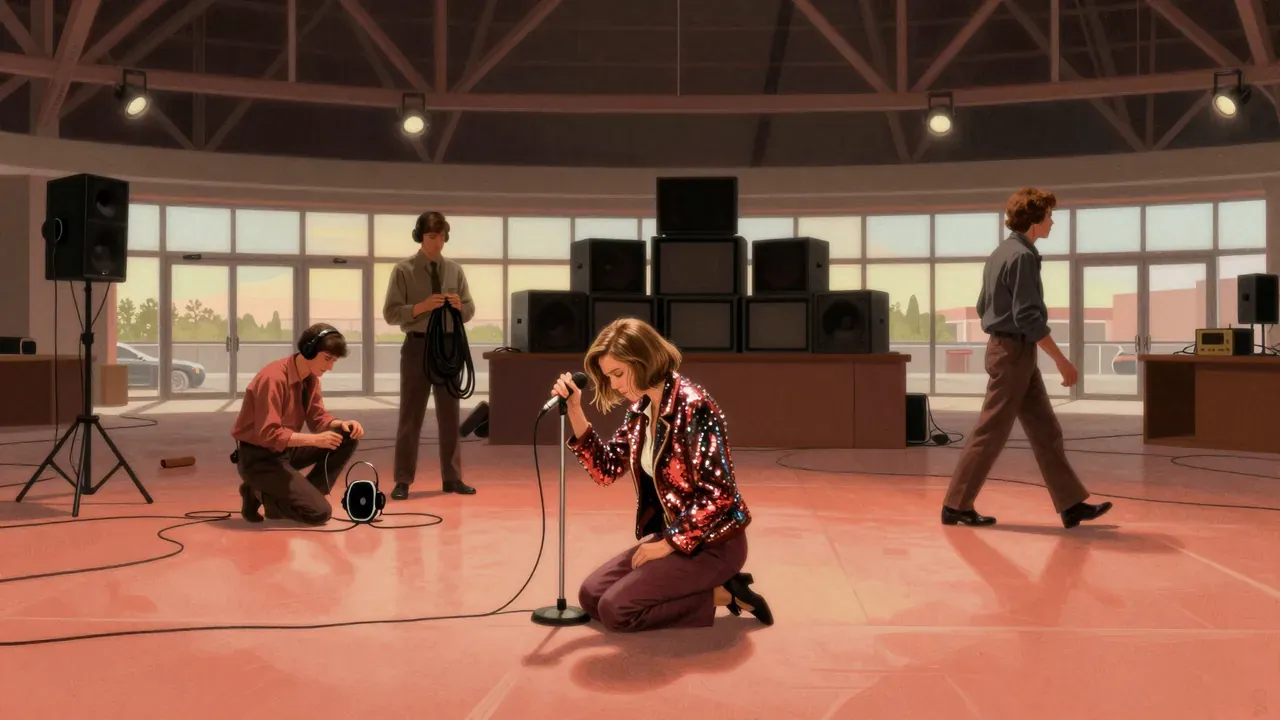
The film works through accumulation and counterpoint. Paul Lohmann’s cinematography uses wide lenses and deep focus to hold multiple planes of action at once; dialogue overlaps, bleeds, and competes — sometimes three conversations audible in one take. Performances are calibrated to feel lived-in rather than performed: Ronee Blakley’s Barbara Jean trembles with real vocal fatigue and emotional exposure; Lily Tomlin’s Linnea sings gospel with quiet authority while signing to her deaf children; Henry Gibson’s Haven Hamilton delivers patriotic platitudes with the polished ease of a man who has recited them for thirty years. Musical numbers are diegetic, recorded live on set, often with visible microphones and imperfect takes. Editing avoids emphasis — cuts land where attention drifts, not where drama demands. There is no score outside the diegetic songs, and Richard Baskin’s arrangements treat each genre — country, gospel, folk, pop — as socially embedded, not stylistic decoration. The craft is anti-hierarchical: no shot privileges one character over another, no scene exists solely to advance plot. Even the political subplot — Hal Phillip Walker’s campaign — is heard only in fragments, broadcast over car radios or murmured by background extras. (158 words)
The weight of it
What lands is the texture of collective life: the way ambition curdles into exhaustion, how fame flattens intimacy, how performance becomes indistinguishable from selfhood. Barbara Jean’s breakdown feels less like a scripted collapse than the inevitable pressure release of a system that demands constant output and zero vulnerability. Linnea’s quiet devotion — singing with her choir, translating lyrics for her children, holding space for others’ crises — lands with cumulative weight because it is never framed as noble, only necessary. The film’s musical sequences work not as interludes but as social diagnostics: Keith Carradine’s ‘I’m Easy’ succeeds because it sounds like a real audition tape — tentative, seductive, slightly out of time. The highway pile-up early on lands not as spectacle but as bureaucratic absurdity: ambulances arrive, paperwork is filed, nobody asks why the cars stopped. Even the assassination, though jarring, lands precisely because it arrives without foreshadowing or motive — a rupture that mirrors how violence enters public life: unannounced, unexplained, absorbed into the next news cycle. The film’s realism is procedural, not psychological: it shows how things happen, not why people do them. (157 words)
The gaps in it
What does not land is the sheer volume of underdeveloped threads. Several characters — Opal the journalist, Tommy Brown the Black country singer, Sueleen the waitress — are introduced with clear thematic purpose but given insufficient room to breathe. Their arcs end not with resonance but with omission: we see Sueleen humiliated on stage, then never again. The political subplot remains stubbornly opaque — Hal Phillip Walker’s platform is never named, his supporters never interrogated, his ideology reduced to bumper-sticker slogans. Some performances suffer from the film’s refusal to settle: Geraldine Chaplin’s Opal speaks constantly but reveals little; her monologues feel like exposition delivered to thin air. The improvisational method, while generative, leaves gaps in motivation — Ned Beatty’s Del seems to exist only to listen, Karen Black’s Connie White only to glitter. A handful of musical numbers — particularly those leaning into parody — sit uneasily beside the film’s prevailing naturalism. And though the film’s refusal to explain is part of its design, it can also feel like evasion: when Barbara Jean is shot, the camera holds on her bloodied dress, then cuts to a banner flapping in the wind. That silence is powerful — but for some viewers, it may read as indifference rather than restraint. (159 words)
The logic of it
The themes that matter are not about music or politics alone, but about the infrastructure of attention: how fame is manufactured, distributed, and withdrawn; how identity is shaped by what audiences demand and what industries supply; how populism thrives on the illusion of access while reinforcing exclusion. The film treats celebrity as labour — exhausting, repetitive, transactional — and gospel as discipline — communal, embodied, unglamorous. Race appears not as theme but as condition: Timothy Brown’s Tommy Brown is treated with respect by white characters but rarely spoken to directly; the Black choir is present but never consulted on the show’s programming. Class is registered in accents, hotel lobbies, and who carries the microphone. The Replacement Party functions less as satire of a specific movement than as an index of democratic fatigue — its rallies draw crowds not because of policy but because they offer spectacle, belonging, and the chance to be seen. Nashville’s deepest concern is with mediation: how sound is captured, how images are framed, how stories are edited out of existence before they begin. It is a film about the machinery of meaning-making, not the meanings themselves. (156 words)
The rhythm of it
This film is for viewers who value density over direction, who find pleasure in listening to overlapping voices rather than following a single thread, and who trust that coherence can emerge from accumulation rather than causality. It rewards patience, repeated viewing, and attention to background detail — the way a radio plays different stations in different rooms, or how a character’s outfit changes across scenes without comment. It is not for those who require narrative propulsion, psychological closure, or moral signposting. Viewers expecting satire will be disappointed by its lack of ridicule; those seeking character study may find the ensemble too dispersed. People who dislike diegetic music, long takes, or films that withhold explanation will likely disengage early. Some critics argue the film’s neutrality borders on complicity — particularly in its treatment of race and gender — and that its formal innovation masks a conservative vision of power. That reading is defensible, but it depends on expecting Nashville to condemn what it only observes. Change the film’s refusal to judge, and you change its entire architecture. (158 words)
The time of it
Yes, it is worth your evening — but only if you watch it as a landscape, not a journey. Its 159 minutes unfold like a city you walk through without a map: disorienting at first, then revealing patterns only visible from a distance. You will not leave with answers, but with a heightened sense of how sound, image, and ambition circulate in public life. It repays attention not with payoff but with texture — the grain of a voice, the weight of a pause, the way a crowd’s energy shifts when a microphone is handed to someone unexpected. Those who expect tight plotting or emotional catharsis will find it inert. But for anyone willing to sit with its rhythms, Nashville offers something rare: a film that feels less like fiction and more like overhearing reality in real time. Its endurance is not due to nostalgia or reputation, but to its precise calibration of scale and silence — a film that knows exactly how much it can show, and how much must remain unsaid. (159 words)