The shape of time
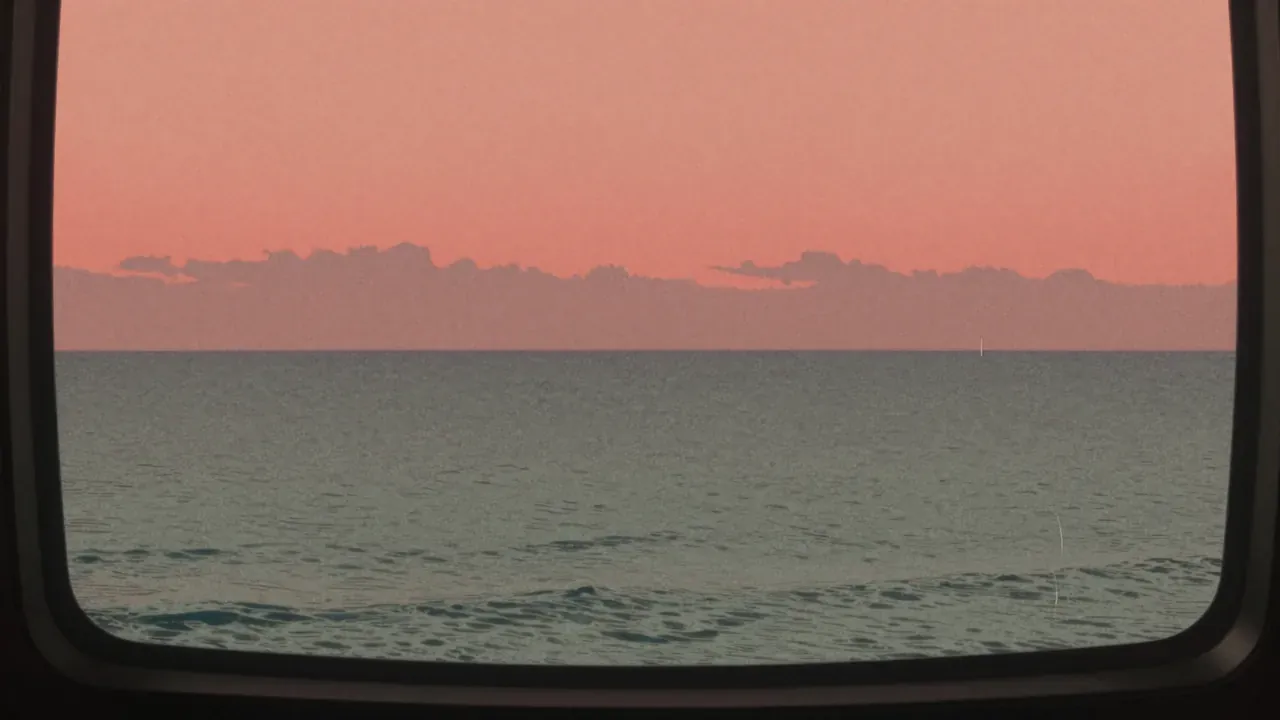
The Seventh Continent is Michael Haneke’s 1989 debut feature, an Austrian psychological drama in German that traces three years in the life of a middle-class Viennese family — engineer Georg, optometrist Anna, and their daughter Eva — as they methodically dismantle their existence before collective suicide. It does not seek to explain motive through psychology or backstory but to expose the hollowness beneath routine: the film treats domestic order not as stability but as complicity, and its austerity is structural, not stylistic. Haneke builds the film on repetition, silence, and withheld context — no exposition, no flashbacks, no interior monologue beyond two letters read aloud. The title refers to Australia, a phantom destination cited in those letters, rendered only as a static image of impossible waves on an isolated shore. This is not a portrait of breakdown but of continuity: the family’s final act is consistent with every prior gesture — measured, procedural, uninflected. Its ambition is forensic, not empathetic; it asks the viewer to register what is done, not why it is felt. (158 words)
The rhythm of repetition
The film works through strict formal discipline: Marie Homolkova’s editing sustains long takes and rhythmic recurrence across its three titled sections — 1987, 1988, 1989 — each beginning with near-identical domestic routines. Birgit Doll, Dieter Berner, and Udo Samel perform with deliberate affectless precision; speech is sparse, gestures economical, emotional inflection suppressed until the fish tank shatters. Alban Berg’s music — drawn from his Lyric Suite and other chamber works — is used sparingly, often as diegetic radio sound or abrupt, dissonant punctuation. There are no establishing shots, no score cues for emphasis; the camera remains at medium distance, observing without commentary. Lighting is flat, interiors clinically lit, colour palette muted and consistent. Sound design is equally restrained: ambient noise dominates — fridge hums, taps running, distant traffic — until the third part, when silences grow longer and phone bells are muffled with cotton. Every craft decision serves the film’s central proposition: that meaning resides not in expression but in the accumulation of unremarkable acts, repeated until they become irreversible. (159 words)
The weight of the everyday
What lands is the cumulative weight of ritualised normality. The first two sections’ repetitions — brushing teeth, folding laundry, commuting, eating breakfast — do not bore; they condition the viewer to recognise pattern as both comfort and cage. When the third section begins with the same gestures, then veers into resignation letters, bank closures, and tool purchases, the shift feels inevitable, not shocking. The destruction sequence lands with chilling clarity: ripping money, flushing it, smashing glass, injecting pills — all performed without tremor or hesitation. The single rupture — Eva’s scream as the fish tank breaks — gains force precisely because it is the only uncontrolled sound in ninety minutes. Haneke refuses catharsis, yet the scene’s physical specificity — water pooling, coins swirling in the toilet, cotton stuffed into bell mechanisms — makes the abstraction of despair concrete. The final image — static on a television screen, flickering with fragmented earlier shots — does not resolve but lingers, suggesting memory not as narrative but as residue. This is not emotional manipulation; it is sensory registration, and it holds. (156 words)
The sound of absence
What does not land is the film’s reliance on a single interpretive key: that the family’s suicide is a rational, even ethical, rejection of consumer capitalism. The logic is implied but never argued, and the absence of counterpoint — no neighbour’s voice, no news report, no archival footage — leaves the critique underdeveloped, more assertion than analysis. The character of Eva, though central to the act, remains opaque; her line about not fearing death is delivered without inflection, and the film offers no means to assess its authenticity or coercion. Some viewers will find the clinical tone alienating rather than clarifying — the refusal of psychological access can read as evasion, not rigour. The static Australian beach image, repeated like a mantra, risks becoming decorative rather than symbolic when stripped of cultural or geographical anchor. And while the police investigation epilogue adds a note of ambiguity, it arrives too late and too briefly to reframe what precedes it. These are not flaws in execution but limits in scope: the film’s power is narrow, its argument absolute, and its refusal to entertain doubt may frustrate those who seek moral or sociological complexity beyond negation. (157 words)
The seventh continent
The themes that matter are not suicide or mental illness but the entanglement of freedom and erasure, autonomy and annihilation. Money is destroyed not as protest but as removal — its physical dissolution mirrors the family’s withdrawal from systems of value, exchange, and record. Time is flattened: the three years pass without ageing, without weather change, without historical reference — a critique of linear progress narratives. Routine is shown not as habit but as infrastructure: the train schedule, the bank hours, the school term — all are upheld until the moment they are abandoned, revealing how deeply dependence is woven into daily life. Silence functions thematically, not just formally: it is the space where language fails, where explanation is refused, where consent becomes indistinguishable from compliance. The film treats the domestic interior as a site of quiet violence — not against others, but against possibility itself. And Australia, never visited, never described beyond its image, stands not for escape but for blankness: the seventh continent is not a place but a negative space, the only terrain left uncolonised by routine. (155 words)
The look of it
This film is for viewers who accept that some truths are best held in silence, who trust duration over exposition, and who find moral weight in restraint. It suits those familiar with European art cinema’s grammar — Bresson, Dreyer, early Tarkovsky — and who value films that withhold rather than offer. It is not for those who require psychological motivation, narrative payoff, or tonal variation; its pace and affectlessness will feel punishing to anyone seeking engagement through empathy or momentum. Some critics have called it emotionally withholding — a fair charge, but one that misreads its aim: it withholds not to exclude, but to prevent substitution of feeling for observation. Those who reject its premise — that modern life’s banality can be lethal — will find it dogmatic. A different verdict would follow if the film allowed even one contradictory voice, one moment of hesitation, one external perspective — but it does not, and that is its point. (159 words)
The last image
Yes, it is worth your evening — but only if you approach it as a controlled experiment in attention, not as entertainment or therapy. Its 104 minutes demand stillness, not immersion; they reward scrutiny, not surrender. You will not leave uplifted, nor enlightened, but possibly recalibrated — aware of how much of your own day is structured by unexamined repetition. It is not a film to watch casually, nor one to revisit lightly; its power lies in its singularity, its refusal to accommodate. Those who dislike it tend to cite its coldness, its lack of ‘humanity’ — a charge that misunderstands its project: humanity here is not warmth but consistency, not feeling but action. To dismiss it as bleak is to miss that its bleakness is precise, named, and deliberately sustained. It earns its duration not through plot but through pressure — the slow build of inevitability. If you need narrative propulsion or emotional release, skip it. If you want to feel the weight of a choice made without fanfare, it is indispensable. (159 words)