The dedication
Germany, Year Zero is a neorealist drama set in Berlin in 1947, made by Roberto Rossellini to show the moral disintegration of a child amid postwar ruin. It is not a documentary record but a tightly focused fable: Edmund Köhler, twelve years old, lives with his dying father and two siblings in a requisitioned apartment, scavenging, stealing, and absorbing poisoned ideas from a former Nazi teacher. Rossellini intended it as the third part of a wartime triptych — after Rome, Open City and Paisà — but shifted from occupied Italy to defeated Germany, from collective resistance to individual collapse. He aimed to trace how ideology, hunger, and adult failure converge on a single boy’s conscience. The film does not reconstruct history; it isolates one psychological trajectory — the slow erosion of innocence under conditions where survival demands complicity, and where moral instruction has been inverted. Its ambition is forensic, not panoramic: to follow a child’s logic to its terminus, step by step, without commentary or relief.
The look of it
The story unfolds in short, unadorned scenes, anchored by Edmund Meschke’s performance — quiet, watchful, physically slight, never pleading for sympathy. Non-professional actors deliver dialogue that feels improvised, even when scripted: Ernst Pittschau as the father speaks with the dry rasp of long illness; Franz-Otto Krüger conveys paralysed shame without melodrama. Robert Juillard’s cinematography uses available light and shallow focus, especially in the Rome interiors, where walls seem to close in. Rear-projection inserts Berlin street footage into studio shots — a compromise that flattens depth but preserves texture. Renzo Rossellini’s score is sparse, mostly piano and strings, used only at key transitions. Editing by Eraldo Da Roma avoids rhythm or emphasis; cuts land without flourish, often on silence or empty space. There is no voiceover, no explanatory title, no music cue for grief. The craft serves restraint: every decision — from casting to framing — subordinates technique to the boy’s point of view, even when that view is confused or compromised.
The sound of it
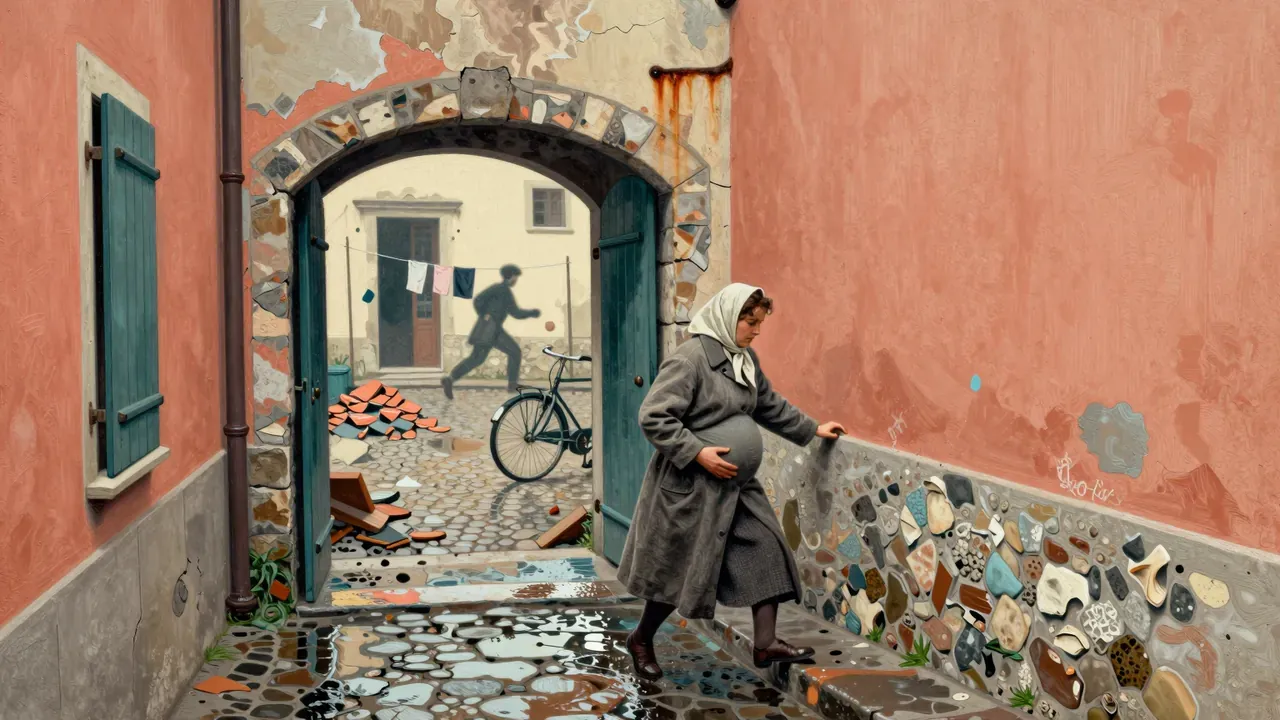
What lands is the cumulative weight of small, irreversible choices. Edmund’s sale of Hitler’s voice recording, his passive presence during a petty theft, his return to Henning after the poisoning — each moment gains gravity because nothing is underlined. The film refuses to moralise, so the horror accumulates in what is shown plainly: a father’s wasted body, a sister’s exhausted refusal to trade her body for food, the indifference of passers-by as Edmund walks past bombed buildings. The final sequence — Edmund ascending rubble, watching his father’s coffin cross the street, then stepping off — carries force because it follows logically from everything before it, not because it is staged for effect. Even the dedication to Romano Rossellini, printed before the first image, works not as sentiment but as structural framing: this is not about Berlin alone, but about how loss reshapes perception. The film’s austerity becomes its authority; it asks the viewer to sit with discomfort rather than resolve it.
The weight of it
What does not land is the film’s attempt to balance documentary fidelity with symbolic compression. The rear-projection Berlin scenes feel detached, their grainy flatness undermining the lived-in immediacy of the Rome interiors. Some performances — particularly Erich Gühne’s Herr Henning — tip into caricature, his clipped diction and stiff posture reading more like stage-Nazi than a plausible survivor clinging to dogma. The script’s reliance on exposition through conversation — Henning lecturing Edmund on Darwinist cruelty, the doctor explaining ration systems — interrupts the film’s otherwise taciturn flow. The shift from Berlin location work to Rome studio sets also creates a subtle tonal rupture: the streets feel urgent and real; the rooms feel rehearsed, slightly airless. These are not flaws in isolation, but fractures in the film’s central claim to realism — a claim it makes repeatedly, yet cannot fully sustain across its hybrid production.
The truth of it
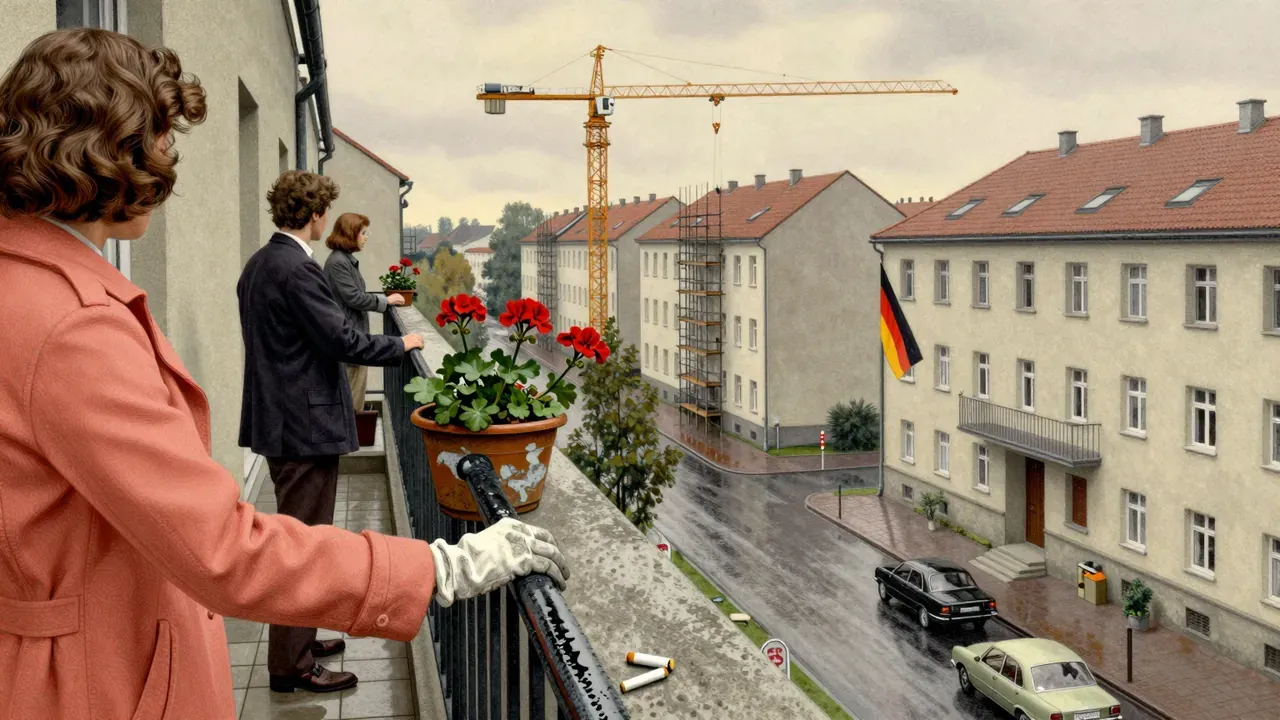
The themes that matter are not war or occupation in the abstract, but the transmission of ideology through intimacy: how a teacher’s words settle in a child’s mind, how a father’s whispered self-loathing becomes permission, how survival tactics become ethical habits. The film treats fascism not as a political system abruptly defeated, but as a residue — in speech patterns, in hierarchies among the ruined, in the way adults delegate moral labour to children. It also examines the limits of care: Eva’s refusal to prostitute herself is an act of will, not virtue; Karl-Heinz’s fear of registration is cowardice and principle entwined. Most quietly, the film questions realism itself — not as truth-telling, but as selection. Rossellini chose to show no Allied soldiers beyond their boots or voices, no Soviet or American policy debates, no rebuilding efforts. His Berlin is a closed circuit of need and misdirection, where history narrows to a single staircase, a single teacup, a single jump.
The end of it
This film is for viewers who can hold ambiguity without demanding resolution, who accept that some moral collapses are neither dramatic nor defiant, but weary and incremental. It suits those familiar with postwar Italian neorealism but willing to confront its less consoling extension into German soil. It is not for viewers who require narrative momentum, psychological explanation, or redemptive closure — the film offers none. Those expecting historical context, geopolitical analysis, or even consistent tone will find it withholding. It is also difficult for younger viewers unfamiliar with the material conditions of 1947 Berlin: the weight of a cigarette, the danger of a ration card, the physical reality of malnutrition must be inferred, not explained. A viewer who needs cause-and-effect clarity, or who finds sustained bleakness alienating, will not find purchase here — and that is by design, not deficiency.
The point of it
Yes, it is worth your evening — but only if you approach it as a study in compression, not catharsis. Its seventy-eight minutes move with deliberate slowness, asking you to register pauses, glances, silences between lines. It repays attention to gesture: how Edmund combs his hair before seeing Henning, how Eva folds a cigarette packet before handing it over, how the father’s hand trembles when he lifts his cup. Those who value emotional efficiency over emotional release will find it rigorous and unsparing. Others may call it cold — and they would not be wrong, though the coldness is structural, not accidental. It is not a film to love, but one to reckon with. To dismiss it as dated or didactic is to miss how precisely it maps the mechanics of despair. Its power lies in what it refuses: comfort, context, and the illusion that innocence can survive intact in a world that has already ended once, and is still counting the cost.