The voice of it
Hedwig and the Angry Inch is a filmed adaptation of John Cameron Mitchell and Stephen Trask’s stage musical, transposed from theatre to screen without flattening its theatricality. It sets out to tell a story of gender, origin, and artistic theft through the persona of Hedwig Robinson — an East German trans woman whose identity is forged in political rupture, medical violence, and rock performance. The film does not aim for realism but for mythic resonance: it frames Hedwig’s life as a series of staged confessions, sung monologues, and stylised flashbacks that borrow from Plato, punk, and post-war German history. Its ambition lies in holding contradiction — drag as both armour and exposure, autobiography as fiction, trauma as fuel for spectacle. It treats musical numbers not as interludes but as narrative engines, with each song advancing character or reframing memory. The film’s structure follows Hedwig’s tour of American roadside venues, using the liminal spaces of Bilgewater’s seafood restaurants and parking lots to mirror her own in-betweenness. It is a work of deliberate artifice, built to be felt before it is parsed.
The craft of it
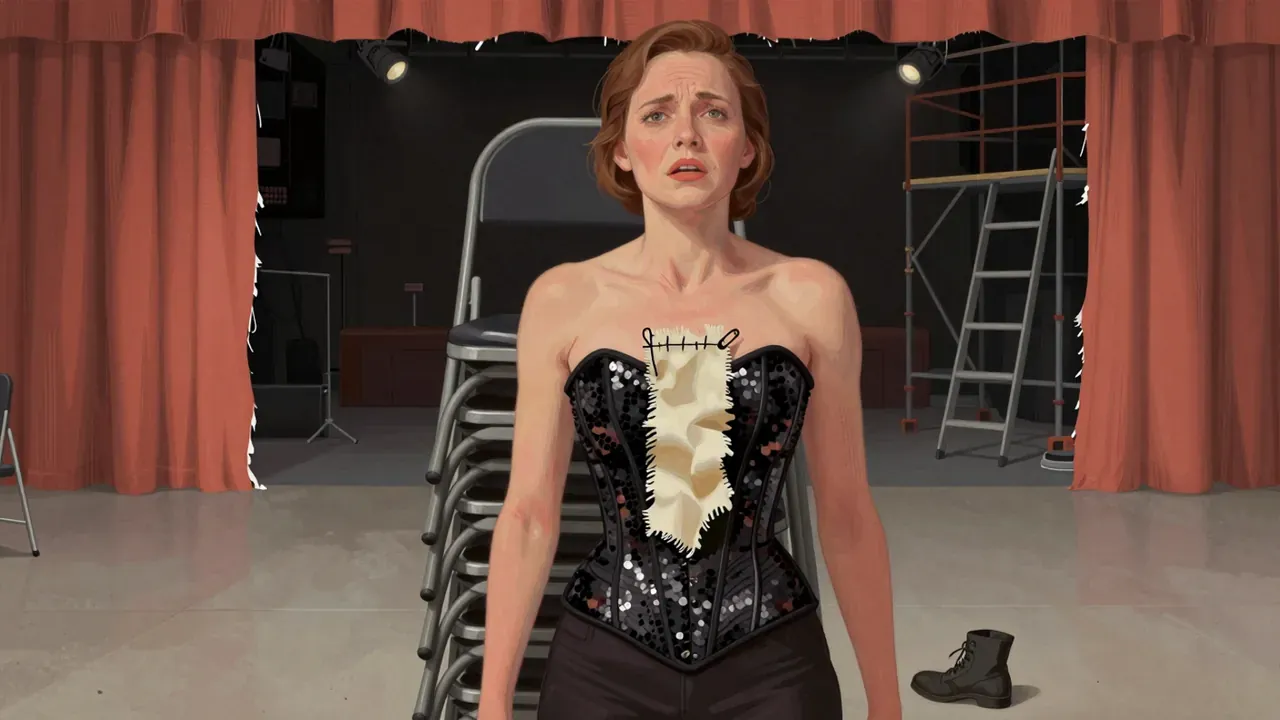
The film works by anchoring its flamboyance in precise craft choices. Frankie DeMarco’s cinematography keeps light tight and textures grainy, favouring shallow focus and handheld intimacy over polish; interiors are often lit like backstage corridors, not soundstages. Mitchell’s performance is physically exacting — the constant shaving, the vocal strain caught in live takes, the way he holds Hedwig’s posture as both defiant and weary. Michael Pitt’s Tommy is deliberately brittle, his voice thinning under pressure, his physical withdrawal legible in every frame where he avoids eye contact. Editing by Andrew Marcus stitches past and present with abrupt cuts, refusing seamless continuity in favour of rhythmic punctuation. Stephen Trask’s score functions as diegetic storytelling: songs are performed on location, often interrupted by ambient noise — a clattering plate, a passing truck — which grounds the fantasy without breaking it. The costume design (uncredited in the sheet but visible) treats drag as labour: wigs are slightly askew, seams show, zips catch. Nothing here is airbrushed; everything is held in tension between construction and collapse.
The truth of it
What lands is Hedwig’s voice — not just Mitchell’s singing, but the tonal authority with which she narrates her own myth. The ‘Origin of Love’ sequence lands because it refuses to simplify the Aristophanes parable into comfort; instead, it leans into the ache of incompleteness, making theology feel bodily. The trailer scene with Tommy Speck lands because it captures adolescent yearning without condescension — the awkwardness of first touch, the weight of unspoken mentorship, the quiet horror of realisation. The Bilgewater’s performances land because they are shot like small disasters: microphones feed back, drumsticks snap, Yitzhak’s face stays impassive while his hands tremble. Even the film’s visual gags — the surgically implanted phone tooth, the dryer-door head injury — land not as slapstick but as extensions of a world where identity is literally wired into the body. The courtroom subplot doesn’t land as legal drama, but as structural irony: Hedwig sues for authorship while having spent the film asserting that stories belong to whoever tells them best. That duality is sustained, not resolved.
The break in it
What does not land is the final act’s shift into non-real space. The transition from Times Square confrontation to metaphysical dissolution feels abrupt, not earned — the logic of the preceding ninety minutes collapses into abstraction without sufficient preparation. The male-form Hedwig confronting Tommy at the end lacks the emotional grammar built earlier; it reads less as revelation than as a retreat from the film’s own politics of embodiment. Some supporting characters remain flat: Phyllis the manager never escapes caricature, her phone-tooth gag repeated without deepening. The East Berlin sequences, though visually distinct, rely too heavily on shorthand — grey walls, static radios, a single shot of the Wall falling on a flickering TV — without grounding Hansel’s interior life before the surgery. The film’s treatment of Yitzhak’s backstory, while expanded in deleted scenes, remains underdeveloped on screen: his resentment, his drag past, his desire for autonomy are implied but not dramatised. And the resolution — fame via paparazzi chaos — undercuts the film’s earlier critique of commodification without offering counterweight beyond spectacle.
The wound of it
The themes that matter are origin, authorship, and the violence of translation — linguistic, bodily, cultural. Hedwig’s story is one of forced relocation: from East Berlin to Kansas, from male to female, from songwriter to footnote. The ‘Angry Inch’ is not just a surgical failure but a metaphor for all the parts of self that resist clean categorisation — the unassimilable remainder. The film treats gender not as fixed identity but as ongoing performance shaped by power: Luther demands marriage as exit visa; Tommy steals songs as erasure; Yitzhak’s silence is both submission and strategy. Music functions as both weapon and wound: Trask’s score borrows from glam, punk, and Eastern European folk, refusing stylistic purity just as Hedwig refuses biological essentialism. The recurring motif of splitting — bodies, nations, myths — ties Cold War geopolitics to personal fragmentation. What matters most is not whether Hedwig ‘wins’ the lawsuit or the love, but how the film insists that survival requires telling your story even when no one is listening — and especially when the version everyone hears is someone else’s.
The audience for it
This film is for viewers who tolerate, even require, discomfort as part of engagement — those who find emotional honesty in theatrical exaggeration, who listen to lyrics as argument, who see drag not as costume but as epistemology. It is for people who value craft over gloss, who notice how a microphone cord drags across a floor or how a performer’s breath catches mid-phrase. It is not for viewers who need linear cause-and-effect, who mistake sincerity for naturalism, or who expect marginal identities to be rendered as pedagogical case studies rather than lived contradictions. Those who reject musicals on principle will find little to convert them here; those who demand tidy resolutions will leave frustrated. A viewer who values psychological realism above all — who needs motivation spelled out, trauma processed, endings closed — will find the film evasive. But that evasion is deliberate: the film refuses to let trauma be ‘overcome’. To change the verdict, the final act would need to earn its metaphysical turn — not by explaining it, but by preparing it through image, rhythm, and restraint earlier on.
The time for it
Yes, it is worth your evening — not as escapism, but as recalibration. Its ninety-five minutes ask you to sit with dissonance: between laughter and grief, between spectacle and vulnerability, between the drag queen on screen and the man behind the wig. It rewards attention to detail — the way Hedwig’s eyeliner smudges after a scream, how the bassline drops just before a flashback begins, how silence hangs longer after certain verses. Its budgetary shortfall and limited release do not diminish its formal control or thematic urgency. Some will find its tone abrasive, its politics unresolved, its ending unsatisfying — and those objections are valid, not flaws. But the film’s endurance lies in its refusal to soften its edges for wider appeal. It assumes intelligence, rewards rewatching, and treats its audience as co-conspirators in myth-making. If you come expecting polished uplift or tidy catharsis, you will be disappointed. If you come ready to be unsettled, challenged, and sung to — then yes, it is worth your evening, and likely several more.