The look of it
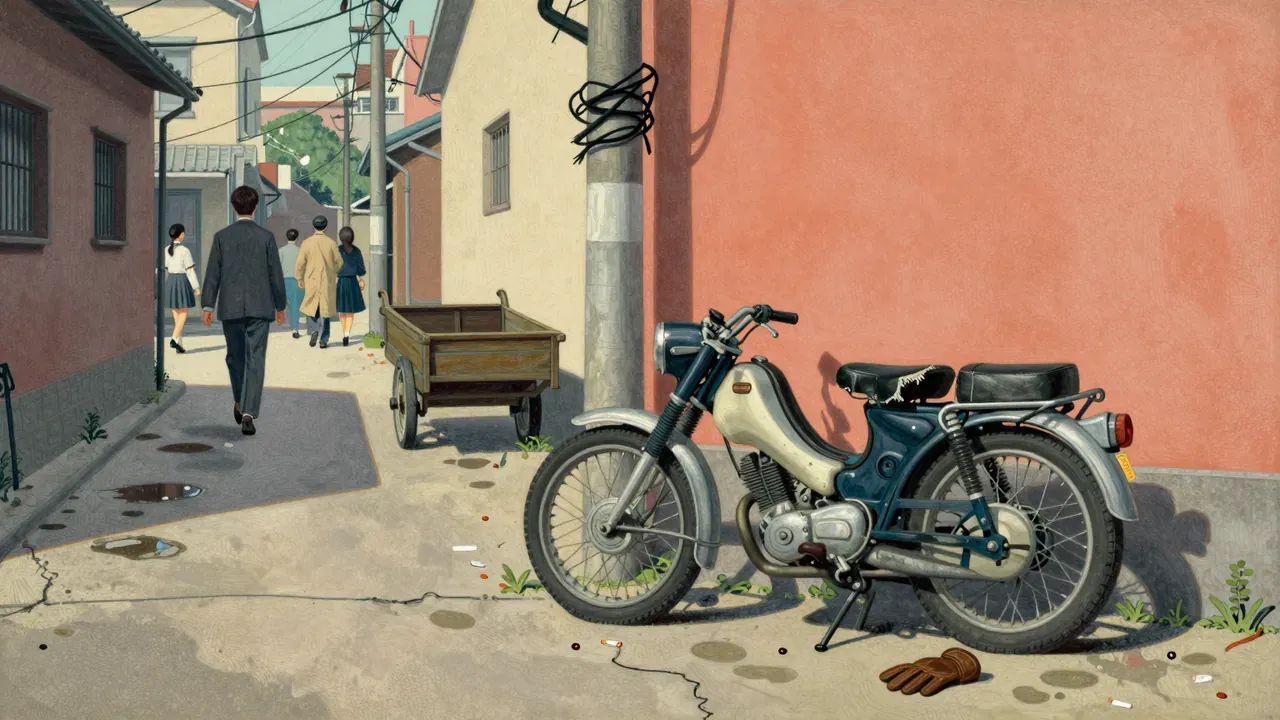
Cruel Gun Story is a Japanese film noir from Nikkatsu Studios, released in January 1964 and directed by Takumi Furukawa. It belongs to the studio’s mid-1960s cycle of urban crime thrillers — lean, black-and-white, morally compressed — that treat the postwar city as a lattice of betrayal and delayed retribution. The film sets out to follow a single arc of downward momentum: a man released from prison for a crime tied to familial guilt, drawn back into violence not by greed but by obligation, then undone by the very loyalty he tries to honour. It does not seek psychological exposition or social diagnosis; its method is procedural and fatalistic, aligning itself with the mechanics of heist planning, the weight of a rosary in a pocket, the delay caused by an armoured truck’s stubborn doors. Its ambition is structural: to make inevitability feel tactile, not philosophical — to show how one compromised choice pulls the next into place like links in a chain, until the only remaining motion is collapse.
The rhythm of it
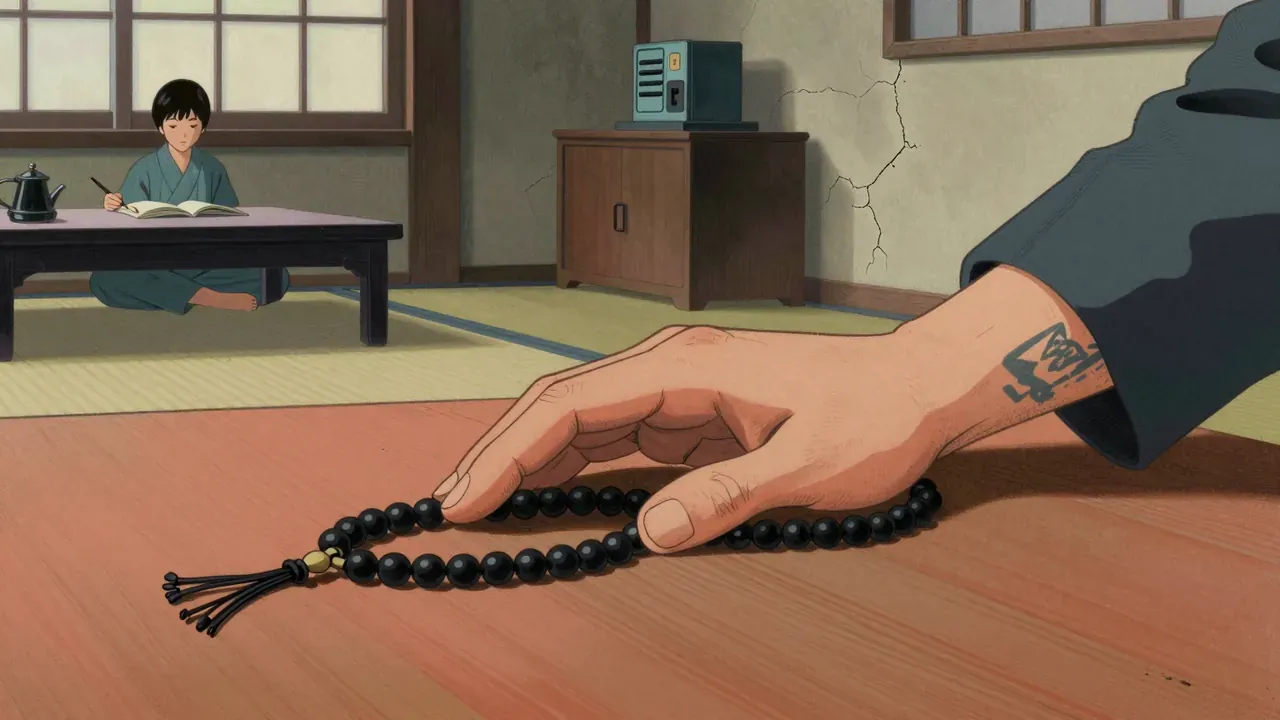
The story moves in tight, uninflected units: recruitment, rehearsal, execution, breakdown, retaliation, conflagration. Joe Shishido plays Joji Togawa with minimal inflection — his face stays closed, his voice low and even, even when delivering lines of quiet anguish. Chieko Matsubara’s Rie appears in only two scenes, yet her presence lingers through the film’s moral architecture: her hospital room is lit with flat, even light, her dialogue stripped of sentiment, her rosary offered not as hope but as a boundary. Takumi Furukawa directs without flourish: camera placement is functional, editing precise but unemphatic, cuts timed to action rather than mood. The robbery sequence unfolds with documentary patience — no music swells, no slow motion, just the winch straining, the exhaust pipe feeding fumes into the cargo hold, the sound of a shoulder wound being bandaged with silence. Cinematographer Kazuo Miyagawa keeps shadows deep but legible; interiors are neither expressionistic nor naturalistic, but occupied — rooms have weight because people stand in them, not because they are lit to mean something.
The weight of it
What lands is the film’s refusal to flinch from consequence. When Shirai is shot in the shoulder, the wound bleeds slowly, the bandage soaks through, and he dies hours later without ceremony — no last words, no close-up on his face, just Takizawa checking his pulse and stating the fact. The sewers are damp and narrow, not symbolic; the fire at the end starts not with a match but with a stumble, a kettle, spilled kerosene — cause and effect remain physical, not metaphorical. The performances land because they avoid emphasis: Yuji Odaka’s Shirai is weary but never pathetic, Minako Kazuki’s Keiko is watchful without being cunning, Yasukiyo Umeno’s Ito issues orders without raising his voice. Even the yakuza boss Matsumoto speaks with bureaucratic calm before pulling his gun. The film’s restraint makes its violence more unsettling: it arrives not as climax but as continuation, part of the same logic that governs the winch, the road signs, the rosary. There is no catharsis, only accumulation — and that accumulation feels earned, not imposed.
The break in it
What does not land is the late-stage pivot into kidnapping and factional yakuza politics. The introduction of Yanagida’s rival gang arrives without groundwork — no prior mention, no visual or tonal shift to signal a new axis of power. His offer to aid Togawa feels narratively convenient, not dramatically inevitable, and the subsequent ransom exchange collapses into generic ambush rather than the film’s earlier precision. The final confrontation in Matsumoto’s house lacks the spatial clarity of earlier set pieces: we do not see where guards are posted, how Togawa enters, or why Ito’s men are absent — the geography dissolves. Worse, the triple misidentification — Takizawa mistaking Togawa for Ito, then shooting him, then dying — strains credibility not because it is implausible, but because the film has spent eighty minutes building a world governed by cause and proximity, only to abandon both for a flurry of mistaken identity in near-darkness. It is the only sequence that feels written, not lived.
The debt in it
The themes that matter are obligation, debt, and the impossibility of clean restitution. Togawa’s crime begins with a sister’s accident, not his own desire; his return to violence is framed not as choice but as repayment — to Shirai, to Rie, to the dead truck driver whose family he imagines compensating. Money circulates as guilt: 120 million yen is never just cash, but the sum required to ‘fix’ what cannot be fixed. The rosary is not faith but a contract — a physical reminder that moral accounting is non-negotiable, even when the ledger is illegible. The film treats loyalty as a vector, not a virtue: it pulls Togawa toward Shirai, then toward revenge, then toward self-immolation. There is no redemption arc, only escalation — each act of fidelity narrows the field of possible action until the only remaining movement is destruction. Class is present but unspoken: the racetrack money belongs to no one, the hospital bills belong to everyone, and the yakuza operate less as criminals than as administrators of a broken system — their betrayal is not personal, but procedural.
The audience for it
This is for viewers who value narrative economy over exposition, who find tension in stillness and dread in procedural detail. It suits those accustomed to mid-century Japanese cinema’s pacing — its long takes, its muted performances, its resistance to emotional signposting. It will frustrate viewers expecting character arcs, thematic resolution, or stylistic punctuation; those who rely on music cues or facial close-ups to locate meaning may feel adrift. It is not for fans of neo-noir theatrics or crime sagas with sprawling ensemble casts — there are no flashbacks, no voiceover, no ironic detachment. Those who require moral clarity or closure will leave unsatisfied: the film’s verdict is not delivered in dialogue but in ash. Disagreement would come from admirers of Seijun Suzuki’s flamboyance or Kinji Fukasaku’s kinetic chaos — this is quieter, colder, more methodical. A different verdict would follow if the final third had retained the rigour of the heist sequence, rather than surrendering to plot mechanics.
The end of it
Yes, it is worth your evening — provided you watch it as a study in compression, not catharsis. Its eighty-seven minutes move with the inevitability of a fuse burning down: no scene overstays, no performance overreaches, no image begs interpretation. It rewards attention to texture — the grain of the film stock, the way Shishido’s jacket catches light in the hospital corridor, the sound of a winch engaging. It is not entertainment in the conventional sense, but it is rigorously made and coherently sustained. Those who expect payoff in revelation or release will be disappointed; those who accept that some stories end not with answers but with smoke rising from a ruined room will find it exacting and unsparing. A second viewing clarifies its architecture — how early details (the rosary, the hospital’s layout, Takizawa’s quiet concern) are not foreshadowing but anchors, holding the descent in place. It earns its bleakness, and that is rare.