The first thirty minutes
Je Tu Il Elle is a 1974 French drama written, produced and directed by Chantal Akerman, starring Akerman herself as Julie — a woman withdrawing from the world after a breakup. It is not a narrative film in the conventional sense, nor does it seek to dramatise psychology through exposition or motivation. Instead, it attempts to register duration, interiority and bodily presence without mediation: time as lived, not plotted; desire as gesture, not climax; identity as pronoun — ‘je’, ‘tu’, ‘il’, ‘elle’ — shifting across positions rather than fixed to a character. The film’s structure is tripartite but uninflected: confinement, transit, return. Its ambition lies in stripping away cinematic convention — no score, no editing rhythm, no psychological explanation — to ask what remains when story is pared back to posture, pause and proximity. It is a work of radical economy, made with near-zero resources, yet its formal restraint is deliberate, not provisional. It seeks not to represent lesbian experience, but to inhabit its temporal and spatial conditions — silence, repetition, unobserved labour, unmediated touch. (158 words)
The road with the driver
The film works through strict compositional choices and sustained attention. Akerman keeps the camera at medium distance, mostly static, often framing Julie frontally in long takes: she eats sugar from a paper bag for over five minutes; she writes letters, crumples them, rewrites; she lies naked on the floor, turning slowly. Niels Arestrup’s truck driver speaks uninterrupted for several minutes in a single take, his monologue delivered with flat, uninflected candour. Claire Wauthion’s ex-lover moves with quiet practicality — making sandwiches, pouring tea — before yielding to touch without fanfare or music. Gordon Willis is not involved; the cinematography is by Babette Mangolte, who uses natural light and avoids dramatic contrast. There is no score, no sound design beyond ambient noise and unprocessed dialogue. Editing is sparse and functional: cuts occur only when location changes or when time must be elided. Performance is anti-expressive: Akerman avoids signposting emotion, treating each action — writing, eating, undressing — as equally weighted. The sex scene is not staged for arousal or revelation, but as a sequence of proximities: hands, breath, skin, light falling across shoulders. Its length is structural, not sensational. (159 words)
The woman’s kitchen
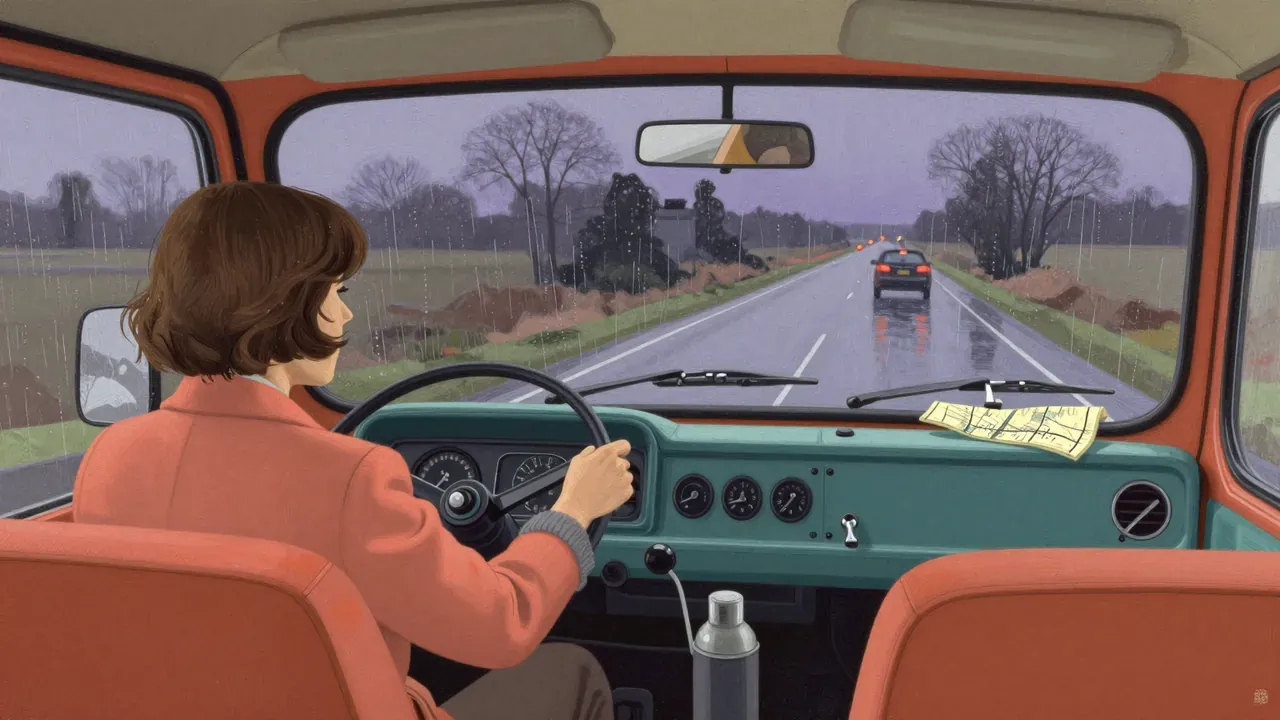
What lands is the weight of unoccupied time — the way silence accumulates meaning when nothing is narratively required to happen. The opening section, where Julie rearranges furniture and eats sugar, becomes a study in self-regulation: her gestures are both ritual and resistance, a body holding itself together through repetition. The hitchhiking sequence gains tension not from danger but from asymmetry — the driver’s voluble domesticity against Julie’s silence, his hand on the gearstick beside her stillness. The final encounter with the ex-lover lands because it refuses catharsis: there is no reconciliation, no verbal reckoning, only physical reacquaintance, tender and matter-of-fact. The film’s refusal to moralise or interpret gives space for the viewer to register sensation before sense — the texture of bread, the warmth of a shared bed, the exhaustion in a blink. Its power is cumulative and somatic, not intellectual: you feel the duration in your own limbs, the relief when a held breath finally releases. That this is achieved without manipulation — no close-ups to cue empathy, no music to prompt feeling — makes it all the more persuasive as an act of cinematic honesty. (157 words)
The bed at dawn
What does not land is any expectation of narrative payoff or emotional resolution. Viewers accustomed to cause-and-effect plotting will find the film withholding, even inert: motivations are absent, consequences unexamined, relationships unexplained. The driver’s monologue, while formally bold, risks monotony without tonal variation or visual counterpoint — it is a long take that asks for patience but offers no structural reward beyond its endurance. The final sex scene, though historically significant, functions here as a formal necessity rather than a dramatic one; its impact depends entirely on whether the viewer accepts its placement as culmination or merely continuation. Some may find the film’s austerity dogmatic — its rejection of music, cutaways or expressive lighting feels less like freedom than constraint. Others may read its minimalism as evasion: the absence of context around Julie’s depression, her sexuality or her social position leaves room for projection, but also for misreading. The film does not invite interpretation so much as demand alignment — and alignment requires surrendering habits of cinematic consumption that many viewers have spent decades acquiring. (156 words)
Je Tu Il Elle
The themes that matter are solitude as practice, not pathology; desire as recurrence, not destination; and language as pronoun, not pronouncement. The title Je Tu Il Elle names roles rather than people — subject, addressee, third-person he, third-person she — and the film enacts that fluidity: Julie is ‘je’ in isolation, ‘tu’ in the truck, ‘elle’ in the bedroom. Gender is not declared but inhabited, shifted, shared. The film treats domestic space as both refuge and cage, and movement — walking, hitchhiking, undressing — as the only available grammar of change. Time is not measured in plot points but in sugar grains, cigarette burns, the slow darkening of a window. There is no commentary on lesbian identity as social category; instead, intimacy is rendered as tactile fact — fingers tracing collarbones, mouths meeting without flourish. The film’s feminism lies in its refusal to make Julie legible to external frameworks: she is not explained, defended, diagnosed or redeemed. Her actions require no justification. This is not apolitical neutrality but a quiet insistence on autonomy — the right to exist without translation, to want without rationale, to rest without reason. (154 words)
The look of it
This film is for viewers who value duration over development, gesture over exposition, and silence over score. It suits those already familiar with structuralist or minimalist film — say, early Godard, Straub–Huillet or later Tarr — or those willing to recalibrate their attention to slower registers. It is also for students of feminist and queer cinema, not as illustration but as primary evidence: a work that precedes theory yet anticipates its concerns. It is not for viewers who require narrative propulsion, emotional cues or psychological scaffolding. Those who rely on editing rhythm, musical punctuation or performance signposting will find it alienating, even tedious. Some critics have argued its austerity borders on asceticism — a charge that misses the point: the film’s rigour is not self-denial but precision. A viewer who finds it unrewarding is not wrong; they are simply operating under different assumptions about what cinema is for. That verdict would shift only if the film were approached not as storytelling but as time-based sculpture — a form where presence, not plot, is the material. (155 words)
The door left open
Yes, it is worth your evening — but only if you set aside the expectation of being told something, and accept instead the invitation to witness something. Its eighty-six minutes do not pass quickly, nor are they meant to; they ask you to inhabit a different relation to time — one where waiting is not emptiness but accumulation. It repays attention not with revelation but with recalibration: after Je Tu Il Elle, a glance, a pause, a silence in another film may carry new weight. It is not entertainment, nor is it instruction; it is an act of cinematic listening — to bodies, to rooms, to the space between words. Those who dismiss it as ‘boring’ are reacting to its terms, not failing to grasp them. Its value lies precisely in its resistance to assimilation: it does not flatter the viewer’s habits, nor does it seek consensus. To call it ‘difficult’ mistakes its clarity for obscurity. It is plain, specific, unhurried — and that plainness is its argument. If you watch it expecting a story, you will leave unsatisfied. If you watch it as an arrangement of time and attention, you may find it unforgettable. (158 words)