What it is trying to do
Crazed Fruit is a 1956 Japanese drama that adapts Shintarō Ishihara’s novel of the same name, aiming to depict postwar youth alienation through a tightly wound triangle of desire, rivalry, and moral collapse. It does not seek realism in the documentary sense but operates as a stylised social symptom — less a portrait of actual beachside life than a pressure chamber for suppressed impulses: sexual restlessness, fraternal envy, class ambiguity, and the hollowing-out of traditional restraint. The film’s ambition lies in its timing and tone: released just eleven years after Japan’s surrender, it frames youthful hedonism not as carefree rebellion but as involuntary reflex — a nervous system jangling under unspoken national trauma. Its method is literary rather than observational: dialogue carries thematic weight, gestures are amplified, silences are charged. It tries to make mood structural — heat, water, motor noise, and sudden stillness all serve the tightening coil of inevitability. This is not a film about choices so much as about how few real ones remain when language, law, and lineage have all receded.
How it works
The story follows Haruji’s quiet infatuation with Eri, Natsuhisa’s confident usurpation, and the fatal convergence of both at sea. Masahiko Tsugawa plays Haruji with minimal inflection — his face often slack, his movements hesitant, his voice barely rising above ambient noise; Yujiro Ishihara’s Natsuhisa moves like someone who has already decided he owns the space around him. Mie Kitahara’s Eri is neither coquette nor victim but a figure whose agency is circumscribed by marital absence and social expectation — she names her condition plainly, without apology or plea. Kō Nakahira’s direction avoids psychological exposition: motivations are shown in glances, in the way hands grip boat rails, in how long a character holds a cigarette before lighting it. Masaru Sato’s score uses sparse piano motifs and abrupt brass stabs, never underscoring but punctuating — a rhythmic counterpoint to the characters’ accelerating disintegration. Editing is economical: scenes cut on motion, not reaction, preserving momentum even as meaning unravels.
What lands
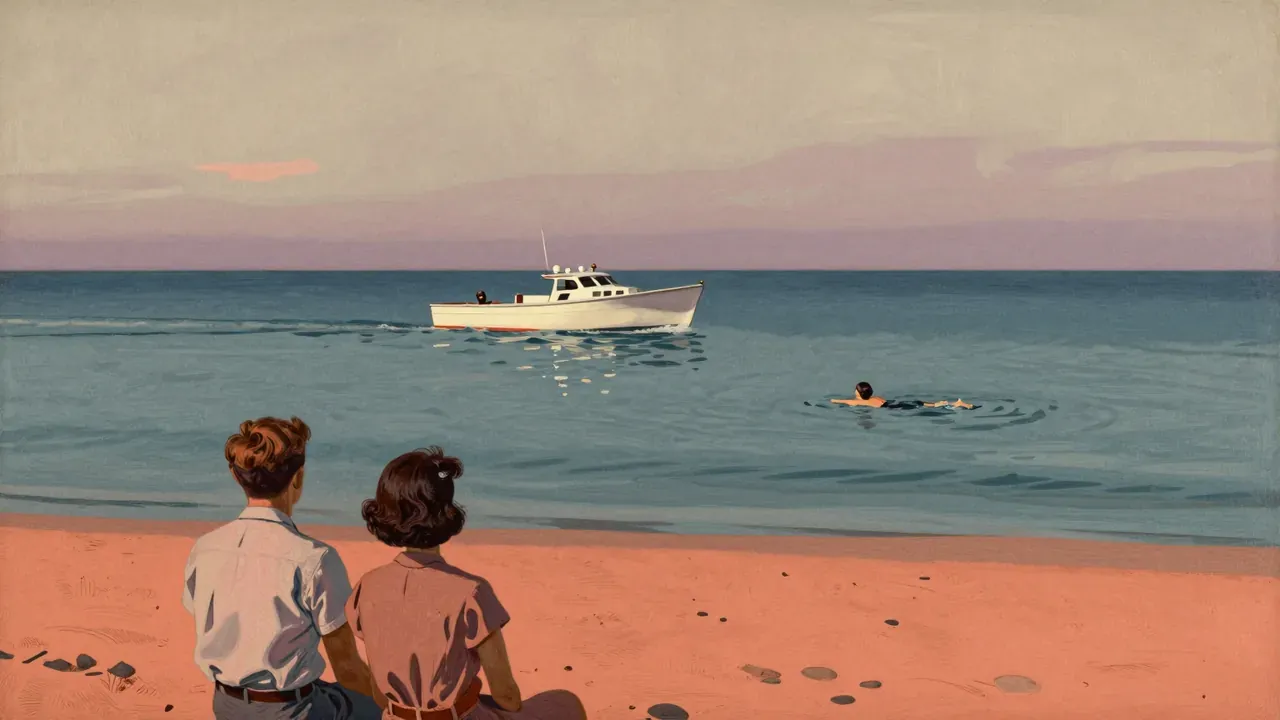
What lands is the film’s physical texture — the glare off wet skin, the grit of sand in hair, the low thrum of motorboats at dusk. These are not decorative details but narrative agents: the heat makes decisions sluggish, the water blurs boundaries between bodies and intentions, the engine noise drowns out hesitation. The final sequence — Haruji circling the boat, Eri swimming towards him, the collision — gains force from its refusal of melodrama: no music swells, no close-up lingers on a tear, no slow motion stretches the moment. It simply happens, abrupt and irreversible, because the film has spent eighty minutes building a world where impulse has no buffer. The casting works precisely because none of the leads perform ‘youth’ as charm or energy; they embody its exhaustion, its impatience, its inability to imagine consequence until it arrives. Even the English-language title Juvenile Jungle feels earned — not as metaphor but as diagnosis: a habitat where instinct overrides code, and survival is measured in seconds, not seasons.
What does not
What does not land is the framing of Eri’s marital status as revelation rather than context. Her admission that she is married — and that her husband’s absence licenses her affairs — arrives late and functions more as plot pivot than psychological anchor. The film gives her no interiority beyond that statement, no history, no contradiction, no contradiction beyond what the script requires to ignite the brothers’ rivalry. Harold Conway appears only as a name and a silhouette; his absence is structural, but the film never interrogates what his presence might have been, or how Eri navigates the asymmetry of power between her and either brother. Similarly, Frank — played with easy charisma by Masumi Okada — remains a functional host, a prop for parties and boats, never a counterweight or foil. The screenplay treats the beach house, the nightclub, the docks as interchangeable stages, never letting place accrue meaning beyond its utility to the next confrontation. There is no sense of community, no economic reality, no generational friction beyond the brothers’ own — the world contracts to three people and the water between them.
The themes that matter
The themes that matter are not love or jealousy in the abstract, but the erosion of mediation — between desire and action, between self and sibling, between individual will and social form. The film traces how quickly language collapses when emotion intensifies: conversations shorten, questions go unanswered, promises evaporate mid-sentence. It treats marriage not as institution but as vacancy — a legal frame emptied of daily presence, leaving room for other arrangements, other collisions. Class surfaces obliquely: Frank’s clubhouse, the American man at the club, the motorboats — all signal a new, imported leisure, untethered from prewar hierarchies but lacking replacement ethics. The sea is not freedom but indifference: it reflects light without warmth, bears weight without memory, accepts bodies without judgment. And the ending refuses catharsis or clarity — Haruji drives away not in grief or rage but in blank continuity, suggesting the violence was not aberrant but logical, the culmination of a system that offered no grammar for restraint.
Who should watch it
This film is for viewers who value precision of mood over exposition, who can sit with unresolved tension and find it more truthful than resolution, and who recognise that 1950s Japanese cinema often used genre frameworks to smuggle sociological critique. It rewards attention to gesture, silence, and spatial rhythm — not passive viewing but active parsing of what is withheld. It is not for those who require psychological motivation spelled out, who expect moral framing or narrative symmetry, or who mistake stylistic economy for emotional thinness. Some will find its pacing too deliberate, its characters too opaque, its ending too abrupt — and they would be right, if their expectation was conventional drama. A different reading — one that treats the film as a clinical study in affective short-circuiting — would change that verdict entirely. But that reading must be chosen, not handed to the viewer.
Is it worth your evening
Yes, it is worth your evening — not as entertainment but as calibration: a chance to reset expectations about what a ‘youth film’ can do when stripped of nostalgia, sentiment, or redemption. Its eighty-six minutes pass without drag because every shot serves the tightening spiral — no filler, no digression, no safety net of irony or distance. You will not leave uplifted, but you may leave unsettled in a useful way: aware of how little separates attraction from possession, affection from erasure, summer from shipwreck. Those who want clear stakes, defined arcs, or ethical closure will feel short-changed — and the film makes no argument against that feeling. But if you accept its terms — that some stories exist not to explain but to enact, not to comfort but to compress — then its economy becomes its virtue, and its austerity, its honesty.