The look of it
Portrait of a Lady on Fire is a French historical drama set in late-eighteenth-century Brittany, centred on the five-day commission of a portrait painter, Marianne, to depict Héloïse, an aristocrat resisting marriage. Céline Sciamma’s film attempts something precise: to construct a romance not as accumulation of incident but as slow calibration of attention — between two women, between artist and subject, between memory and image. It rejects period spectacle in favour of psychological fidelity, using the constraints of its era — silence, seclusion, limited agency — not as backdrop but as grammar. The film’s ambition is structural as much as thematic: to make time feel porous, so that past and present coexist without voiceover or flash-cut; to treat desire as legible in gesture, glance, and withheld breath rather than dialogue or exposition. It is not a film about breaking out of history but about finding sovereignty within its narrowest margins. Sciamma works from a conviction that looking can be an act of resistance, and that portraiture — especially when done by a woman for a woman — is never neutral. The film’s quietness is deliberate, not passive.
The way it moves
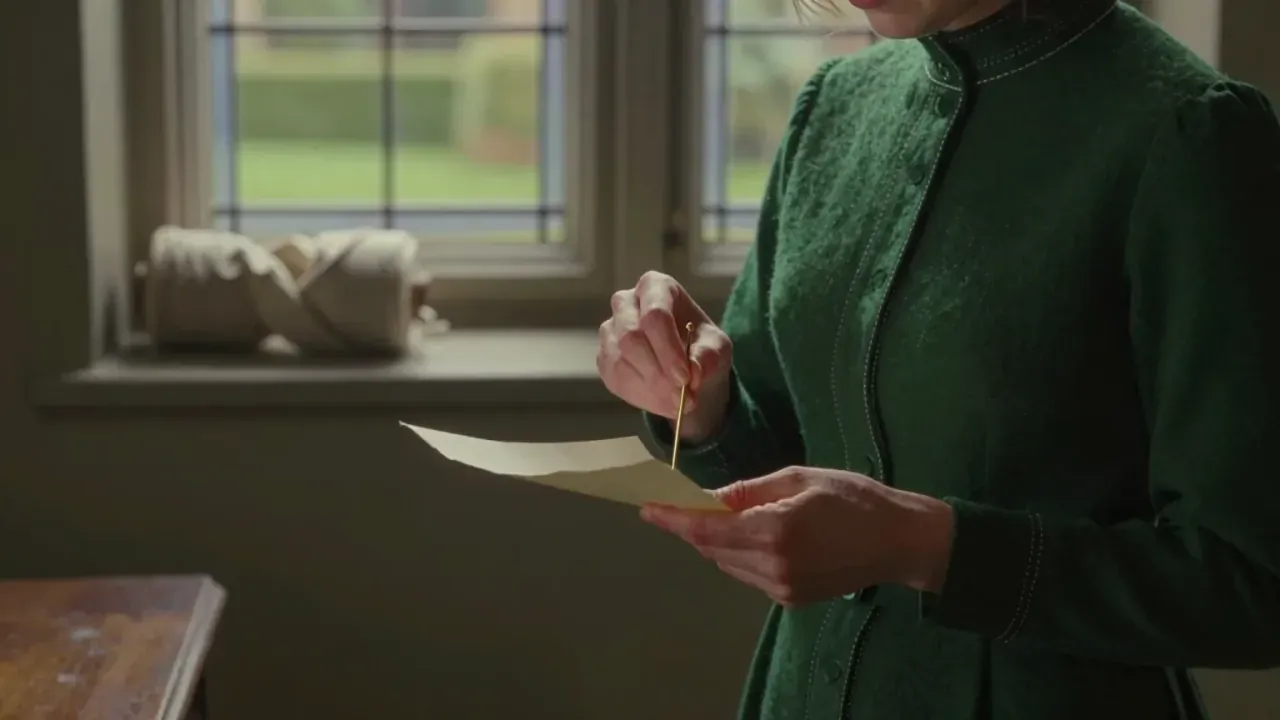
The story unfolds with minimal exposition and no narrative shortcuts: Marianne arrives, observes, paints, confesses, re-paints, loves, departs. Adèle Haenel and Noémie Merlant hold the film through restraint — their performances rely on micro-shifts in posture, hesitation before speech, the weight of a glance held a half-second too long. Claire Mathon’s cinematography avoids candlelit softness in favour of cool, even light — interiors are lit like museum galleries, exteriors like geological surveys. She keeps the frame tight, often centring faces in medium close-up, refusing scenic grandeur. Julien Lacheray’s editing sustains duration without indulgence: a walk lasts as long as it takes to cover the ground; a silence lasts until it unsettles. Para One’s score is absent for over an hour, then erupts as a cappella chant — a single, unaccompanied female choir singing Latin phrases — making sound itself feel like rupture. The paintings seen in the film were made live during shooting by artist Hélène Delmaire, whose hands appear on screen; this material continuity anchors the film’s central metaphor: that creation and intimacy are inseparable acts.
The weight of silence
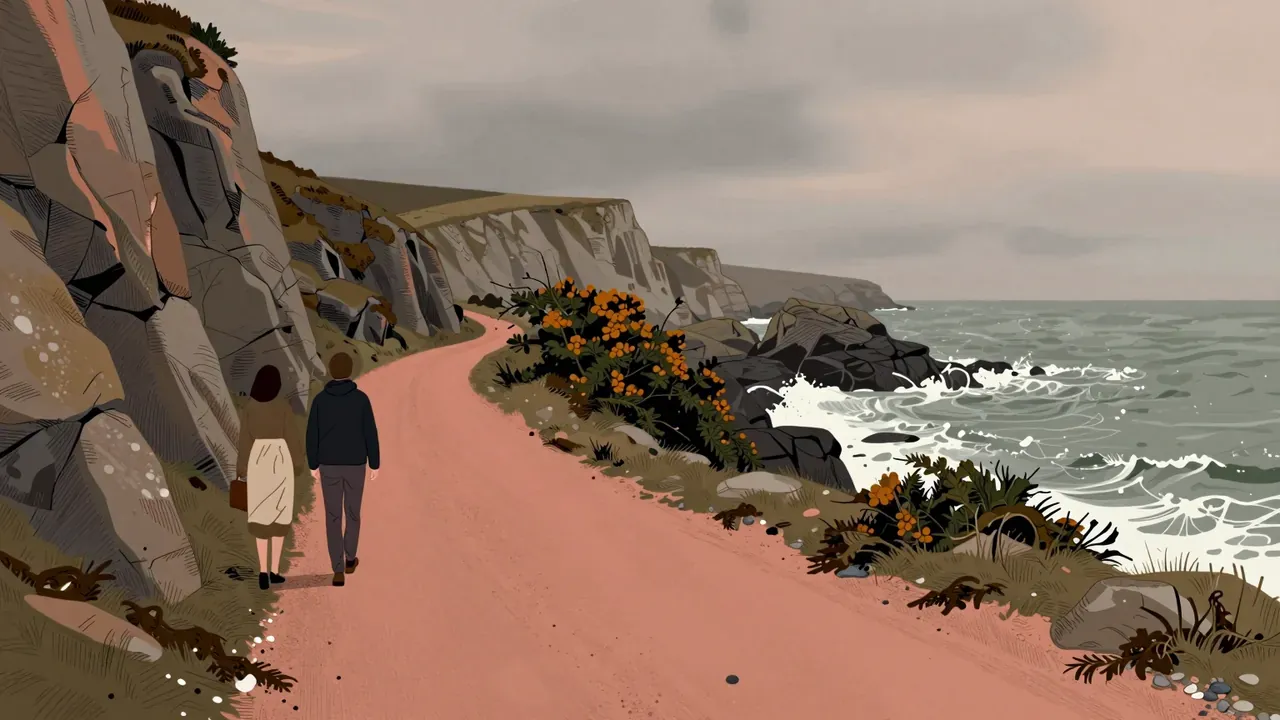
What lands most firmly is the film’s architecture of reciprocity. Every major exchange — the first walk along the cliffs, the reading of Orpheus and Eurydice, the bonfire sequence — builds on prior glances, prior silences, prior gestures. The Orpheus debate does not serve as allegory but as diagnostic tool: it reveals how each woman understands risk, trust, and the cost of turning back. The bonfire scene works because the music arrives not as punctuation but as culmination — after seventy minutes of near-silence, the chant feels less like score than collective breath. The abortion subplot is handled without melodrama or exposition: Sophie’s distress is registered in her hands, her absence from meals, her quiet return to work. Even the final concert sequence lands because it refuses closure: Marianne sees Héloïse across a theatre, not reunited but observed, remembered, acknowledged — the emotion is in the distance, not the proximity. The film trusts its audience to hold multiple temporal layers at once, and rewards that patience with emotional precision rather than catharsis.
The edges of the frame
What does not land is the Countess. Though Valeria Golino gives a performance of contained authority, the character remains functionally opaque — her grief over her elder daughter’s suicide is stated but not dramatised, her control over Héloïse feels procedural rather than psychologically rooted. The island setting, while visually coherent, never acquires symbolic weight beyond isolation; its geography stays literal, not resonant. The film’s commitment to austerity occasionally tips into under-determination: the political context of late ancien régime France is absent, not elided — there are no references to unrest, taxation, or shifting class structures, which makes the characters’ confinement feel aesthetic rather than historical. Some viewers may find the pacing inhospitable: scenes do not accelerate toward revelation but settle into duration, and the lack of external conflict means tension lives entirely in subtext — a choice that excludes those who require narrative propulsion. The film assumes fluency in visual syntax and tolerance for ambiguity, and offers no translation.
The fire in the title
The themes that matter are looking, memory, and the conditions under which women create. The film treats portraiture as a site of negotiation — not just between artist and subject, but between intention and representation, between what is shown and what is withheld. The recurring motif of fire — in the title, in the dress catching flame, in the bonfire — is never explained but functions as index of both danger and transformation. The Orpheus myth is revisited not to moralise but to interrogate the ethics of witnessing: when is attention care, when is it violation? The film’s strongest idea is that love and art share the same vulnerability — both depend on sustained attention, both risk distortion through projection, both demand surrender to another’s rhythm. Its feminism is procedural: the camera rarely leaves the women’s line of sight; men appear only peripherally, if at all; power resides in who holds the brush, who chooses the pose, who decides when to turn away. This is not a film about liberation from constraint, but about finding agency inside it.
Who it is for
This film is for viewers who value composition over plot, silence over exposition, and emotional resonance over resolution. It suits those accustomed to arthouse pacing, comfortable with French-language dialogue without subtitles-as-translation, and receptive to films where desire is conveyed in stillness. It is not for viewers who require clear cause-and-effect storytelling, visible antagonists, or narrative momentum. Those who dislike ambiguity in motivation or find extended stillness alienating will likely disengage early. It also presumes some familiarity with portraiture as practice — not as decoration but as encounter — and with the material realities of eighteenth-century women’s lives: restricted movement, limited authorship, reliance on indirect communication. A viewer expecting historical context beyond domestic space, or seeking explicit political commentary on the era, will leave unsatisfied. Its appeal is narrow but deep: it rewards attention, not consumption.
What remains
Yes, it is worth your evening — provided you arrive prepared to watch, not just see. Its 121 minutes unfold with the gravity of a held breath, and its rewards are cumulative, not immediate. You need no prior knowledge of Sciamma’s work or French cinema, but you do need willingness to sit with uncertainty, to accept that some questions — why the Countess insists on the portrait, why Héloïse agrees to pose, why Marianne chooses memory over reunion — remain open. Those who find this frustrating will call it cold; those who feel it as clarity will call it necessary. The film’s power lies in its refusal to explain itself, and its insistence that meaning resides not in answers but in the quality of attention paid. If you have ever looked closely at someone and felt time slow, this film will feel like recognition — not escape, but confirmation.