The look of it
Cría Cuervos is a psychological coming-of-age film set in Madrid during the final months of Franco’s dictatorship, using an eight-year-old girl’s fractured perception to hold private grief and public silence in the same frame. It does not dramatise history directly but lets political weight settle in the pauses: in the mute grandmother’s stillness, in the army uniforms glimpsed in photographs, in the way adults speak around truth rather than through it. Carlos Saura’s aim is neither exposé nor allegory for its own sake, but a sustained study of how childhood consciousness absorbs trauma without syntax — where memory, fantasy and guilt bleed across temporal boundaries because the child has no grammar yet for cause, consequence or complicity. The film treats repression as physiological: Ana’s belief that she poisoned her father is not a plot twist but a logical endpoint of a mind trying to assign agency in a world where no adult names what is happening. It refuses catharsis, choosing instead to linger in the ambiguity between mourning and accusation, between care and violence, between memory and invention. That refusal is structural, not stylistic — it is built into the editing, the sound design, the pacing.
The shape of time
The story unfolds through Ana’s perspective, with time folding back on itself without warning or explanation: a glass of milk appears twice, once washed by a living father, once by a daughter who believes she killed him. Ana Torrent, aged eight, carries the film with a stillness that never reads as passive — her gaze holds space for what others omit. Geraldine Chaplin plays both mother and adult Ana, the latter dubbed, a choice that underscores dislocation rather than continuity. Teodoro Escamilla’s cinematography avoids flourish: interiors are lit like rooms seen at dusk, with deep shadows pooling in corners, while exteriors feel drained of heat, even in summer. Federico Mompou’s piano score is sparse and repetitive, echoing the rigidity of ritual; the pop song ‘Porque te vas’ enters like a foreign object — its melody bright, its lyrics hollowed out by repetition until they become incantation. The editing, by Pablo González del Amo, favours duration over punctuation: shots hold past comfort, letting silence accrue weight. There are no flashbacks labelled as such — only shifts in light, voice, or focus that register as memory before the mind catches up.
What stays in the frame
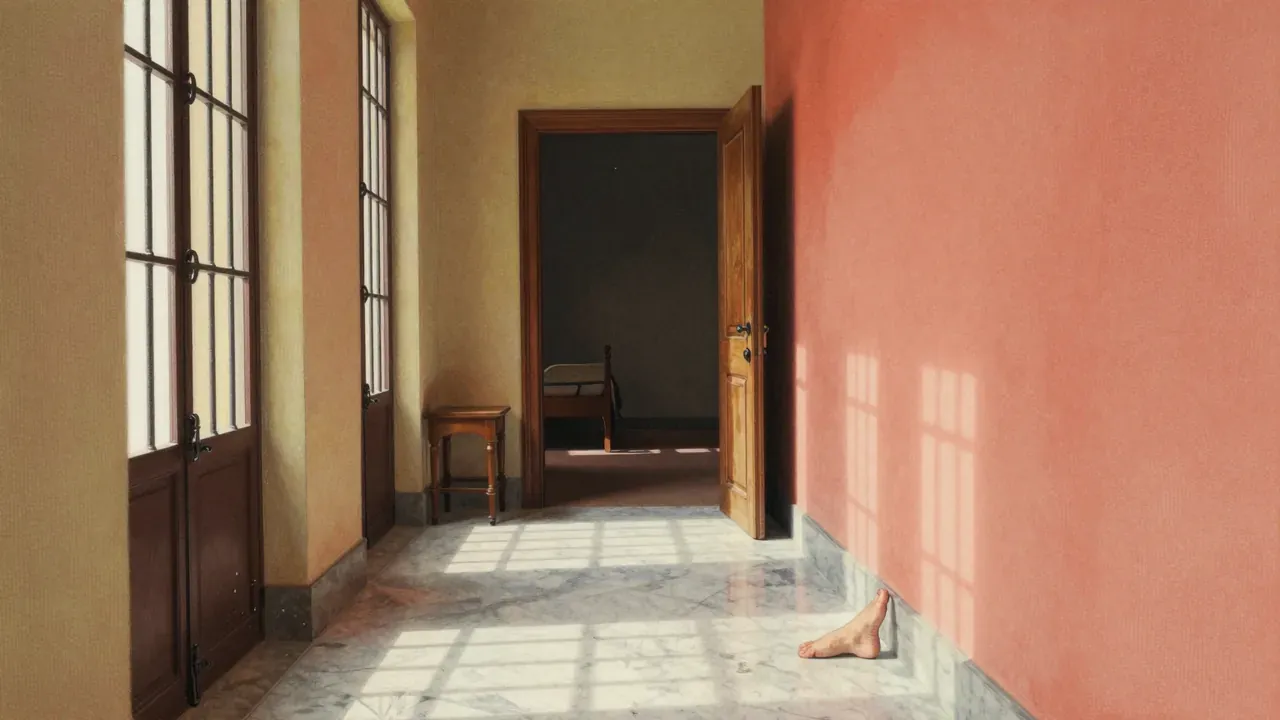
What lands is the unbearable precision of Ana’s interior life: the way she strokes Roni the guinea pig until he stops breathing, then sits beside him without crying; the way she watches her aunt sleep, fingers hovering near her temple, not in malice but in rehearsal; the way she washes the same glass twice, first for her father, then for Paulina, as if ritual could make intention real. These moments do not build to revelation but accumulate as evidence of a psyche under slow pressure. The film’s restraint makes the few eruptions — Ana’s sudden appearance with the pistol, the grandmother’s quiet ‘no’ when offered baking soda — land with physical force. The domestic space itself lands: the house is not a setting but a character, its corridors long and hushed, its basement dark and unvisited until necessity forces descent. Even the maid Rosa’s warmth feels earned, not sentimental — her laughter is loud, her touch casual, and her eventual absence from the final tracking shot speaks louder than any dialogue about loss. The film trusts the viewer to notice what Ana notices, and that trust pays off in sustained, low-frequency tension.
Where it breaks the spell
What does not land is the framing device of adult Ana addressing the camera. Her monologue — explaining the poison, the motive, the sodium bicarbonate — arrives too late and too plainly, breaking the film’s careful ambiguity without adding clarity. It names what the rest of the film leaves open: whether Ana’s belief in her own agency is delusion, resistance, or something more complex. The shift from embodied performance to exposition weakens the ending’s resonance. Similarly, Nicolás’s presence feels underdeveloped: his connection to Anselmo’s wartime past (the División Azul) is mentioned but never activated beyond background texture, leaving his role as Paulina’s lover oddly inert. The political context, though palpable in atmosphere, remains just that — atmospheric. Viewers looking for direct critique of Francoism may find the film too oblique; those expecting narrative resolution will be frustrated by its refusal to confirm or deny Ana’s culpability. The film’s strength is its refusal to decide — but that refusal becomes less compelling when voiced aloud, rather than held in silence.
What it says about power
The themes that matter are not abstract but bodily: the weight of unspoken grief, the exhaustion of caring for the dying, the violence of enforced stillness. Childhood here is not innocence but precocious witness-hood — Ana sees her mother’s pain, her father’s infidelity, her aunt’s control, and internalises them as failures of self. The title’s proverb — ‘Raise crows and they’ll gouge your eyes’ — operates on three levels: as parental fear of rebellion, as state fear of dissent, and as Ana’s fear that love itself is dangerous, that care invites betrayal. Memory is not nostalgic but forensic: Ana replays scenes not to understand but to locate the moment things broke. Time is non-linear not for effect but because trauma does not obey chronology — the past invades the present not as flashback but as recurrence. The film treats silence as material: the grandmother’s muteness, the maid’s withheld opinions, the father’s refusal to acknowledge his wife’s illness — all are forms of power, all are inherited. What matters most is how the film insists that political oppression and domestic cruelty are not parallel tracks but the same road, paved with unspoken rules and punished questions.
Who walks with Ana
This film is for viewers who tolerate ambiguity, who value sustained mood over exposition, and who accept that some questions — Did she kill him? Does she know she didn’t? Is her mother’s ghost real or a coping mechanism? — are more valuable unanswered. It rewards attention to gesture, to light, to the rhythm of footsteps on marble. It is not for those who need narrative closure, moral clarity or emotional release — the film offers none of these. Anyone seeking overt political argument or psychological diagnosis will leave dissatisfied, as will viewers who require energetic pacing or character arcs with turning points. Parents of young children may find its depiction of grief and dissociation difficult not because it is graphic, but because it is so recognisably truthful. Those who respond to Víctor Erice’s The Spirit of the Beehive or Ingmar Bergman’s Fanny and Alexander will likely find common ground here — but fans of Saura’s later flamenco films may be surprised by its austerity.
Why it takes its time
Yes, it is worth your evening — not as entertainment but as immersion in a particular kind of gravity. Its 112 minutes pass slowly, deliberately, and that slowness is essential: it mirrors Ana’s experience of time as elastic, thickened by dread and memory. To watch it impatiently is to miss its method. The film asks for patience not as a virtue but as a condition of understanding — you must sit with Ana’s silences, her repetitions, her unexplained actions, until their logic emerges in the body before the mind. Anyone who has ever felt powerless in a world governed by unspoken rules will recognise something here. Those who dislike films that withhold explanation, that resist interpretation, or that treat childhood as psychologically dense rather than quaint will not find it worthwhile. A different verdict would follow if the film were shorter, or if its central metaphor were made explicit — but then it would be another film entirely.