The time-travel premise
Jubilee is a self-consciously abrasive fantasy film that uses Queen Elizabeth I’s time-travel as a framing device to survey Britain in the mid-1970s—not as documentary, but as mythic ruin. Derek Jarman does not aim for coherence or character psychology; he constructs a collage of punk-era London, shot on location in post-Blitz rubble and derelict housing, to stage a ritual dismantling of national symbols, historical continuity and patriarchal authority. The film treats history not as sequence but as rupture: Dee and Ariel are less plot agents than spectral commentators, their presence underscoring the arbitrariness of both Tudor pageantry and Jubilee-year spectacle. Jarman’s intent is polemical, not explanatory—he wants the viewer to feel the texture of decay, the friction between nihilism and nostalgia, the exhaustion of meaning in a society hollowed out by empire’s afterlife and capital’s retreat. It is a film built from provocation, not persuasion: every image, line and edit serves that refusal of reassurance. (132 words)
The look of it
The story unfolds episodically, with no causal through-line—scenes pivot on mood, gesture or sonic rupture rather than narrative logic. Performances are deliberately unpolished: Nell Campbell’s Amyl Nitrate delivers monologues like incantations; Ian Charleson’s John Dee speaks in measured cadence against the grain of chaos; Adam Ant and Toyah Willcox inhabit roles without naturalism, treating dialogue as graffiti. Peter Middleton’s cinematography favours tight close-ups, shallow focus and deliberate grain, avoiding polish or continuity editing. Brian Eno’s score is sparse, ambient, often submerged beneath diegetic noise—street sounds, radio static, distorted guitar feedback. There is no conventional lighting design or set dressing; locations are used raw, their peeling paint and broken windows left unmediated. Dialogue is frequently muffled or overlaid; scenes cut before resolution. This is not incompetence but method: the film rejects cinematic fluency to mirror the disintegration it depicts. Its craft is anti-craft—intentionally ragged, refusing the seduction of technique. (148 words)
What holds the frame
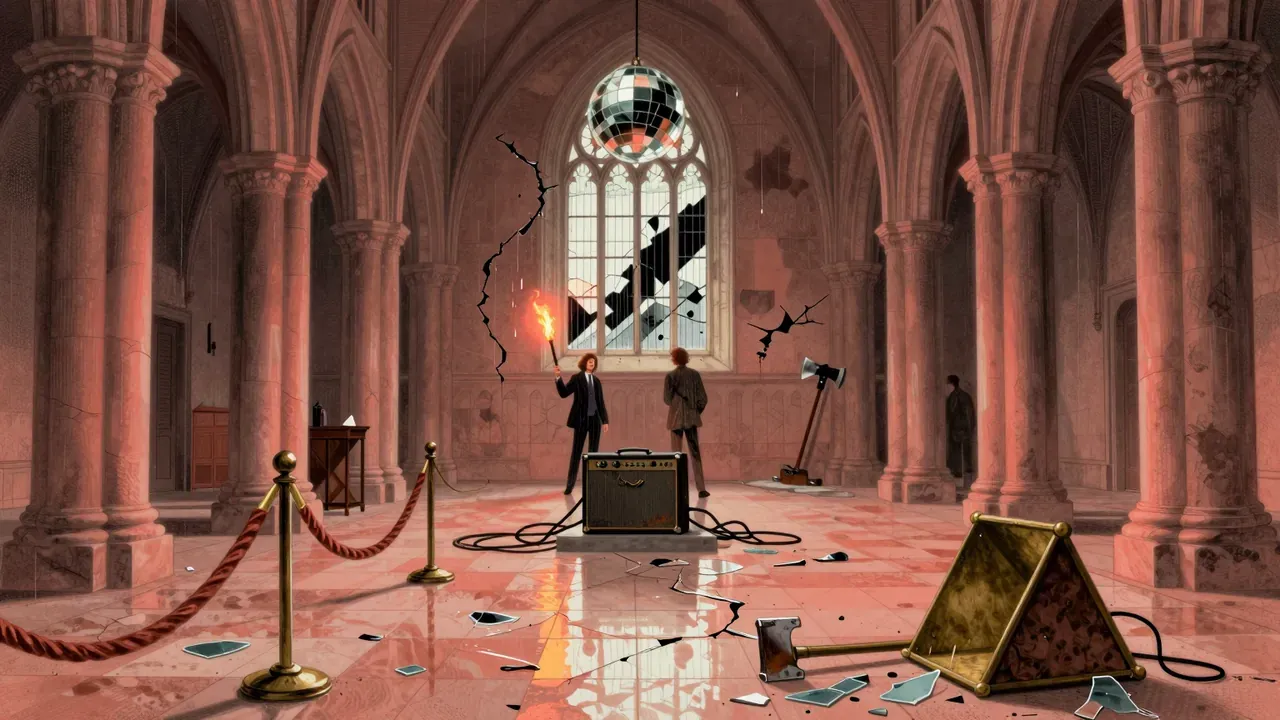
What lands is the physicality of its world—the damp brick of a squat, the glare off a cracked mirror in a café, the way light catches dust motes in a derelict cathedral. The film’s most persuasive moments are non-verbal: Bod’s silent strangle of Elizabeth I, Mad tearing postcards with slow, wet fingers, Crabs’s stillness before she kills Happy Days. These images hold weight because they are anchored in material reality, not allegory. The casting of actual punk figures—Jayne County, The Slits, Richard O’Brien—gives the ensemble an authenticity no script could manufacture. Even when dialogue falters, the bodies in frame assert presence: Hermine Demoriane’s watchful stillness, Steven Severin’s coiled posture, David Brandon’s weary irony. The film also succeeds in its tonal consistency: every scene sustains a low hum of dread and absurdity, never slipping into satire or sentiment. Its vision of London feels lived-in, not curated—a city where history isn’t buried but littered, visible in rubble and graffiti alike. That specificity, that refusal to aestheticise poverty or violence, remains potent. (142 words)
Where the logic frays
What does not land is the film’s attempt at ideological clarity. Its critique of punk’s contradictions—its flirtation with fascism, its commodification, its misogyny—is delivered in gestures rather than arguments, leaving key positions ambiguous or contradictory. Bod’s anarchism reads as pure negation, not philosophy; Amyl’s Hindley fixation is presented without irony or interrogation, making it difficult to read as satire. The male characters—Sphinx, Angel, Max—are underwritten, functioning more as props for female rage than as counterpoints. Ginz’s transformation from exploiter to aristocrat lacks grounding, his Dorset retreat arriving without thematic preparation. Some sequences—like the Westminster Cathedral disco—feel theatrically forced, their shock value undercut by repetition elsewhere. The film’s resistance to narrative also works against itself: without emotional through-lines, the deaths of Sphinx, Angel and Kid register as incidents, not losses. And while its rejection of professionalism is coherent, it occasionally collapses into incoherence—moments where sound drops out, or cuts misfire, that feel like gaps rather than choices. (146 words)
What it’s really about
The themes that matter are not punk, but what punk exposes: the collapse of civic memory, the violence of inheritance, the erotic charge of destruction. Jubilee treats history as a contested site—not just Elizabethan versus modern, but the 1977 Silver Jubilee versus the 1603 death of Elizabeth I, both moments of symbolic exhaustion. Class appears not as economics but as spatial fact: the gang moves through abandoned churches and palaces not as squatters but as inheritors of vacancy. Sexuality is presented as fluid, transactional, weaponised—but never liberated: even Viv’s artistic past is framed as failure, not freedom. The film’s deepest concern is sovereignty—not political, but bodily and temporal. Who owns time? Who names history? Who gets to destroy? These questions are asked not in dialogue but in action: Bod stealing the crown, Crabs burning a policeman, Ginz leasing Buckingham Palace. The film’s fantasy element is not escapism but inversion: it imagines a Britain so broken that the only possible future is backward, into myth. That backward glance is neither nostalgic nor redemptive—it is forensic. (143 words)
Who it’s for
This film is for viewers who value texture over exposition, who find meaning in dissonance, and who accept that some ideas resist narrative form. It rewards patience with atmosphere, attention to composition, and tolerance for unresolved tension. It is not for those who require psychological motivation, narrative payoff or tonal consistency—even within its own logic, Jubilee refuses comfort. Those expecting a ‘punk film’ in the sense of celebration or documentation will be alienated; Jarman’s view is diagnostic, not participatory. Critics who value classical structure or emotional accessibility—like Derek Malcolm, who called it ‘not a very good film’—would rightly find it unsatisfying on those terms. A shift in verdict would require the film to offer clearer ethical scaffolding: if its nihilism were more rigorously argued, or its violence more precisely located, its provocations might cohere. As it stands, its power lies in its refusal to choose sides—or to explain itself. (141 words)
Is it worth your evening
Yes, it is worth your evening—if you approach it as a historical artefact first, a film second. It occupies a precise cultural hinge: made in 1977, released in early 1978, it captures London before Thatcher, before gentrification’s first wave, before punk’s absorption into fashion and marketing. Its grain, its locations, its cast—all are irreplaceable records of a moment that has since been erased or rebranded. Watching it now is less about enjoyment than about witnessing: the way a young woman smokes in a doorway lit by a single bulb, the sound of boots on broken glass, the silence after a scream. Those who want entertainment, clarity or catharsis should look elsewhere. But those willing to sit with discomfort, ambiguity and formal risk will find few films from this period so materially honest. Its flaws are inseparable from its value—and that is rare. (138 words)