What the play becomes on screen
Miss Julie is a 1951 Swedish film adaptation of August Strindberg’s 1888 naturalist play, directed and written by Alf Sjöberg. It attempts to translate the claustrophobic intensity of the stage version — first staged by Sjöberg in 1949 — into cinematic terms without abandoning its psychological rigour or social precision. The film retains the play’s single-night structure and its tightly bound setting: a noble estate on Midsummer’s Eve, where class boundaries blur only to snap back with greater violence. Sjöberg does not soften Strindberg’s deterministic view of human behaviour; instead, he deepens it through visual contrast — between candlelit interiors and sun-bleached exteriors, between the servants’ communal singing and Julie’s solitary collapse. The ambition is not reinterpretation but distillation: to make the play’s moral and physiological tensions legible in movement, framing, and silence. It treats the source as a fixed architecture, then builds around it with cinematic grammar rather than against it. Word count: 127
The look of it
The story unfolds in real time across one evening, anchored by Anita Björk’s performance as Julie — restless, volatile, physically unmoored — and Ulf Palme’s Jean, whose deference curdles into calculation with unnerving consistency. Göran Strindberg’s cinematography keeps the camera close but never intrusive, using shallow focus and tight compositions to mirror Julie’s narrowing options. Dag Wirén’s score is sparse, punctuating key moments with dissonant woodwind phrases that avoid melodrama. The production design, carried over from the 1949 stage version, gives the kitchen and adjoining rooms a lived-in authenticity: worn floorboards, steam rising from kettles, the weight of linen napkins folded for a ball that never truly begins. Max von Sydow appears briefly but decisively as the valet Kristin, his stillness contrasting with Julie’s agitation. There are no flashbacks, no voiceover — exposition arrives through argument, gesture, and what characters withhold. Word count: 136
How the body tells the story
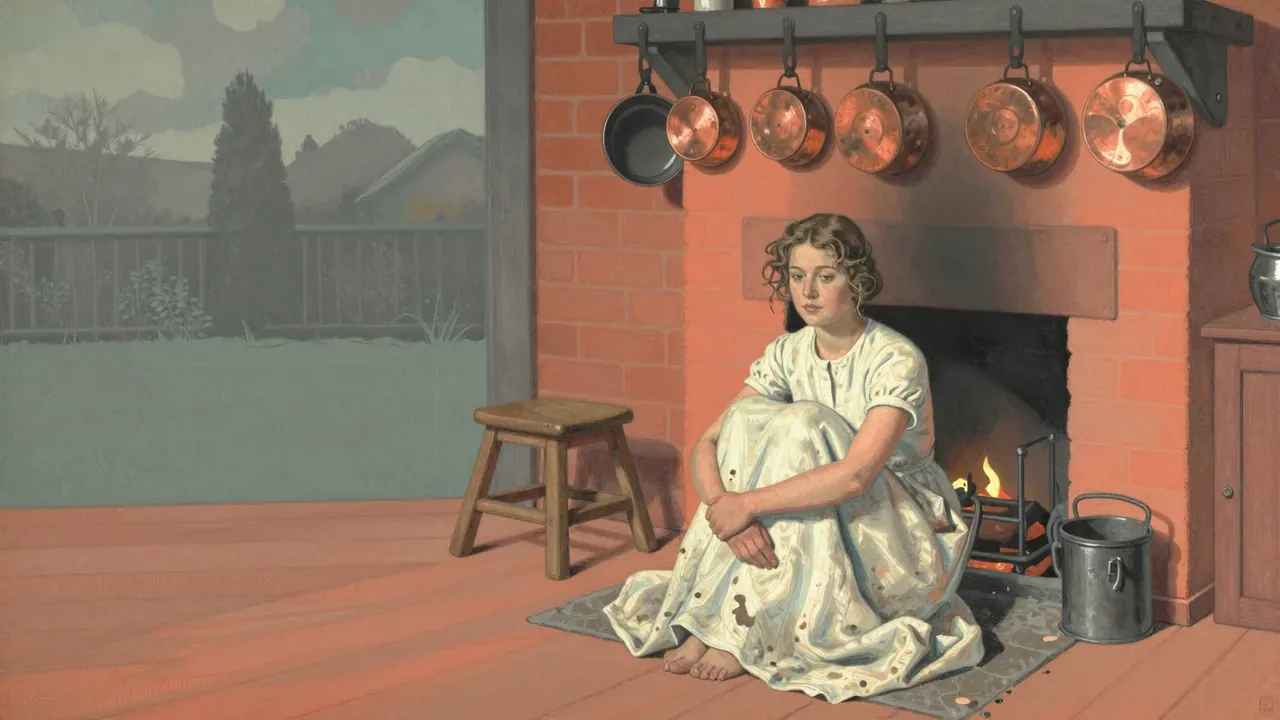
What lands most forcefully is the film’s refusal to grant Julie redemption or even coherent agency. Her descent is neither tragic nor heroic but physiologically plausible: her breathing quickens before she speaks, her hands tremble when she pours beer, her posture collapses incrementally until she sits on the floor like a child who has forgotten how to stand. The Midsummer setting — all light and false cheer — becomes deeply ironic, its folk motifs underscoring the inevitability of hierarchy. Jean’s shift from subservience to cold pragmatism feels earned because it is shown in small increments: a glance held too long, a pause before obeying, a deliberate misreading of Julie’s tone. The final sequence — the broken birdcage, the razor, the portrait of the Countess — carries no shock value, only grim logic. This is not catharsis but confirmation: the system absorbs and erases her without needing to raise its voice. The film’s restraint makes its conclusions harder to dismiss. Word count: 142
Where the frame cracks
What does not land is the attempt to expand beyond the play’s original confines. The exterior sequences — filmed at Drottningholm Palace Park and Stora Wäsby Castle — introduce spatial freedom that works against the script’s suffocating design. Julie’s walk in the garden, though visually striking, dilutes the pressure built indoors; the hand hiding behind the sculpture feels theatrically literal where the play relies on implication. Some supporting performances lack the same calibrated tension: Anders Henrikson’s Count Carl remains distant, more symbol than presence, and Inga Gill’s Kristin, while technically precise, never quite unsettles as the text demands. The film also struggles with Strindberg’s philosophical interjections — particularly Jean’s monologue about Italy — which sound stilted when spoken aloud without the rhetorical momentum of live theatre. These are not failures of craft but of translation: moments where the medium’s strengths become liabilities. Word count: 139
What the walls are made of
The themes that matter are class as physiology, not ideology; desire as contamination; and inheritance as curse rather than privilege. Julie’s aristocratic status is not abstract — it lives in her posture, her inability to tolerate heat or noise, her reflexive command over others’ bodies. Jean’s ambition is not aspirational but defensive: his talk of hotels and capital is less about mobility than about erasing the memory of being chased off the estate as a boy. The fire set by Julie’s mother is not backstory but structural fact — a precedent for self-immolation as the only available form of autonomy. Even the finch Serine functions thematically: caged, ornamental, expendable. The film treats gender not as identity but as position — Julie’s femininity is inseparable from her father’s title, her mother’s rebellion, and Jean’s access to her. There is no psychology outside circumstance. Every decision follows from material condition, not character arc. Word count: 132
Who it lets in — and who it shuts out
This film is for viewers who accept that drama need not offer resolution, comfort, or even clarity — only fidelity to its own logic. It rewards attention to gesture, silence, and spatial relationships, and assumes familiarity with European naturalism’s premises. It is not for those who require narrative propulsion, moral ambiguity, or emotional release. Anyone expecting psychological realism in the modern sense will find it alienating: Julie’s motivations are never explained, only enacted. Those who prefer adaptations that open up or reinterpret their sources may find Sjöberg’s approach too reverent, too confined. A viewer who values strong female performances but expects agency or growth will leave unsettled — not because the film fails, but because it refuses that expectation. Word count: 120
Why it stays with you
Yes, it is worth your evening — if you are prepared to sit with discomfort without seeking relief. Its 89 minutes pass with the weight of inevitability, not tedium. The performances, especially Björk’s, are sustained at a pitch few films risk, and Strindberg’s ideas gain new force when rendered in concrete, tactile detail. It is not ‘enjoyable’ in any conventional sense, but it is exacting, unsparing, and formally coherent. Those who reject it tend to do so on grounds of datedness or austerity — critics like Walter Goodman found Björk’s shifts unconvincing, but that objection presumes emotional continuity as a virtue, whereas the film treats discontinuity as truth. A different verdict would follow only if the film softened its determinism or expanded its perspective — choices that would make it less Strindberg, not more humane. Word count: 124