The promise made
Peau d’Âne is a French fairy-tale musical that adapts Charles Perrault’s 1695 Donkeyskin — a story in which a king, bound by a deathbed vow, resolves to marry his daughter. Jacques Demy treats the material not as allegory or psychological case study but as a self-contained, brightly lit dream logic: a world where moral gravity coexists with confectionery colour, where taboo is acknowledged but never dwelled upon, and where song functions as narrative propulsion rather than emotional exposition. The film does not seek to modernise the tale’s discomfort so much as to encase it in artifice — gilded frames, slow-motion gestures, choral interjections — so that its severity becomes legible only through contrast with the surrounding whimsy. It is neither satire nor subversion, but a deliberate, stylised re-enactment of folklore’s formal grammar: repetition, impossible conditions, transformation, and sanctioned reversal. Demy’s aim is not resolution of the tale’s tension but its ceremonial staging — a ritual in which form holds content at arm’s length.
The look of it
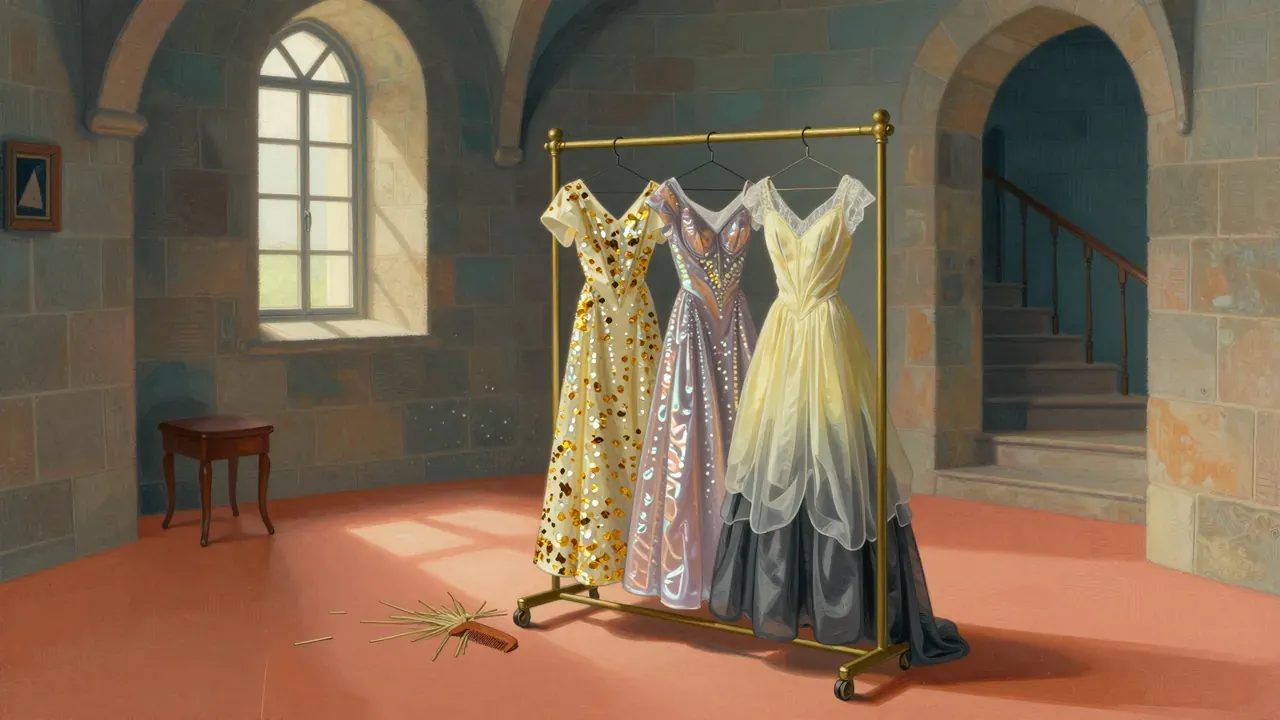
The story unfolds with clockwork fidelity to Perrault’s structure: three impossible dresses, a donkey skin, flight, disguise, a ring-in-cake, and a double wedding. Catherine Deneuve plays the princess with stillness and watchful precision; her physical presence anchors the film’s visual extravagance without softening its austerity. Jean Marais, as the Blue King, avoids grotesquerie — his desire reads as solemn, even weary, rather than predatory. Ghislain Cloquet’s cinematography favours wide, symmetrical compositions, often shot in natural light within the Châteaux de Chambord and Pierrefonds, lending grandeur without opulence. Michel Legrand’s score moves between baroque pastiche and jazz-inflected waltzes, underscoring action rather than interpreting feeling. Anne-Marie Cotret’s editing sustains rhythm over revelation: scenes end on a held note or a cut to empty architecture, not a character’s reaction. The live-action statues, borrowed from Cocteau, are not effects but punctuation — pauses in time rather than spectacle.
What holds the eye
What lands is the film’s tonal consistency: its refusal to wink, explain, or soften. The lilac fairy’s helicopter arrival — anachronistic, absurd, perfectly timed — works because the film has already established its own internal chronology, one in which magic and machinery coexist without comment. The costume design (by Jacqueline Moreau) delivers tangible wonder: the sun dress glints with real gold leaf, the moon dress shimmers with crushed mother-of-pearl, the weather dress shifts hue under changing light — details that reward attention without demanding interpretation. The pig-sty sequence, shot in misted woodland near Senlis, grounds the fantasy in tactile reality: mud, straw, steam from breath, the weight of the donkey skin as cloth, not symbol. Even the singing voices — Anne Germain’s clear soprano for Deneuve, Jacques Revaux’s warm tenor for Perrin — feel like extensions of character rather than interruptions. Nothing here feels imposed; everything feels chosen, then left to breathe.
Where the logic slips
What does not land is the prince’s arc: Jacques Perrin’s performance is earnest but underwritten, and the romance lacks friction or discovery — he falls in love at first sight and remains there, untroubled by doubt or delay. The film gives him no interiority beyond longing, and his sickbed sequence, though visually lush, rests on a plot device (the cake) that feels less like inevitability and more like narrative convenience. The supporting courtiers — Sacha Pitoëff’s Prime Minister, Fernand Ledoux’s Red King — speak in arch, declamatory tones that occasionally tip into monotony rather than stylisation. The final double wedding, while logically satisfying, arrives without emotional accumulation: the king’s redemption is asserted, not earned, and the lilac fairy’s sudden marriage to him reads as structural symmetry rather than earned closure. There is no reckoning with the incestuous premise beyond its initial articulation and subsequent evasion — a choice that serves the film’s aesthetic but leaves thematic residue unexamined.
What the colours mean
The themes that matter are obligation, inheritance, and the weight of language. The king’s vow — spoken to a dying queen — becomes a binding spell, not a moral failing; the princess’s resistance is linguistic and procedural: she demands impossibilities, trusting syntax itself to deflect desire. Her flight is not rebellion but adherence — to the letter of the vow’s condition, to the fairy’s counsel, to the logic of the tale. The donkey skin is both shield and stigma: it hides her identity but also marks her as untouchable, animal, other. Colour functions as moral taxonomy: blue for royalty and stasis, red for passion and danger, lilac for mediation and ambiguity. The film treats class not as social critique but as theatrical convention — servants sing in harmony, nobles speak in verse, and status is signalled by fabric, not behaviour. There is no commentary on power beyond its formal expression: crowns, thrones, heraldry. What matters is how rules are stated, kept, bent, and broken — not whether they should exist.
Who walks with it
This film is for viewers who value design as meaning, who find pleasure in precise visual cadence and who accept fairy tales as grammatical systems rather than psychological blueprints. It rewards patience with pattern, attention to texture, and tolerance for emotional reserve. It is not for those who require character motivation to be legible in contemporary terms, or who expect moral complication to be dramatised rather than contained. Viewers unsettled by the premise’s implications — even when stylised — may find the film’s detachment alienating rather than clarifying. Those seeking narrative urgency, psychological realism, or satirical edge will leave unsatisfied. Its appeal lies in its discipline: every frame obeys the same quiet logic. To dislike it is not to misunderstand it, but to prefer a different contract — one where feeling is named, consequence is traced, and fantasy serves interrogation rather than embodiment.
How long it stays
Yes, it is worth your evening — provided you approach it as a crafted object, not a story to be solved. Its 86 minutes pass without strain, sustained by Cloquet’s light, Legrand’s melodies, and Demy’s unwavering control of scale and pace. It offers no easy catharsis, but it does offer coherence: a rare thing in adaptations of folklore, where tone often frays under the weight of competing intentions. Those who find beauty in restraint — in a held glance, a repeated motif, a door closing on empty space — will leave with images that linger. It is not ‘accessible’ in the commercial sense, but it is generous in its clarity of purpose. To call it ‘light’ would misrepresent its gravity; to call it ‘heavy’ would ignore its airiness. It occupies a third space: deliberate, luminous, and quietly insistent — a film that asks only that you meet it on its own terms, and repays that meeting with exactitude.