The shape of absence
Eclipse is the third film in Michelangelo Antonioni’s loose trilogy on modern alienation, following L’Avventura and La Notte. It attempts not to tell a story but to trace the erosion of connection — between people, between intention and action, between time and presence. Set in Rome and Verona in mid-1961, it follows Vittoria, a literary translator, as she drifts from one relationship to another without settling into either grief or desire. The film does not seek resolution, nor does it offer psychological explanation; instead, it builds atmosphere through duration, silence, and architectural framing. Its ambition lies in formal restraint: long takes, sparse dialogue, deliberate pacing, and a refusal to assign motive or closure. It treats emotion as ambient rather than dramatic, and narrative as something that recedes under scrutiny. The eclipse of the title is literal only in its inspiration — Antonioni filmed one in Florence — but functions throughout as metaphor: a temporary obscuring, a failure of light, a moment when visibility collapses and meaning must be held in suspension rather than declared.
The grammar of silence
The film works through accumulation, not causality. Gianni Di Venanzo’s cinematography holds space with weight: wide shots of the Rome Stock Exchange emphasise scale over individuality; tracking shots along empty apartment blocks suggest routine without rhythm. Monica Vitti’s performance is calibrated in micro-gestures — a pause before answering, a glance away mid-conversation — while Alain Delon plays Piero with physical confidence but emotional vacancy, his charm never quite bridging the gap between proximity and intimacy. Eraldo Da Roma’s editing sustains this unease: cuts often arrive just after emotional peaks, leaving silence where reaction should be. Giovanni Fusco’s score is sparse, punctuating rather than underscoring. The script, co-written by Antonioni and three others, avoids exposition; characters speak past each other, their words landing in gaps rather than exchanges. Even the construction site — recurring across several scenes — is less setting than condition: unfinished, provisional, structurally exposed.
The last light
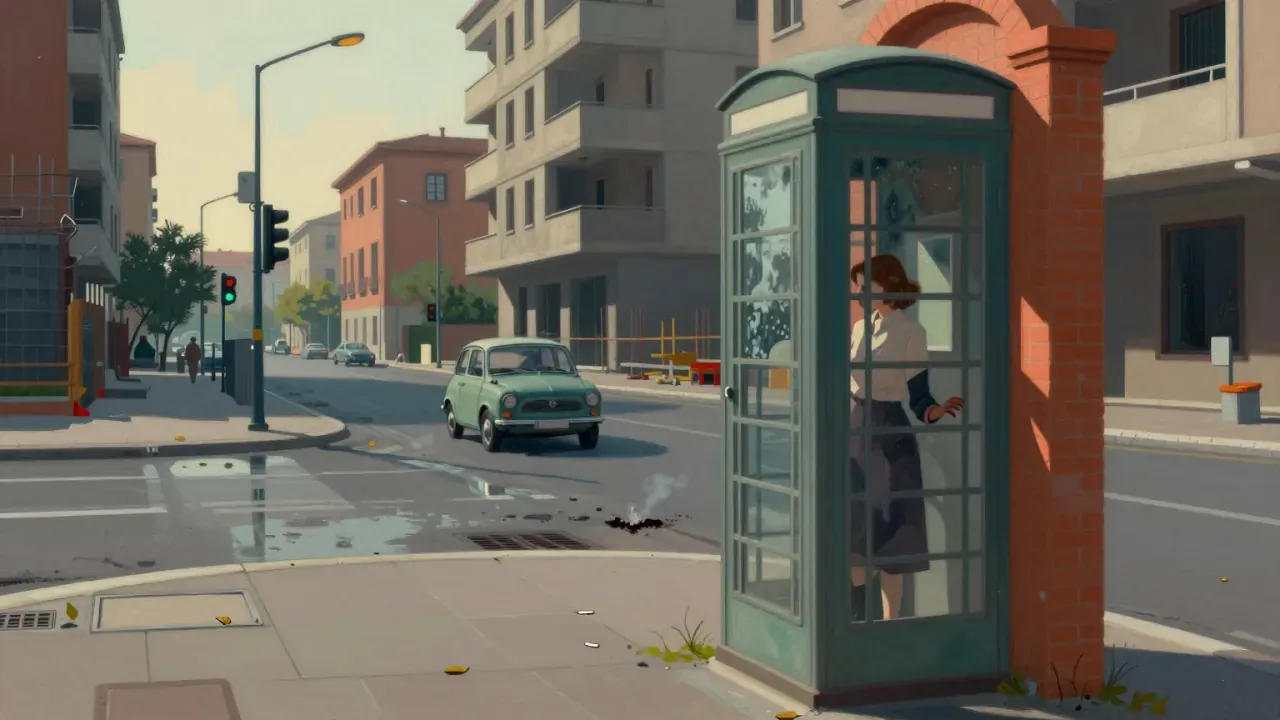
What lands most decisively is the final sequence: seven minutes without either lead character, built from lingering shots of Rome’s urban periphery — traffic lights changing, leaves skittering, a fountain cycling water, a telephone booth ringing unanswered. It is not abstract for abstraction’s sake, but a sustained formal reckoning with absence. The earlier scenes accumulate quiet precision: Vittoria’s blackface mimicry of Marta’s colonialist fantasy lands not as satire but as exhausted mimicry — a gesture stripped of irony, revealing how little agency remains when language and identity have both been hollowed out. The stock exchange scenes do not critique finance directly, but render it as sensory overload — shouting, ticker tape, frantic glances — against which Vittoria’s stillness becomes an act of resistance. The film’s pacing, often mistaken for inertia, in fact trains attention on what is omitted: no backstory, no interior monologue, no moral framing. That discipline rewards close watching, not passive reception.
The function of figures
What does not land is any sense of Riccardo as more than a functional counterpoint — Francisco Rabal’s performance is restrained, but the script gives him no dimension beyond being left behind. Similarly, Louis Seigner’s Ercoli appears briefly as a neighbour and vanishes without resonance; his presence feels structural rather than thematic. The subplot involving Marta’s dog Zeus has no narrative return and dissipates without consequence, functioning more as atmospheric detour than compositional necessity. Some viewers may find the film’s refusal to clarify motivation frustrating rather than provocative — particularly in Piero’s abrupt shifts between tenderness and indifference, or Vittoria’s oscillation between withdrawal and physical availability. The film assumes a viewer willing to sit with ambiguity as substance, not symptom; without that willingness, the repetitions — of location, posture, silence — risk reading as omission rather than design. There is no misstep in craft, but there is a consistent withholding that some will read as evasion.
The logic of delay
The themes that matter are not stated but inhabited: the exhaustion of romantic language in a world increasingly mediated by capital and infrastructure; the disjunction between private feeling and public space; the slow attrition of selfhood under conditions of affluence and choice. Banking and construction appear not as backdrops but as parallel systems — both involve speculation, both defer completion, both operate on faith in future value. Vittoria’s work as a literary translator underscores the instability of meaning itself: words passed through layers of interpretation, never arriving intact. The film treats time not as linear progression but as sediment — moments pile up without resolving, like the unmet appointment on Sunday, 10 September. Ennui here is not laziness but the physiological residue of sustained disengagement. Antonioni does not diagnose late capitalism so much as film its texture: the hum of air conditioning, the glare off glass office towers, the way a sports car’s engine sounds both powerful and disposable.
The audience it presumes
This film is for viewers who treat duration as material, not obstacle — those accustomed to the pacing of Bresson, Tarkovsky or early Akerman, and who understand silence as syntax. It is for readers of Beckett or Blanchot, for students of post-war Italian sociology, for anyone who finds emotional resonance in vacant lots and flickering streetlights. It is not for those who require narrative propulsion, clear stakes, or character arcs — nor for viewers who equate engagement with plot density or verbal exposition. Those who find slow cinema ‘boring’ on principle will not be converted here; the film makes no concession to impatience. A change in verdict would follow not from altering the film’s pace or structure, but from a shift in cultural tolerance for unresolved experience — if audiences were once again trained to hold ambiguity as generative rather than deficient. Until then, its demands remain absolute.
The weight of the watch
Yes, it is worth your evening — provided you set aside the expectation of conventional payoff and accept duration as part of its argument. Its 126 minutes are not filled but measured: each shot asks you to recalibrate attention, to notice how light falls across concrete, how a door closes without sound, how a face registers nothing and everything at once. It repays rewatching not because it reveals hidden clues, but because its architecture becomes legible only over time — the recurrence of certain windows, the rhythm of footsteps on gravel, the way Vittoria’s hair catches light in different scenes. Those who dismiss it as ‘cold’ mistake emotional restraint for absence; those who call it ‘intellectual’ overlook how deeply physical its discomfort is — the ache of waiting, the weight of unspoken words, the vertigo of standing in a half-built room. It is not entertainment, but it is rigorously alive — and that aliveness demands, and rewards, full presence.