The look of it
Alice in the Cities is Wim Wenders’ fourth feature and the first of his Road Movie trilogy — a deliberate pivot from stylistic imitation toward a personal, observational mode. It attempts to hold still the disorientation of late modernity: a writer adrift in America, then Europe; a child untethered from place or language; both moving without itinerary or authority. The film does not seek resolution but registers the friction between intention and drift, between narrative expectation and lived slowness. Its ambition is structural as much as thematic: to let silence, repetition, and minor logistical failures carry weight; to treat travel not as progression but as suspension. Shot on 16 mm in black and white, it refuses the polish of commercial cinema not for austerity’s sake but because its subject — the erosion of certainty in perception, memory, and connection — demands a medium that feels provisional, tactile, unvarnished. It is a film about looking without knowing what to look for, and about caring without being asked.
The shape of the journey
The story follows Philip Winter, a West German writer who fails to produce an article on the US, then becomes temporarily responsible for a nine-year-old girl named Alice after her mother vanishes. Their journey across Amsterdam, Wuppertal, and the Ruhr area unfolds through long takes, sparse dialogue, and repeated gestures — boarding buses, scanning street signs, misreading maps. Rüdiger Vogler plays Philip with muted exhaustion, never emoting but registering shifts in posture and gaze; Yella Rottländer, aged nine, performs Alice with unforced attention, her presence grounded in physical detail — the way she holds a Polaroid, squints at a train schedule, or folds her legs in a car seat. Robby Müller’s cinematography keeps focus shallow and light flat, favouring mid-distance framing that denies intimacy while refusing detachment. Peter Przygodda’s editing sustains duration without monotony, letting scenes breathe just past comfort. The Can score — recorded sight-unseen in one session — pulses with low-frequency unease, underscoring absence rather than drama.
The weight of silence
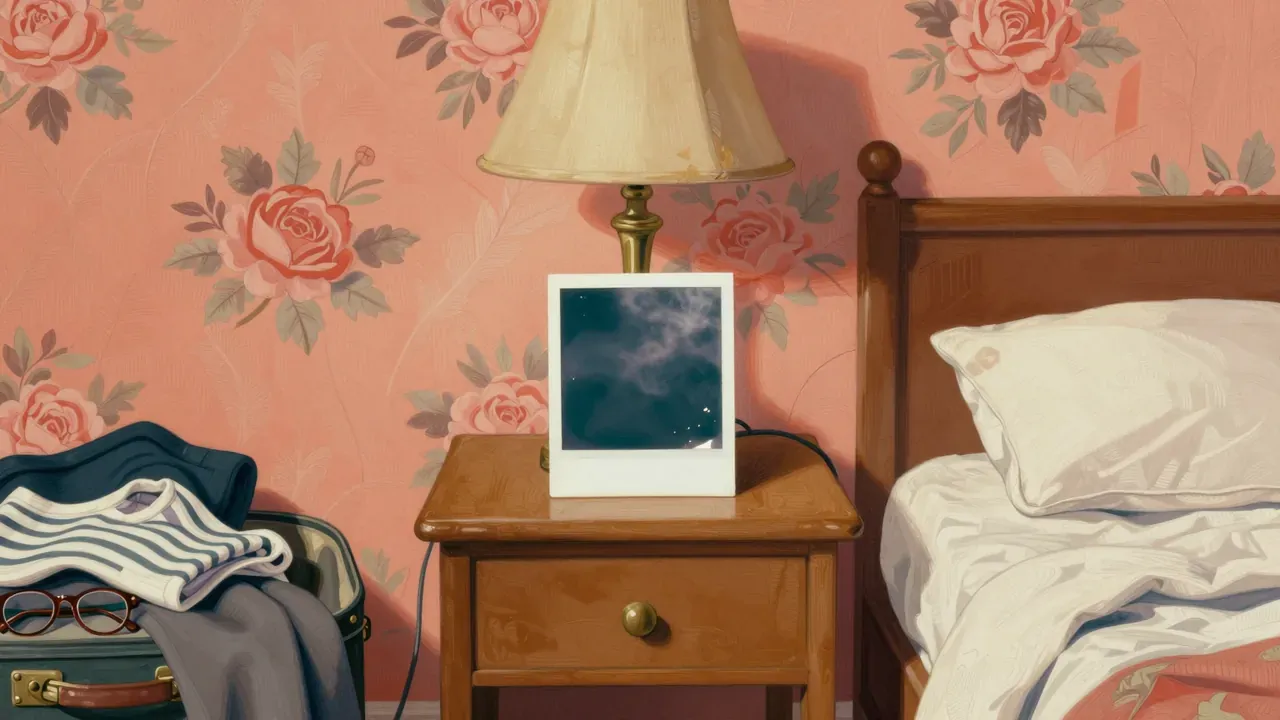
What lands is the cumulative weight of small, unremarkable decisions: Philip choosing not to leave Alice at the police station; Alice slipping back into his car after escaping custody; the two shouting insults at each other in a swimming pool. These moments avoid sentimentality by anchoring emotion in behaviour, not exposition. The film’s refusal to explain Lisa’s departure or the grandmother’s whereabouts makes their eventual reunion feel earned not narratively but existentially — as relief, not payoff. The use of Chuck Berry’s ‘Memphis, Tennessee’, decolourised and repurposed from Pennebaker’s archive, works precisely because it is mediated, distant, a fragment of longing heard second-hand. Likewise, the recurring motif of Polaroids — images taken but not developed, seen but not understood — lands as a quiet metaphor for the limits of documentation, of memory, of authorship itself. The film trusts the viewer to sit with ambiguity, and rewards that patience with texture, not revelation.
The rhythm of repetition
What does not land is the framing device of Philip’s journalistic assignment. His failure to write about America remains abstract, under-specified, and ultimately irrelevant to the emotional logic of the central relationship. The opening scenes in the US — North Carolina, New York — feel like exposition dropped in from another film, visually disconnected and thematically undernourished. Similarly, the cameo appearances by Wenders himself and others (Sam Presti, Lois Moran) do not cohere as commentary or irony; they register as self-conscious intrusions rather than structural choices. The film’s resistance to conventional plotting occasionally tips into vagueness: Alice’s sudden recollection of her grandmother’s name and location lacks internal rhythm or preparation, arriving less as breakthrough than narrative convenience. And while the 16 mm grain and 4:3 broadcast format were pragmatic constraints, their aesthetic effect — especially in later restorations — can flatten spatial relationships, making some cityscapes feel hermetic rather than inhabited.
The unreliability of recall
The themes that matter are those embedded in motion and omission: the fragility of adult competence, the resilience of child logic, the unreliability of memory as a navigational tool. It treats language not as a bridge but as a series of partial overlaps — German, English, Dutch — where meaning accrues through repetition, gesture, and shared silence. Parenting appears not as duty or sacrifice but as improvisation under constraint: Philip has no claim on Alice, yet assumes responsibility through accumulated proximity. The film also probes authorship — Philip’s stalled article, Alice’s undeveloped photos, Wenders’ own near-abandonment of the project — suggesting that meaning emerges not from control but from surrender to process. Crucially, it avoids diagnosing alienation as pathology; instead, it presents dislocation as ambient condition, as ordinary as catching a bus or misreading a sign. Its quietest theme is endurance: not of hardship, but of uncertainty held long enough for something else to begin.
The practice of care
This film is for viewers who tolerate extended silences, who find tension in waiting rooms and bus terminals, who value precision of gesture over exposition, and who accept that some journeys end without arrival. It suits those familiar with post-war German cinema’s preoccupations — identity, reconstruction, the residue of trauma — but also those drawn to films where children are treated as agents of perception rather than symbols of innocence. It is not for viewers who require clear motivation, causal plotting, or emotional payoff within a scene. Those expecting the warmth of Paper Moon or the mythic sweep of Paris, Texas will find it withholding. A viewer who dislikes static compositions, unresolved endings, or the deliberate pacing of early 1970s European art cinema would likely reject it outright — and fairly so. Its value depends on willingness to meet it on its own terms: as a record of looking, not a delivery of meaning.
The space after the question
Yes, it is worth your evening — provided you watch it without agenda, on a screen large enough to register Müller’s gradations of grey, and with time to let its rhythms settle. Its 107 minutes unfold like a slow-developing photograph: initial blur gives way to detail only if you stay with it. It repays attention not with plot twists but with accumulated nuance — the way Alice’s hair catches light in a train window, how Philip’s shoulders drop when he stops resisting her presence. Some will call it inert; others, essential. Its worth hinges on whether you believe cinema can be an act of patient witness rather than explanation. Those who demand clarity, closure, or catharsis will leave unsatisfied — and the film makes no argument against that position. But for those open to a film that treats wandering as method and care as habit, not heroism, it remains singular. Its economy — of image, sound, and speech — has not dated; if anything, it feels more necessary now.