The look of it
La Pointe Courte is Agnès Varda’s first feature, made in 1955 with no studio backing and a budget of $14,000. It sets out two parallel strands: a Parisian couple negotiating the quiet erosion of their marriage, and the residents of Sète’s La Pointe Courte quarter resisting a public health ban on shellfish harvesting from their lagoon. Varda does not treat these as metaphors for one another but holds them in deliberate, unblended proximity — a structural choice modelled on Faulkner’s The Wild Palms, as she later confirmed. The film avoids psychological exposition or narrative resolution in either thread. Instead, it observes how personal doubt and collective resistance unfold in the same sun-bleached, salt-worn space, without privileging one over the other. Its ambition is formal and ethical: to place fiction and non-fiction on equal footing, to let local voices speak without translation or narration, and to test whether a film can be both intimate and civic without collapsing one into the other. It is not a manifesto, but it behaves like one — quietly, insistently, without fanfare. (158 words)
The shape of it
The story moves between two registers: scripted scenes with Silvia Monfort and Philippe Noiret as the unnamed couple, and documentary-style sequences with non-professional actors from Sète — the Lubrano family, Anna Banegas, Marcel Jouet — playing versions of themselves. Alain Resnais edits with a rhythm that refuses to smooth over the disjunction: cuts linger on faces mid-thought, hold on empty doorways, or pause just after dialogue ends. Gordon Willis is not involved; the cinematography is by Jean Rabier and Ghislain Cloquet, who shoot in natural light, often at midday, letting glare flatten depth and sharpen texture. Varda’s direction avoids performance cues: Monfort’s stillness reads as reserve, not vacancy; Noiret’s pauses feel earned, not rehearsed. The fishermen’s arguments about the lagoon are shot in long takes, with overlapping speech and off-camera interjections — no score, no voiceover, no explanatory title cards. Even the water jousts are filmed as lived spectacle, not staged pageantry. The craft is unadorned but precise: every frame acknowledges its own making, its limits, its debt to the place and people it records. (159 words)
The rhythm of it
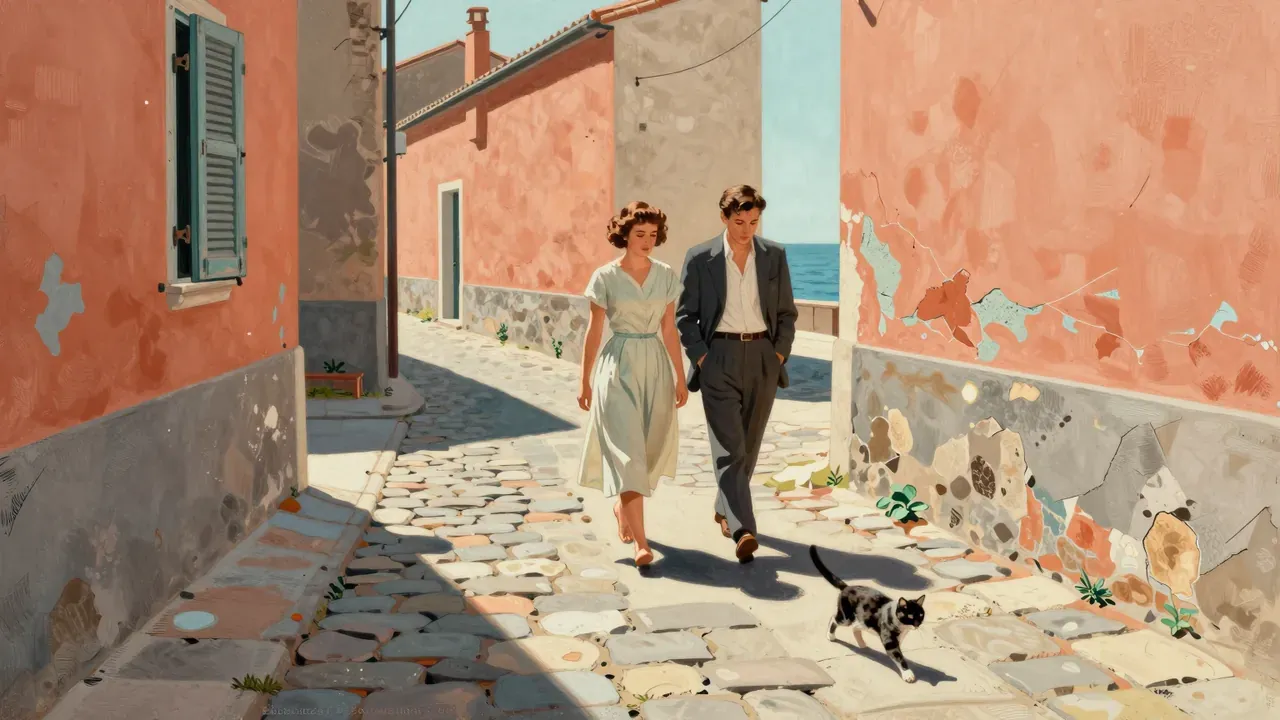
What lands is the film’s refusal to resolve. The couple’s reconciliation feels neither triumphant nor sentimental — it arrives after shared silence, a walk through a dance, and the quiet admission that love need not stay urgent to remain binding. That lands because it is shown, not told: Monfort’s hand resting on Noiret’s shoulder as they board the train is the only gesture of closure the film offers. The fishermen’s arc also lands: their defiance is pragmatic, communal, unheroic — they fish, test the water, argue, mourn a child, then dance. There is no victory, only continuity. The film’s attention to material detail — the weight of nets, the grit of sand under bare feet, the way light hits wet stone — grounds both narratives in physical reality. Even the cats, which appear without commentary, do so as inhabitants, not symbols. This attentiveness makes the film feel inhabited rather than constructed. It does not ask for empathy but assumes it, and that assumption proves justified. The viewer is not led; they are allowed in. (157 words)
The silence of it
What does not land is the structural conceit when it strains for equivalence. The couple’s storyline, though restrained, operates on a different scale of consequence and interiority than the village’s struggle — one concerns private feeling, the other collective survival — and the film never quite reconciles that imbalance. At times, the juxtaposition feels more like editorial intent than organic convergence. Some scenes with the Soldino family lack the density of the central couple’s exchanges; their conflicts — Jules’s disapproval of Anna’s romance, for instance — are sketched but not deepened. The absence of backstory for the locals, while ethically sound, leaves certain emotional turns under-supported. A viewer expecting cohesion may find the film’s dual focus diffuse rather than dialectical. It is not that the threads clash, but that their grammar differs: one is psychological realism, the other social portraiture — and the editing, however skilled, cannot fully harmonise registers that obey different rules. That friction is part of Varda’s point, but it remains a friction. (156 words)
The texture of it
The themes that matter are endurance, coexistence, and the quiet labour of holding things together. Not revolution, not rupture, but the daily work of living alongside others — spouses, neighbours, generations — when conditions are uncertain and authority untrustworthy. The lagoon ban is never framed as right or wrong, only as an external pressure the community absorbs and negotiates. Similarly, the marriage is not saved by revelation or apology, but by proximity, patience, and shared observation. Class is present not as ideology but as texture: the fisherman’s hands, the wife’s city-bred posture, the way food is prepared and shared. Gender enters through gesture — Anna’s quiet assertion of choice, Rossette’s unspoken authority in her kitchen, the wife’s gradual shift from spectator to participant. Varda treats all this without emphasis, as if these were facts of weather or tide. There is no thesis, only accumulation: a portrait of life sustained not by certainty, but by repetition, reciprocity, and the willingness to return, again and again, to the same place. (155 words)
The demand of it
This film is for viewers who value attention over exposition, who trust images before explanations, and who find resonance in understatement. It suits those familiar with post-war French cinema’s rhythms, or with documentary traditions that resist narration. It is not for viewers who require clear causality, defined character arcs, or emotional payoff calibrated to genre expectations. Someone expecting the stylistic energy of Breathless or the narrative drive of The 400 Blows may find La Pointe Courte slow or withholding — and that reading is valid, not mistaken. The film’s pace is not a flaw but a condition: it asks the viewer to adjust, not to be adjusted for. A change in context — say, screening it alongside contemporary observational documentaries or recent arthouse films that blend non-professional and professional performers — would likely shift that verdict. But as a standalone experience, its demands remain specific and unyielding. (159 words)
The weight of it
Yes, it is worth your evening — provided you arrive without agenda. Its eighty minutes pass without hurry but also without dead air; every shot has weight, even the empty ones. It repays attention not with rewards but with recalibration: after watching, the ordinary world feels newly textured, quieter, more legible. That effect is rare and durable. A viewer who finds it inert is not wrong — the film makes no plea for engagement, only space for it. Those who dislike it tend to cite its ambiguity or its refusal to explain itself, and those are features, not bugs. What would change the verdict? A longer runtime might dilute its precision; a tighter narrative structure would betray its ethics. Its value lies precisely in its singularity: a debut that rethinks what a feature can contain, and how much it can leave unsaid. It earns its place not as a precursor, but as a completed statement. (158 words)