The first feature
Jour de Fête is Jacques Tati’s first feature film and a sustained experiment in visual storytelling rooted in the rhythms of rural France. It sets out to observe, not explain: to render the texture of a village on fête day — its sounds, its slowness, its unselfconscious choreography — while gently framing modernity as an imported absurdity. Tati does not satirise progress outright but treats efficiency as a foreign language François mishears, then tries to speak with his body. The film avoids narrative propulsion in favour of recurrence and variation: repeated gestures, returning characters, cyclical tasks. Its ambition is structural as much as comic — to build a world where time bends around human scale, where a hayfork matters more than a timetable. It is neither nostalgic nor corrective, but attentive: a study in how people move when no one is timing them. The film’s formal choices — sparse dialogue, diegetic sound, long takes — all serve that attention. It is not trying to be clever, nor to provoke; it is trying to hold still long enough for the ordinary to reveal its own logic.
The postman’s round
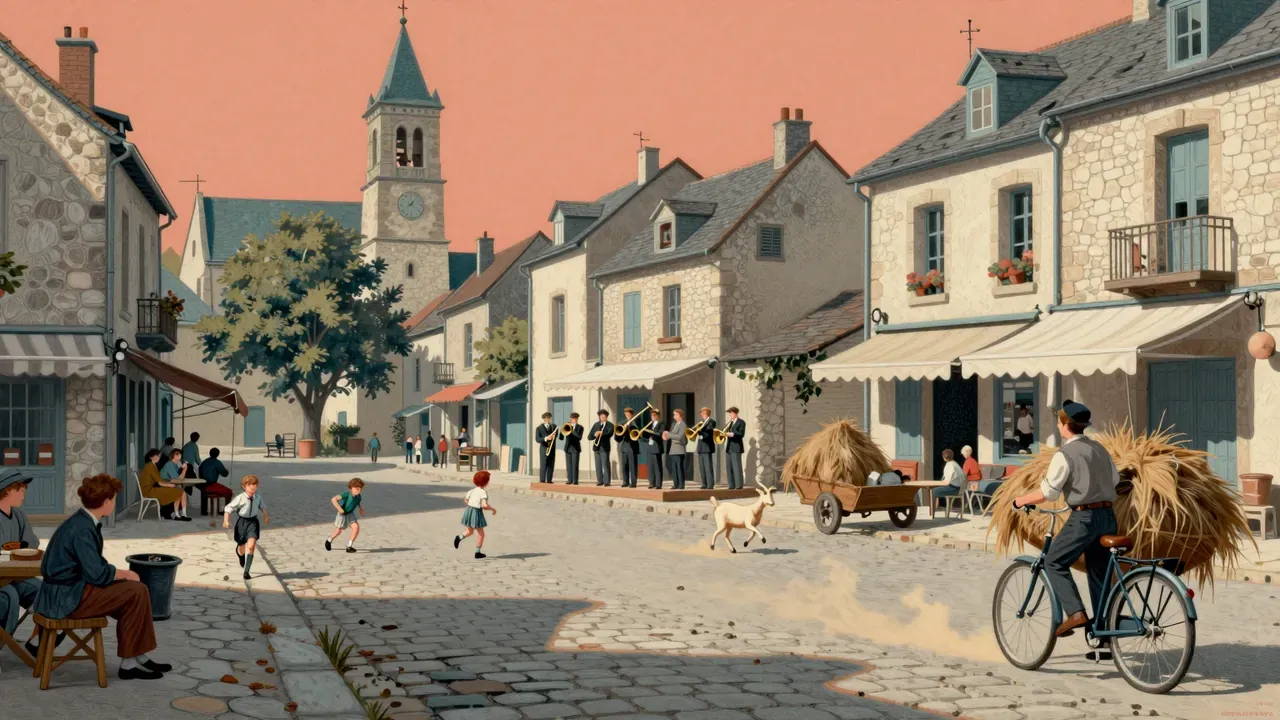
The story follows François, a postman in Sainte-Sévère-sur-Indre, whose routine unravels after he watches a US postal documentary at a travelling fair. His attempts to emulate transatlantic speed — cutting corners, pedalling frantically, abandoning protocol — form the spine of the action. Jacques Tati performs François with minimal inflection, letting physicality carry meaning: a tilt of the head, a pause before stepping off a curb, the way he leans into his bicycle like it might bolt. Paul Frankeur and Guy Decomble play the fairground men with easy condescension, their Americanisms delivered without irony, as if they were simply facts of nature. Jacques Sauvageot’s cinematography keeps the frame open and shallow, often placing characters at the edge or mid-distance, letting background activity — children chasing geese, women hanging laundry — register as equal to the foreground. Sound design is precise: birdsong swells and recedes, the brass band stutters in tune, the clatter of a cartwheel punctuates silence. Editing is unhurried, with cuts timed to breath or gesture rather than plot beats.
What repeats
What lands is the film’s quiet conviction in the dignity of slowness. François’s exhaustion is never pathetic; it is the logical outcome of forcing a human body into a machine’s logic. The final image — the boy completing the round on François’s bicycle while the mailman helps pitchfork hay — lands because it arrives without commentary, earned by the film’s consistent refusal to moralise. The humour works through accumulation: the same dog appears three times in different contexts; the goat-woman reappears like punctuation; the post office stamp thuds with increasing weight. Even the colour restoration (1995) serves the film’s intent: the pastel tones of the fairground tents, the washed-out greens of the fields, the dusty ochres of village walls all reinforce a world that exists before saturation — visually and socially. The film’s rhythm gives space for these details to settle, and the viewer begins to notice what the villagers notice: the angle of light on a cobblestone, the way dust hangs in air after a cart passes, the difference between a laugh and a cough in a crowded bar.
Where it explains
What does not land is the early stretch of exposition, particularly the fairground cinema sequence. Its spoof documentary — contrasting French and American postal systems — feels didactic next to the rest of the film’s oblique method. The narration is flat, the graphics crude, and the satire too literal to sit comfortably beside Tati’s later, more elastic visual wit. Some supporting performances verge on caricature: the gendarme’s stiffness, the mayor’s bluster, the schoolteacher’s primness all lack the gentle specificity given to François or the goat-woman. The 1964 re-edit, which inserts painter scenes and partial colour, disrupts the original’s coherence — the new footage feels illustrative rather than organic, as if Tati were explaining a joke he’d already told. And while the black-and-white version benefits from its austerity, the 1995 colour restoration, though technically impressive, occasionally flattens depth: some backgrounds lose definition, and the palette — however faithful — risks making the village look quaint rather than lived-in. These are not flaws in intent, but in execution: moments where the film’s patience wavers.
Curves and corners
The themes that matter are continuity and resistance — not political resistance, but the quiet persistence of embodied knowledge against abstraction. Tati frames rural life not as backward but as differently calibrated: time measured in hayricks and church bells, not timetables; space shaped by footpaths and hedgerows, not grids. The film’s central tension is between curves and straight lines — in François’s route, in the layout of the village, in the very grammar of movement. When he tries to ‘cut corners’, he is not just speeding up; he is violating the spatial logic of the place. The goat-woman, recurring like a motif, embodies this: she moves slowly, speaks rarely, and observes everything. She is not a symbol but a presence — a reminder that some ways of being do not require justification. Technology enters not as villain but as visitor: the fairground projector, the bicycle, the postal stamp — all are tools that only become absurd when divorced from human scale. The film’s enduring concern is how people retain shape when systems demand they flatten themselves.
Who it meets
This film is for viewers who value observation over explanation, who find pleasure in duration and repetition, and who trust silence as a carrier of meaning. It rewards patience, not expertise — no knowledge of French history or slapstick tradition is required, but a willingness to let scenes breathe is essential. It is not for those who need narrative momentum, clear character arcs, or verbal wit as the primary engine of comedy. Viewers expecting the tighter construction of Mon Oncle or the architectural precision of Playtime may find Jour de Fête too loose, too gentle, too unconcerned with payoff. Those who dislike long takes, ambient sound, or films where nothing ‘happens’ in the conventional sense will likely disengage early. The film assumes a certain tolerance for ambiguity — for not knowing whether a shot is setting up a gag or simply registering light on a wall. That assumption is its boundary: it does not court distraction, and offers no compromise to those unwilling to meet it on its own terms.
How long it lasts
Yes, it is worth your evening — provided you watch it as it asks to be watched: without hurry, without expectation of escalation, with attention to what happens at the edges of the frame. Its seventy-six minutes pass slowly, but not emptily; they accumulate texture, not incident. You will not laugh aloud often, but you may catch yourself smiling at the way a chicken crosses a road, or how a shadow lengthens across a courtyard. It is not a film to consume but to inhabit, briefly. Those who dismiss it as slight have mistaken restraint for thinness. Others — particularly fans of silent-era physical comedy or contemporary slow-cinema practitioners — may find its influence everywhere, from Aki Kaurismäki to Kelly Reichardt. If you expect a film to declare its importance, Jour de Fête will disappoint. But if you accept that significance can reside in a man pausing to watch a dog drink from a puddle, then it repays attention fully.