The weight of a day
Still Walking is a domestic drama set over one day in the Yokoyama household, built around the twelfth annual memorial for the family’s deceased eldest son. It does not seek revelation, climax or rupture, but rather quiet accumulation: the weight of unspoken grievances, the persistence of ritual, the slow erosion of certainty in filial duty and parental expectation. Hirokazu Koreeda writes and directs with the restraint of a clinical observer who has chosen not to look away. The film attends to how time settles in rooms — in the steam off a pot of miso soup, in the pause before a question is answered, in the way a mother folds laundry while listening to her daughter talk about moving in. Its ambition is structural as much as emotional: to hold a single day taut enough that its ordinary surfaces reveal fault lines of grief, hierarchy and endurance. It assumes no urgency beyond the human need to mark time, and no resolution beyond the act of showing up — again — even when nothing changes. (159 words)
The look of it
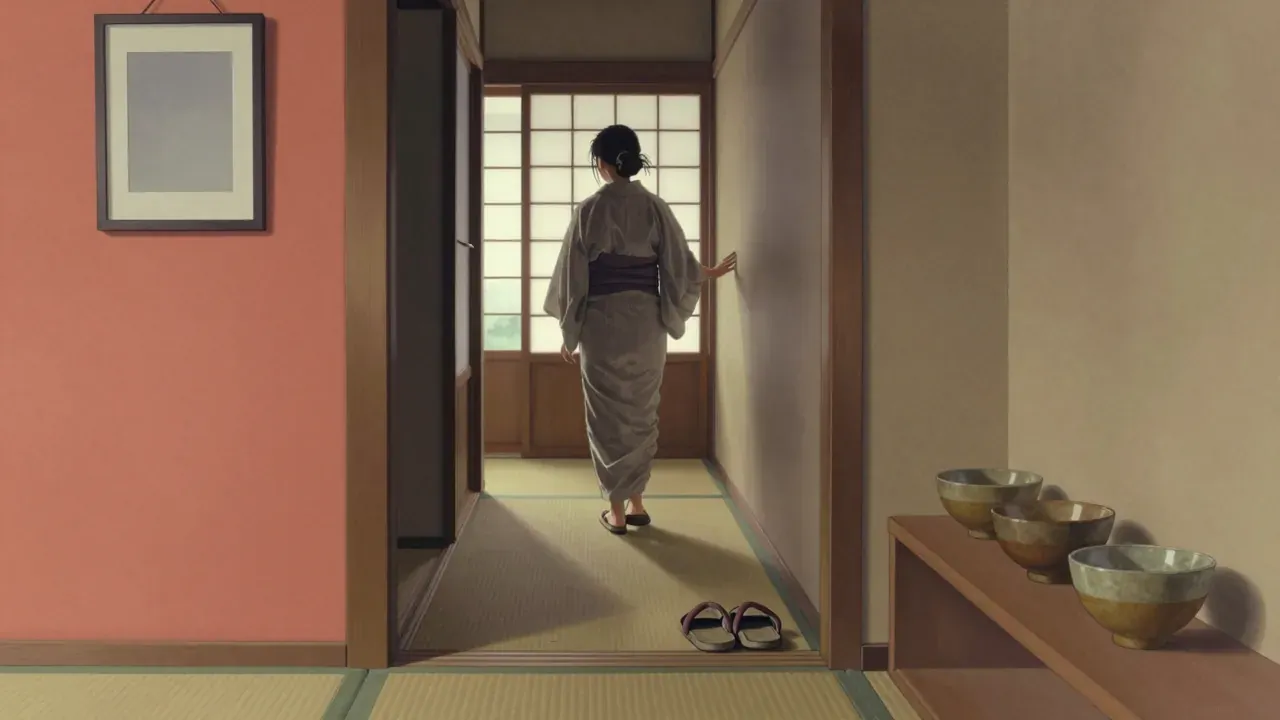
The story unfolds across twelve hours, anchored by meals, visits and small departures. Hiroshi Abe plays Ryota with contained weariness, his posture tightening at each paternal slight; Kirin Kiki’s Toshiko moves through the house like someone rehearsing a role she no longer believes in, her gestures precise, her silences thick. Yoshio Harada’s Kyohei carries authority like a stiff collar — never shouting, yet always imposing. Yutaka Yamazaki’s cinematography avoids flourish: interiors are lit as lived-in, not composed — windows diffuse daylight, lamps cast shallow pools, corridors remain dim. Koreeda edits with patience, letting scenes breathe past their apparent end, holding on faces after dialogue stops. Gontiti’s score is sparse, often absent, returning only in fragments — a piano motif half-remembered, then gone. There are no flashbacks, no voiceover exposition, no symbolic weather. Even the butterfly landing on Junpei’s photograph arrives without fanfare, and departs just as quietly. The craft serves duration, not emphasis. (158 words)
What stays in the room
What lands is the cumulative pressure of repetition — the way a phrase repeated across generations becomes both comfort and cage. Toshiko’s insistence on inviting Yoshio year after year, Kyohei’s offhand medical advice to Atsushi, Ryota’s habitual deference to his father’s silence: these are not plot points but habits, worn smooth by time. The film earns its emotional gravity not through revelation but recognition — the viewer sees themselves in the hesitation before a difficult question, the relief of a shared glance across a crowded table, the exhaustion of performing ‘family’ while grieving privately. The final voiceover — delivered without inflection, listing facts like inventory — lands with particular force because it refuses catharsis. It names what was promised and what was not kept, not as failure but as ordinary human drift. That honesty, sustained over 114 minutes without recourse to melodrama or irony, is what makes the film settle into memory rather than pass through it. (156 words)
Where the frame thins
What does not land is the film’s occasional reliance on narrative convenience to sustain its structure. Yoshio’s arrival feels less like inevitability and more like obligation — a device to externalise guilt rather than deepen it. His character remains underwritten, functioning primarily as a mirror for others’ resentment, not as a person with interiority. Chinami’s subplot about moving in with her parents resolves too neatly, her motivations flattened into dutifulness without the same granular attention given to Ryota’s professional insecurity or Toshiko’s private sorrow. A few supporting figures — the sushi deliverer, the neighbour taken to hospital — exist only to punctuate mood or advance thematic shorthand. These moments do not break the film, but they thin its texture. They are the places where Koreeda’s observational discipline gives way to schematic function, where behaviour serves theme rather than emerging from it. A viewer attuned to psychological nuance may find those passages hollow where the rest feels fully inhabited. (157 words)
What the rituals carry
The themes that matter are inheritance, not of property or title, but of tone, habit and silence. Still Walking treats grief not as an event but as infrastructure — something built into the floorboards, the meal schedule, the way a parent looks at a child’s hands. It examines how families assign meaning to absence: Junpei is remembered not for who he was, but for what his death permits — Toshiko’s lifelong mourning, Kyohei’s perpetual disappointment, Ryota’s quiet rebellion. Ageing appears not as decline but as recalibration: Kyohei’s helplessness during the neighbour’s emergency is not weakness but the collapse of a lifetime’s professional identity. Ritual matters not for its symbolism but for its repetition — the annual visit, the shared song, the grave-tending — all acts that assert continuity even as they conceal fracture. The film insists that love persists not despite contradiction, but within it: resentment and devotion coexist in the same glance, duty and distance share the same room. (159 words)
Who it meets
This film is for viewers who value duration over incident, who find resonance in glances held a beat too long, who accept that some questions go unanswered not from evasion but from exhaustion. It rewards attention to gesture, to rhythm, to the space between lines. It is not for those who require narrative propulsion, moral clarity or emotional payoff. A viewer expecting catharsis, confrontation or transformation will leave unsatisfied — the Yokoyamas do not reconcile, apologise or change course. Those who associate ‘drama’ with escalation may mistake its stillness for inertia. What would change this verdict? A tighter edit removing the peripheral characters, or deeper development of Yoshio’s perspective, might strengthen its coherence — but the film’s power lies precisely in its refusal to over-explain. Its restraint is not omission; it is selection. (159 words)
What it asks of you
Yes, it is worth your evening — provided you approach it as you would a long conversation with someone you know well but rarely see: without agenda, with patience, with willingness to sit in silence. It asks for nothing more than presence, and repays it with uncommon fidelity to how people actually live inside time. Those who watch films to be moved quickly or decisively may find it withholding; those who watch to feel seen in their own quiet accumulations of regret and routine will find it generous. It does not demand belief, only attention — and it sustains that attention by trusting the weight of small things: a teacup placed down, a door left ajar, a song remembered wrong. Its value is not in what it says, but in how faithfully it shows the shape of a life as it passes — unremarkable, unvarnished, unmistakably real. (158 words)