The sound of it
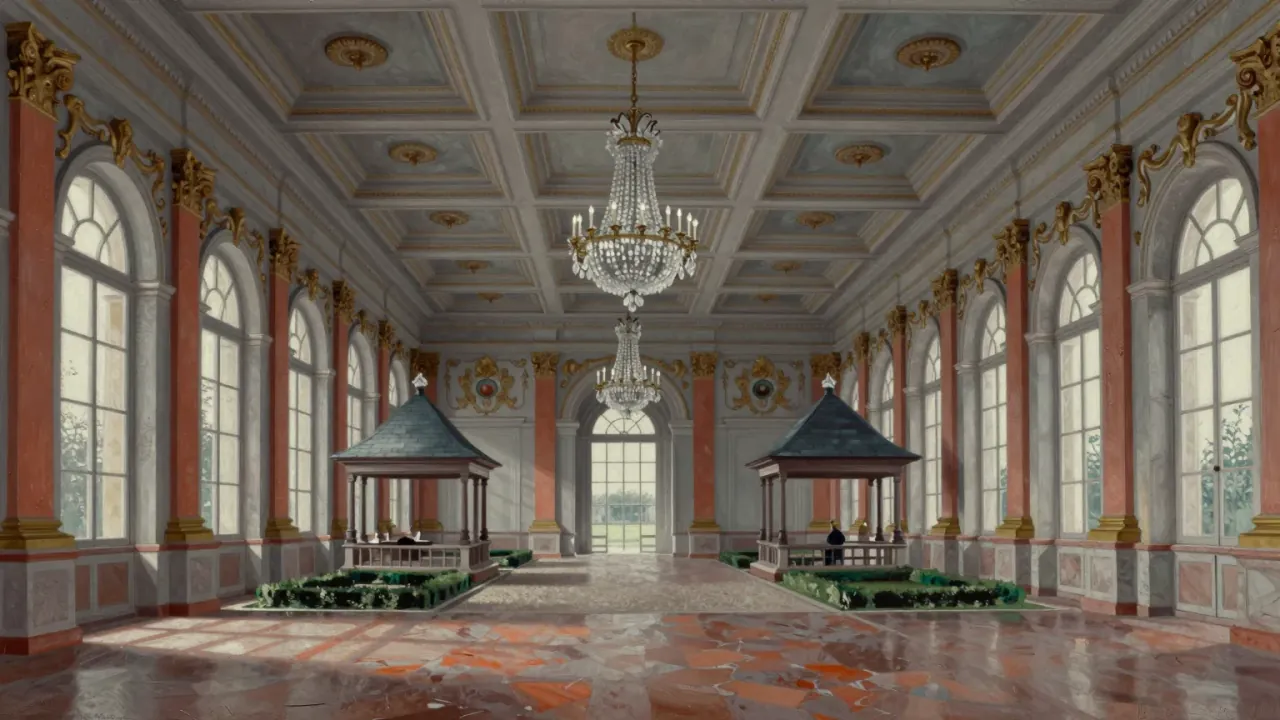
India Song is a film that refuses to be a film in the conventional sense: it is a spoken text performed over images, a drama of voice and absence rather than action or revelation. Marguerite Duras wrote it from an unproduced play commissioned by the Royal National Theatre, then directed it without ever visiting Calcutta — choosing instead to imagine the monsoon, the heat, the decay of empire from memory and invention. The setting is 1937 Calcutta, but the locations are the Château Rothschild, the Grand Trianon, and two soon-to-be-demolished Paris apartments — all deliberately chosen for their silence, their emptiness, their slow surrender to time. The film does not seek to depict India, nor even to evoke it; it uses India as a name, a resonance, a vessel for exhaustion, desire, and linguistic suspension. Its ambition is structural and philosophical: to separate sound from image, narrative from chronology, character from psychology. It asks the viewer to hold meaning in the space between what is said and what is shown — and to accept that the space may remain empty. (158 words)
The look of it
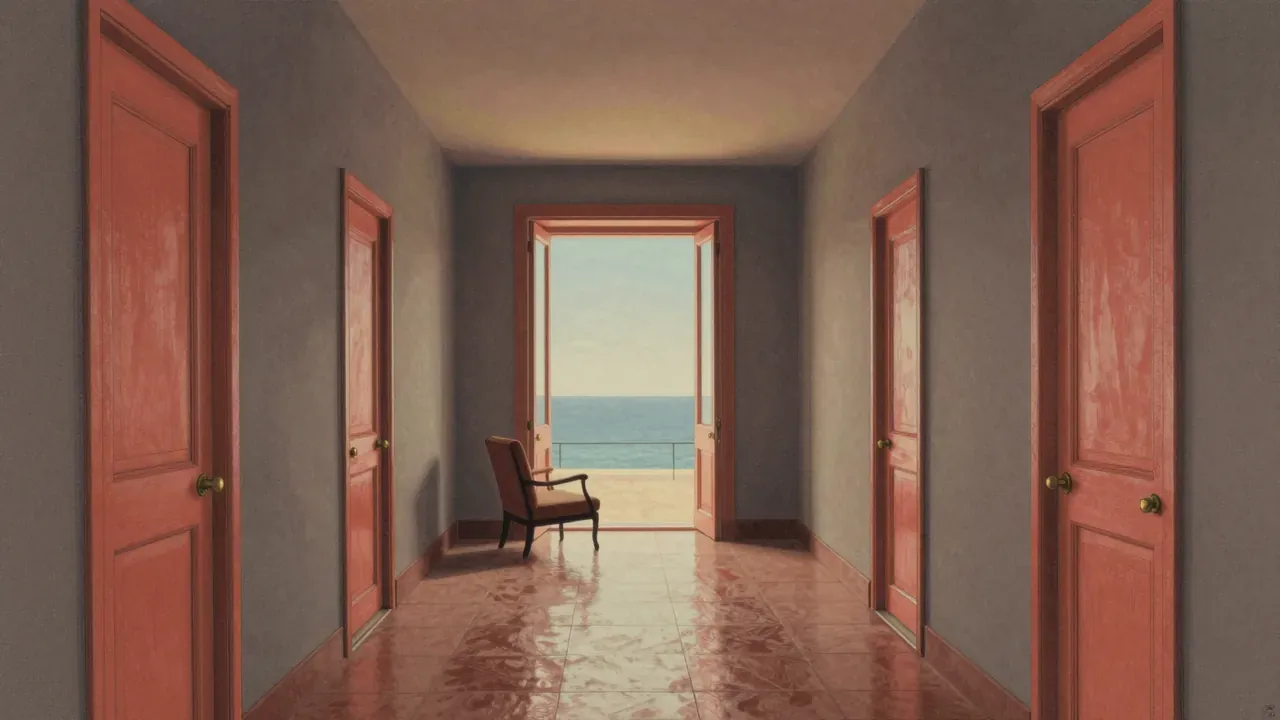
The story unfolds through layered voiceover, with Delphine Seyrig’s Anne-Marie Stretter speaking most lines — often describing actions she does not perform on screen, or events that occur off-camera. Bruno Nuytten’s cinematography keeps the interiors dim and shallow, the camera moving slowly across empty rooms, corridors, and staircases, rarely settling on faces for more than a few seconds. There are no close-ups of emotion, no reaction shots, no continuity editing — only long takes, static frames, and deliberate ellipses. The actors appear in costume but rarely speak live; their voices were pre-recorded, then laid over silent footage. Carlos d’Alessio’s score is sparse, atmospheric, often submerged beneath dialogue or ambient rain. Michael Lonsdale’s Vice-Consul never touches Anne-Marie; Mathieu Carrière’s German attaché speaks only once; Claude Mann’s Michael Richardson appears mostly as a silhouette. Performance here is anti-theatrical: presence without projection, gesture without consequence. The craft is unified in its refusal of emphasis — every decision serves the principle that what is withheld matters more than what is shown. (159 words)
The weight of it
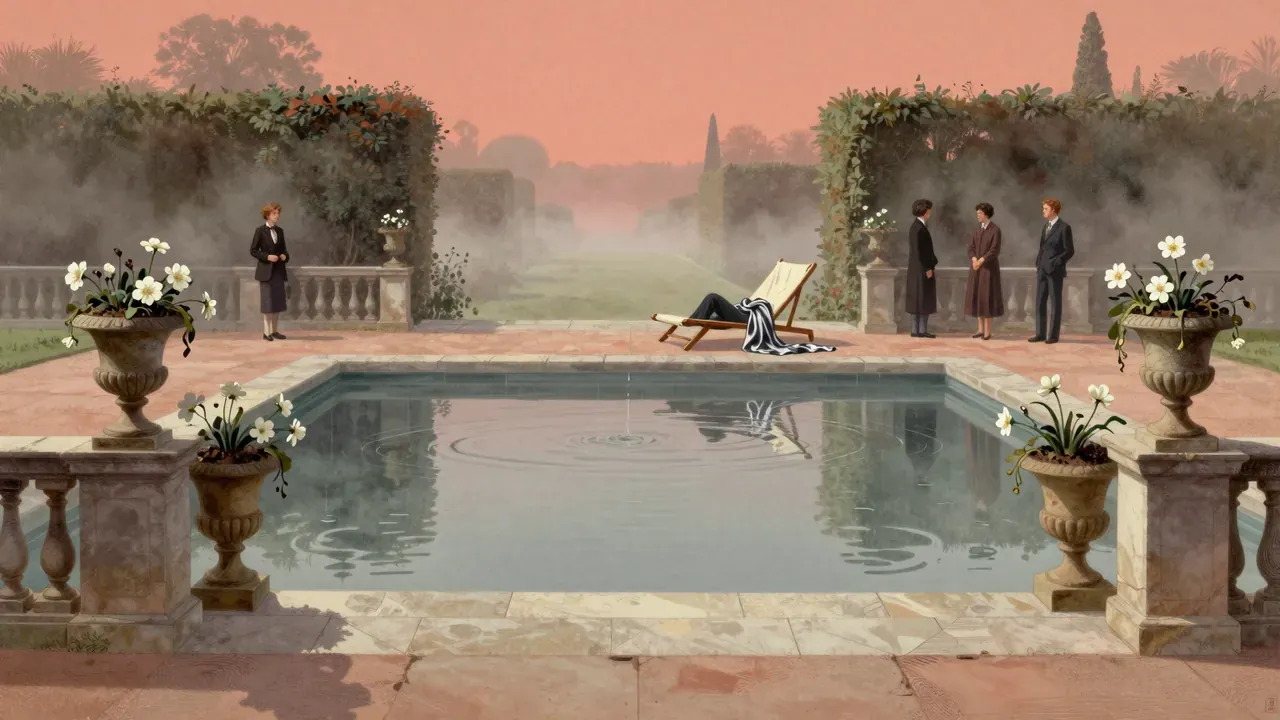
What lands is the weight of silence, the precision of tone, and the cumulative effect of repetition. Seyrig’s voice — measured, weary, detached — carries the film’s emotional gravity without ever straining for pathos. The monsoon is felt not in rain on skin but in the dampness of light, the condensation on windows filmed at dawn, the way sound lingers in empty halls. The film’s refusal to explain — why Anne-Marie abandons music, why the Vice-Consul shoots leprosy patients, why the young guest remains unnamed — becomes its strength: these absences are not omissions but architecture. The sequence at the delta islands works because it strips away exposition entirely; the group’s departure, Anne-Marie’s solitude, the coat left on the beach — all are presented as facts without commentary, leaving room for the viewer to inhabit the ambiguity. The film’s coherence lies not in plot logic but in rhythmic consistency: the cadence of the voiceover, the pacing of the edits, the recurrence of certain phrases like incantations. It sustains its own internal grammar for two hours, and that discipline is rare, rigorous, and persuasive. (159 words)
The gap in it
What does not land is any claim to psychological realism or historical texture. The film’s detachment from context — its refusal to show leprosy, colonial administration, Indian characters, or even the city beyond embassy walls — makes its political dimensions inert rather than provocative. The setting reads less as critique and more as aesthetic convenience: India is a backdrop, not a subject. Some viewers will find the lack of visual engagement alienating — the camera’s reluctance to settle, the refusal to grant even basic spatial orientation, the near-total absence of human interaction on screen. The pre-recorded voices occasionally slip out of sync with lip movement, not as error but as policy; yet this choice risks reading as indifference rather than intention. The film assumes a level of tolerance for abstraction that many will not share, and offers no bridge for those who need grounding in character or cause. Its austerity can feel less like rigour and more like exclusion — a closed system that admits only those already fluent in its syntax. Those expecting narrative momentum, emotional payoff, or social insight will leave unrewarded, and the film gives them no reason to stay. (159 words)
The air of it
The themes that matter are exhaustion, repetition, and the erosion of self under empire and marriage. Anne-Marie’s seventeen years across Asian capitals are not recounted as experience but as attrition — each posting a layer of silence added to her voice. Her Venetian childhood, her musical promise, her first marriage in Laos: all are cited like entries in a ledger, not memories. The monsoon is not weather but metaphor — a force that erases distinction, blurs boundaries, dissolves certainty. Colonialism appears not as policy or violence but as atmosphere: the stifling heat, the imported furniture in decaying châteaux, the diplomats who speak French about places they do not understand. Desire is rendered as inertia — the affair with Michael Richardson is less passion than shared resignation; their suicide pact is less despair than mutual recognition of futility. Language itself is unstable: names shift (Ana-Maria Guardi becomes Anne-Marie Stretter), roles blur (ambassador, vice-consul, attaché), pronouns drift. What endures is not identity but echo — the voice returning, altered, over the same image. The film treats time not as progression but as sediment: layers of speech, light, and silence accumulating without resolution. (159 words)
The audience for it
This film is for viewers who treat cinema as a medium of thought rather than storytelling — those accustomed to Beckett, early Godard, or late Resnais, and willing to sit with unresolved syntax. It rewards patience with density: repeated viewings yield new inflections in Seyrig’s delivery, new patterns in Nuytten’s framing, new resonances in d’Alessio’s score. It is not for those who rely on narrative scaffolding, emotional cues, or visual clarity — anyone needing to know who did what to whom, or why, will find it impenetrable. Those who value craft as service to story, not as autonomous structure, will reject its methods. A viewer who finds Tarkovsky slow or Rivette opaque may still find India Song intolerable; its resistance to interpretation is absolute. That resistance is not a flaw but a condition — and the verdict changes only if one accepts that condition as legitimate. Those who do not will not be persuaded by argument, only by time spent inside its logic. (159 words)
The time in it
It is worth your evening only if you arrive prepared to receive it as a composition in sound and rhythm, not as a drama of incident. Two hours pass slowly, deliberately, without concession — and that slowness is the point, not a problem to be solved. Its value lies in its singularity: few films so rigorously subordinate image to voice, or treat silence as material. It repays attention not with revelation but with recalibration — adjusting how one hears, how one watches, how one holds absence. Those who expect engagement through empathy or plot will find it arid; those open to engagement through pattern and pause will find it immersive. It is not a film to enjoy but to inhabit — and inhabiting it requires surrendering familiar terms of cinematic contract. Its success is inseparable from its difficulty; to wish it otherwise is to misunderstand its purpose. It is worth the evening for those who believe cinema can be poetry, not just prose — and who accept that poetry need not explain itself. (159 words)