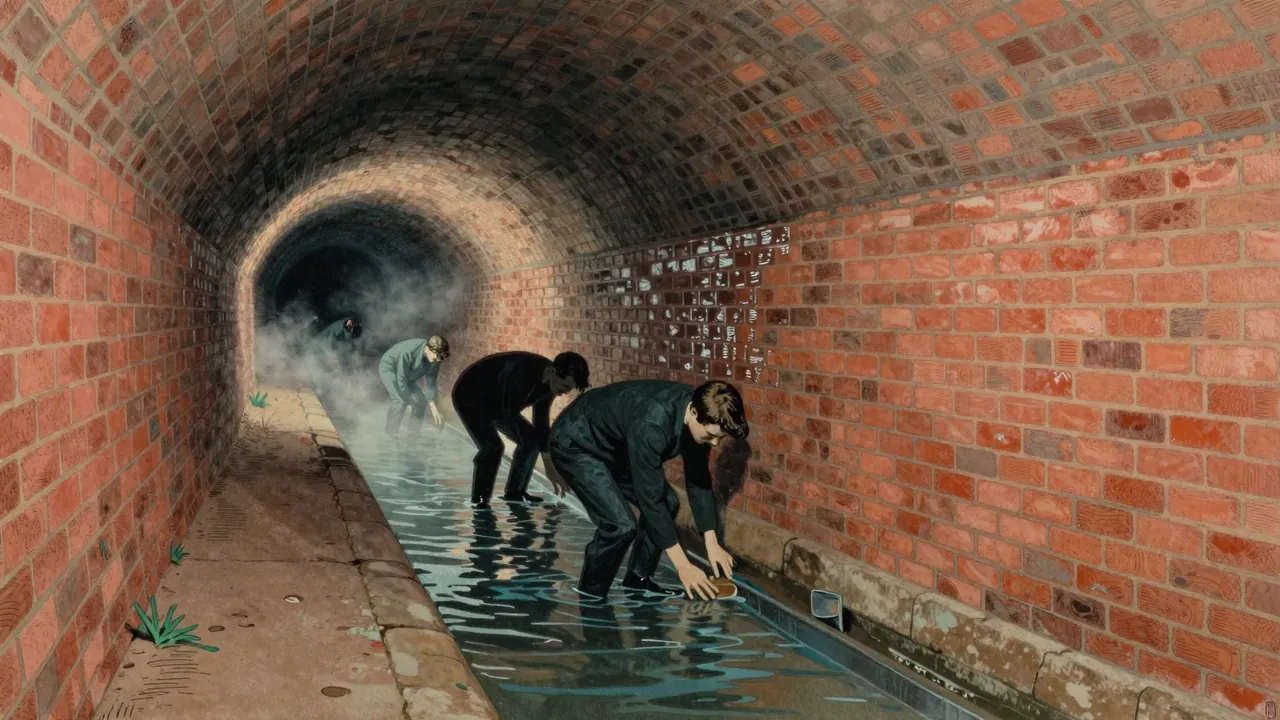
The descent
Canal is a Polish war drama set during the final days of the 1944 Warsaw Uprising, centred on a group of Home Army fighters and civilians retreating through the city’s sewer system. It does not seek to commemorate or mythologise the uprising, nor does it offer political justification for its outbreak or collapse. Instead, it attempts something narrower and more austere: to trace the physical and psychological dissolution of a unit under inescapable pressure, using the sewers as both literal route and structural metaphor. The film was adapted by Jerzy Stefan Stawiński — a participant in the actual retreat — from his own short story, and directed by Andrzej Wajda at a moment when official narratives of resistance were still tightly controlled. Its ambition is not explanatory but experiential: to convey the narrowing of options, the erosion of command, the weight of exhaustion, and the quiet collapse of dignity without recourse to heroics or redemption. It treats the uprising not as a chapter in national legend but as a sequence of diminishing choices, ending where it began — in darkness, with no exit.
The look of it
The film works through accumulation rather than emphasis: long takes in cramped, low-lit spaces; performances that avoid theatricality in favour of fatigue and withdrawal; and a sound design that privileges muffled footsteps, distant gunfire, and the constant drip of water over dialogue. Jerzy Lipman’s cinematography keeps the frame tight and the light low, often obscuring faces or reducing figures to silhouettes against murky walls. Jan Krenz’s score is sparse, used only at key junctures — a single piano motif recurs like a failing pulse. The cast deliver restrained, unvarnished work: Tadeusz Janczar as Korab conveys physical collapse without melodrama; Wieńczysław Gliński’s Zadra grows increasingly hollow-eyed, his authority fraying into silence; Emil Karewicz’s Mądry retains a brittle civility until it snaps. There are no close-ups to signal emotional climax — just sustained medium shots that hold characters as they falter, hesitate, or stop speaking altogether. The editing avoids rhythm or relief, letting scenes run until breath runs out. This is not realism as fidelity to fact, but realism as refusal of narrative comfort.
What holds still
What lands is the sheer physicality of descent — the grime, the stench implied by shadow and sound, the way light fails not once but repeatedly, each time more definitively. The film’s most enduring moments are those where action stops: Korab leaning against a wall while Stokrotka tries to steady him; Halinka switching off her torch before shooting herself; Smukły disarming two grenades before the third kills him. These are not dramatic beats but attritional ones — small failures that compound. The film also lands its moral ambiguity: no character is clearly right or wrong, only varying degrees of compromised will. Zadra’s orders are pragmatic until they are not; Kula lies not out of malice but to preserve a last illusion of cohesion; even the German soldiers are heard but rarely seen, their presence registered as vibration or silhouette. The absence of exposition — no maps, no strategy meetings, no flashbacks — forces attention onto what remains: bodies moving, stopping, falling. That restraint makes the final image — Zadra turning back into the dark — land with the weight of inevitability, not tragedy.
What slips away
What does not land is the attempt to suggest broader historical critique through visual shorthand. A brief shot of a crumbling statue in the ruins, or the recurring motif of the ocarina played by the composer Michał, gestures toward cultural loss and romantic futility, but these elements remain isolated rather than integrated. The film’s thematic weight rests on its central descent, and when it lifts its gaze — even briefly — to allegory or symbolism, the effect feels imposed rather than earned. Similarly, the framing device — a voiceover stating that these are the last hours of the characters’ lives — risks flattening individuality into foregone conclusion, though it does succeed in establishing tone. The film also struggles with its ensemble: some characters vanish without trace (Gustaw, Lindorfówna’s civilian) not because the narrative demands it, but because the script has no room for them once the group fragments. This isn’t carelessness — it mirrors the real disintegration — but it leaves certain arcs unresolved in ways that feel structural rather than expressive. The film’s rigour becomes its limit: it refuses to explain, and sometimes that refusal reads as omission.
The shape of courage
The themes that matter are endurance without purpose, leadership without authority, and heroism stripped of recognition. Canal interrogates the idea of ‘Polish heroism’ not by rejecting it, but by showing how it dissolves under sustained pressure — not in cowardice, but in exhaustion, miscommunication, and the simple failure of the body to obey the will. It treats romantic sacrifice not as noble but as biologically unsustainable: the sewers are not a stage for martyrdom but a digestive tract for the uprising itself. The film also explores the collapse of hierarchy: Zadra’s rank means nothing underground; Korab’s injury renders his experience irrelevant to those who must keep moving; Mądry’s intellect offers no purchase in the dark. What persists is not ideology or loyalty, but fleeting human contact — a kiss in the last light, a lie told to spare someone’s despair, a shared silence before the end. These are not affirmations of solidarity, but evidence of its fragility. The film’s political edge lies not in condemning the uprising, but in refusing to let it be remembered as anything other than what it was: a series of decisions made in narrowing corridors, with no audience and no afterlife.
Who walks with it
This film is for viewers who accept that war films need not depict combat to convey its cost, and who value formal discipline over exposition or catharsis. It suits those accustomed to arthouse pacing, comfortable with ambiguity, and willing to sit with discomfort without resolution. It is not for viewers seeking narrative clarity, moral certainty, or historical context — there are no dates, no maps, no explanations of the Home Army’s chain of command or Soviet non-intervention. Those who require character backstories, emotional payoff, or even consistent screen time for named performers will find it withholding. Some historians may object to its narrow focus — it omits the civilian population outside the sewers, the role of women beyond Halinka and Stokrotka, and any engagement with post-war memory politics. But its limitation is deliberate: it is not a survey, but a section cut. Anyone expecting a tribute, a polemic, or a thriller will misread its intent. Its audience is not the general public, but those who understand that a film can be historically grounded without being didactic.
Why it stays
Yes, it is worth your evening — provided you watch it as a sustained act of attention, not passive consumption. Its ninety-five minutes demand presence: the camera does not guide the eye, the sound does not cue emotion, the plot does not reward patience with revelation. It repays close viewing precisely because it offers so little in return — no uplift, no irony, no stylistic flourish to cushion the descent. That austerity is its strength. Those who dismiss it as unrelentingly bleak miss how precisely it calibrates despair: it never shouts, never lingers unnecessarily, never mistakes suffering for significance. Its power lies in what it refuses — explanation, judgement, even closure. To call it ‘difficult’ is accurate but insufficient; it is difficult in the way breathing becomes difficult underwater. You emerge not enlightened, but altered — aware of how easily coherence unravels, how quickly light fades, and how quietly a story ends when no one is left to tell it. That is not nihilism. It is precision.