The shape of time
Cléo from 5 to 7 is a real-time portrait of a woman waiting for a medical diagnosis — not as clinical suspense, but as an embodied, sensory, socially textured passage through Paris on the longest day of the year. Agnès Varda structures the film precisely: 90 minutes covering 90 minutes, from 5 p.m. to 6:30 p.m., with the biopsy result deferred until the final frames. It does not aim to dramatise illness so much as to suspend narrative causality in favour of attention — to how light falls on pavement, how a hat feels too heavy in summer, how a stranger’s voice can recalibrate fear. The film treats time not as plot engine but as material: measured in bus arrivals, café orders, radio static, and the slow shift of shadow across Montsouris. Its ambition is structural and philosophical — to hold space for dread without resolving it, then let resolution arrive quietly, without fanfare or score swell. It is a film about being present while wishing you were elsewhere, and about how presence itself becomes possible only when someone else looks at you as if you are already whole. (158 words)
The body in frame
The story moves by accumulation, not incident: Cléo walks, listens, watches, tries on clothes, hears news bulletins, sits beside a waterfall. Corinne Marchand carries every frame with unforced physicality — her posture shifts with each encounter, her breathing audible in silence, her gaze often held just off-centre, as if resisting the camera’s claim on her. Jean Rabier and Alain Levent shoot in natural light, favouring shallow depth and soft focus that blur background detail without obscuring social texture — shopfronts, street signs, passing cars all legible but never dominant. Michel Legrand’s score is sparse, often absent; when present, it underscores mood rather than action. Janine Verneau’s editing avoids cuts that signal transition — many scenes end not with a cut but with Cléo walking out of frame, the next location arriving via sound or ambient shift. The supporting cast — Dorothée Blanck, Antoine Bourseiller, Sami Frey — behave like people who exist beyond the frame, their dialogue unpolished, their reactions delayed or incomplete. There is no exposition; backstory arrives in fragments — a line about José’s schedule, a glance at a record sleeve, a song title whispered twice. (159 words)
The look of it
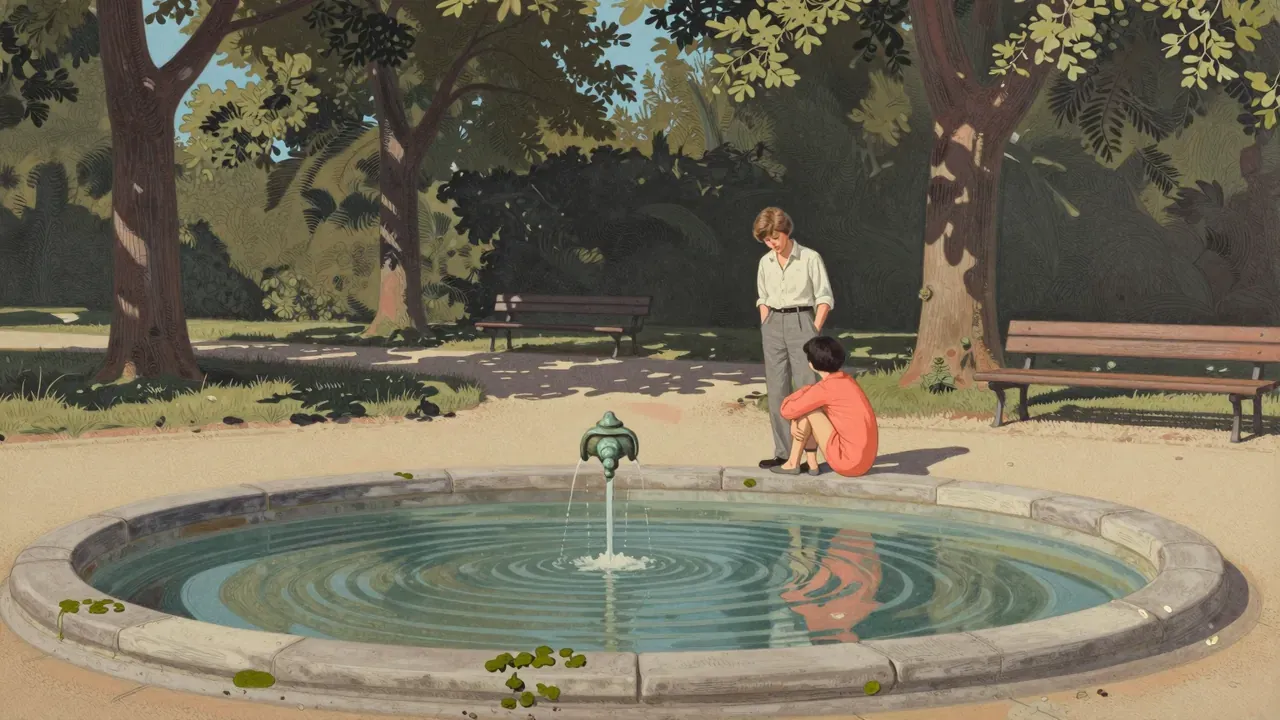
What lands is the weight of ordinary time made visible: the way a hot water bottle presses into Cléo’s abdomen, the grain of a black fur hat under summer light, the sudden quiet when a jukebox stops playing her own voice. The film trusts duration — a full minute watching Cléo walk past mirrored shop windows, another watching her stare at rain-smeared glass — and that trust pays off in accumulated emotional precision. The Parc Montsouris sequence works because it refuses to stylise stillness: the fountain’s spray, the rustle of leaves, Antoine’s hesitant questions — all feel unscripted in rhythm, even though they are tightly composed. The hospital garden scene lands not for its revelation but for its restraint: the doctor’s casual delivery, Cléo’s lack of tears, the absence of music. Even the silent short film within the film functions not as metaphor but as counterpoint — its slapstick absurdity doesn’t explain Cléo’s fear, but makes space for it by contrast. The film’s most persuasive moments are those where nothing changes externally, yet something inside Cléo loosens — a breath held too long finally released. That subtlety is earned, not assumed. (157 words)
The weight of small things
What does not land is the framing device of the tarot reading: its portentousness feels imported rather than organic, and the fortune teller’s ambiguity reads less as mysticism and more as narrative scaffolding the film otherwise dispenses with. The early scenes with José and Bob the composer occasionally slip into archness — their attempts at levity land flat because the film has already established Cléo’s interior gravity as non-negotiable, making their performative cheer seem tonally misjudged rather than character-revealing. The Algerian War radio reports, though historically grounded, remain at surface level — heard but not interrogated, a backdrop rather than a pressure point. Likewise, the cameo appearances by New Wave figures in the cinema short feel like insider acknowledgements rather than functional elements; they add texture but no thematic heft. The film’s refusal to dramatise Cléo’s professional life — her singing, her recordings, her status — also leaves a slight gap: we see her as object of gaze (in the studio, on the radio) but rarely as agent of craft. That omission isn’t fatal, but it means the film’s portrait of artistic identity remains partial. (158 words)
The fear beneath the surface
The themes that matter are mortality as perception, not prognosis; time as lived duration, not plotted progression; and selfhood as relational, not fixed. Cléo’s fear is not of death per se, but of vanishing — of being reduced to a diagnosis, a patient number, a voice on a radio no one hears. Her name ‘Cléo Victoire’ is a stage alias; Florence emerges only late, spoken aloud to Antoine, as if naming herself requires a witness who does not already know her as spectacle. The film treats illness not as biological fact but as social condition: how others respond to her anxiety reveals more about them than about her — José’s dismissal, Angèle’s helplessness, Bob’s forced jollity. The repeated motifs — mirrors, reflections, black clothing, the colour green in the park — do not symbolise but accumulate associative weight: reflection as both distortion and possibility, black as mourning and assertion, green as life that persists regardless of human drama. The Algerian War broadcasts sit alongside these not as parallel narrative but as reminder: individual dread coexists with collective violence, neither cancelling nor explaining the other. (159 words)
Who it is for
This film is for viewers who value attention over explanation, who find tension in stillness and resonance in restraint. It rewards patience, comfort with ambiguity, and willingness to sit with unease without demanding catharsis. It is not for those who require clear cause-and-effect storytelling, strong external conflict, or emotional signposting — viewers expecting a medical thriller or a romance will find its pacing opaque, its stakes diffuse. Those who dislike films where little ‘happens’ in conventional terms may mistake its slowness for emptiness. A viewer who values psychological realism over plot mechanics, or who responds to visual and sonic texture as meaning-making tools, will find it rich. Someone who finds existential uncertainty intolerable — or who expects female protagonists to be either triumphant or broken — will likely resist its quiet insistence on complexity. The film assumes its audience can hold multiple truths: that Cléo is terrified and also capable of laughter, that she is vulnerable and also sovereign, that relief arrives not with a bang but with a shared glance. That assumption is its invitation — and its boundary. (159 words)
What stays
Yes, it is worth your evening — not as diversion, but as recalibration. It asks ninety minutes of your attention and returns them sharpened: you notice how light changes on a wall, how silence holds different weights in different rooms, how a conversation can pivot on a single word spoken softly. Its value lies in what it refuses: exposition, exposition, exposition; dramatic irony, musical cueing, narrative payoff. It is worth watching because it models a way of looking — at others, at oneself, at time — that feels ethically attentive rather than extractive. Some will call it slight; others, especially those accustomed to faster rhythms or clearer stakes, may find it withholding. But its power is cumulative and cumulative only if met on its terms: as an act of sustained observation, not consumption. To dismiss it as ‘slow’ is to miss that its slowness is its argument — that presence, not progress, is the ground of being. That argument remains urgent, and undimmed by sixty years. (159 words)