The setting and silence
Japanese Girls at the Harbor is a 1933 Japanese silent drama, adapted from Toma Kitabayashi’s novel, that traces the moral and emotional fallout of jealousy, racial ambiguity, and social exclusion among mixed-race teenagers in interwar Yokohama. It does not aim for realism in the documentary sense, nor does it seek to flatter its audience with resolution or redemption; rather, it holds steady on Sunako’s quiet disintegration and slow reassembly—not as recovery, but as withdrawal. The film treats Catholic schooling, colonial-era port life, and the precarious status of Eurasian identity as ambient conditions, not backdrops. Its ambition lies in compressing years of consequence into seventy-two minutes without voice, relying instead on intertitles, gesture, and composition to register shifts in conscience and circumstance. It is not a sociological survey, nor a polemic: it observes, with restraint, how shame settles into posture, how forgiveness is withheld not by God but by time and habit. It asks what remains when repentance is neither offered nor accepted—only endured.
The shape of time
The story unfolds in two distinct temporal blocks, separated by intertitles marking elapsed years—a structural choice that avoids exposition in favour of implication. Michiko Oikawa’s performance as Sunako anchors the film: her stillness after the shooting, the slight tremor in her hands while pouring drinks, the way she turns away from mirrors—all are calibrated without theatricality. Hiroshi Shimizu directs with lateral patience: scenes often begin mid-gesture, end before closure, and privilege peripheral figures—Dora adjusting her collar, Miura sketching a passer-by—over central action. The cinematography (uncredited in the fact sheet, so unnamed here) favours shallow depth and off-centre framing, particularly in interior spaces like the church prayer room or the bar where Sunako works. Intertitles are sparse and functional, never explanatory; they name states (“God hasn’t forgiven”) rather than motives. Editing is rhythmic but unemphatic, allowing silence to accumulate weight. There are no musical cues—no score is listed—so rhythm emerges from footsteps on wooden floors, the clink of glasses, the rustle of school uniforms against pews.
The weight of consequence
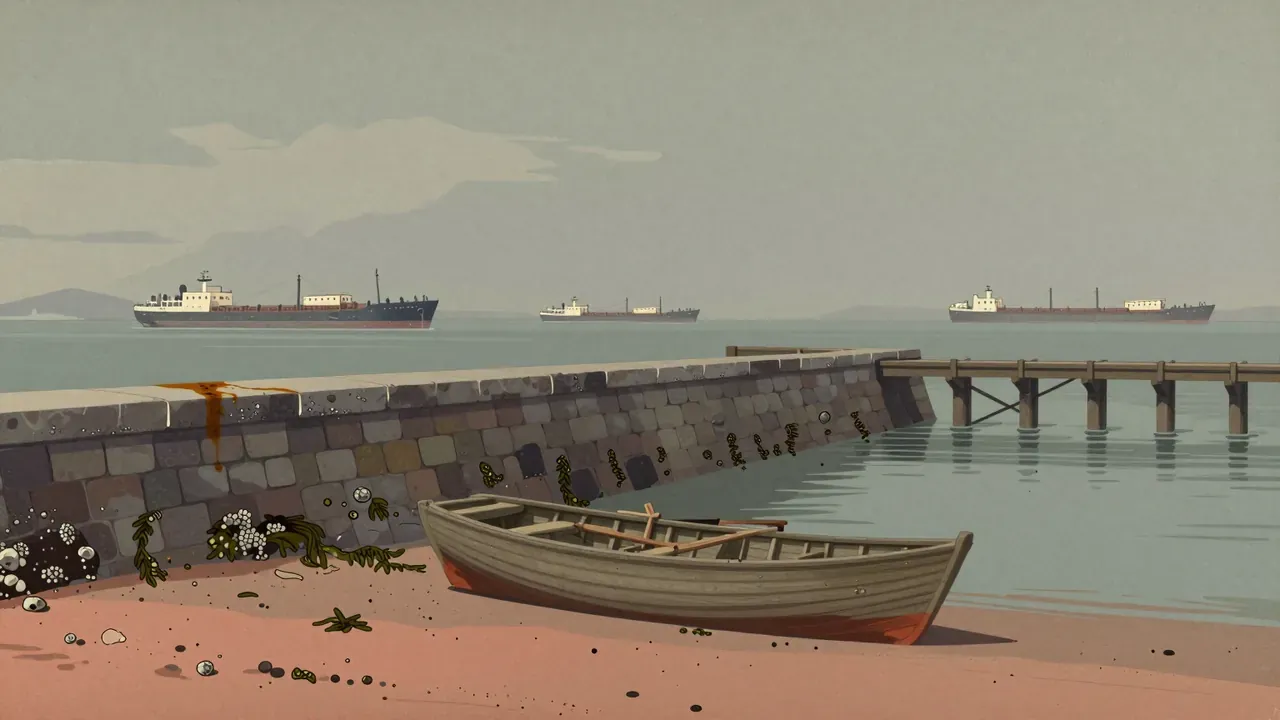
What lands is the film’s refusal to moralise Sunako’s choices. Her shooting of Yoko is neither sensationalised nor excused; it appears as an abrupt, almost mechanical act, followed not by panic but by numb retreat. Later, her decision to step aside for Dora feels less like virtue than exhaustion—her agency narrowed to withdrawal, not sacrifice. The visual grammar supports this: repeated shots of harbour water, seen through windows or from decks, suggest both escape and stasis—movement without direction. Shimizu’s use of architecture matters: Catholic school corridors echo with institutional authority, while the painter’s cramped studio offers no privacy, only shared air and mutual observation. The final departure by ship carries no uplift; the frame lingers on Sunako’s face, unreadable, as the vessel pulls away—not toward hope, but away from repetition. These effects do not depend on novelty or technique, but on consistency of tone and fidelity to consequence. The film trusts its audience to sit with discomfort without explanation, and that trust is repaid.
Where the structure thins
What does not land is the underwritten presence of Henry. Ureo Egawa plays him as charmingly vacant, but the script gives him no interiority beyond his function as catalyst—his shift from Sunako to Yoko to Dora reads as plot necessity, not psychology. Similarly, Yoko’s survival and later illness feel narratively convenient rather than earned; her reappearance lacks the weight of Sunako’s earlier trauma, and her death arrives without resonance beyond its utility in clearing space for Sunako’s departure. The intertitles occasionally strain under their own solemnity—phrases like “God hasn’t forgiven” risk flattening ambiguity into dogma, especially when the film otherwise avoids theological commentary. Some transitions between time periods rely too heavily on title cards alone, leaving character development feeling elliptical rather than economical. And while the film’s silence is a formal strength, it also limits access: viewers unfamiliar with Japanese silent conventions may misread pacing as hesitation, or stillness as vacancy, rather than as deliberate withholding.
The air they breathe
The themes that matter are not those of sin and salvation, but of duration and displacement—how long shame lasts, how far one must go to outrun it, and whether reinvention requires geography or merely silence. Racial hybridity is present not as theme but as condition: Sunako and Dora attend a Catholic school not as converts but as pupils whose names mark them as outsiders in both Japanese and foreign communities. Their mixed heritage is never discussed aloud, yet shapes every social transaction—their exclusion from certain circles, the assumptions made about their morality, the ease with which Henry discards them. The film treats adolescence not as a phase but as a permanent fracture: Sunako never becomes an adult in the conventional sense; she becomes someone who remembers being young, and lives accordingly. Responsibility is reframed not as duty but as cessation—Henry’s ‘becoming a responsible father’ means staying put, not acting. And faith is ambient, not doctrinal: crucifixes appear in frames, prayers are overheard, but belief is never interrogated—only its absence, its silence, its architectural persistence.
Who walks with it
This film is for viewers who value precision over exposition, who find emotional weight in withheld glances and unspoken consequences, and who accept silence as a narrative medium rather than a deficit. It rewards attention to texture—the grain of film stock, the drape of a school blazer, the way light falls across a harbour wall—and tolerates no impatience with ambiguity. It is not for those who require psychological cause-and-effect, clear moral signposting, or narrative propulsion. Viewers expecting the expressive clarity of sound-era Japanese cinema—or the stylistic flamboyance some historians attribute to it—may find Shimizu’s approach too muted, too resistant to emphasis. Those who associate silent film with broad pantomime will likely misread its restraint as emptiness. A change in verdict would follow either a fuller restoration (the existing print’s quality affects legibility of intertitles and facial nuance) or a bilingual intertitle translation that preserves their terseness—currently, many English versions soften their austerity, diluting their impact.
The length of its breath
Yes, it is worth your evening—if you are prepared to meet it on its own terms: seventy-two minutes of sustained, unsentimental attention to consequence without catharsis. It demands no prior knowledge of Japanese cinema, but it does ask that you relinquish expectations of resolution, of character arcs, of music cueing emotion. Its power resides in accumulation: small gestures accrue meaning across years, and the final image—a ship receding, not arriving—lands because everything preceding it has refused easy answers. Those who dislike films that withhold explanation, or who need emotional release at the close, will leave dissatisfied. But for viewers who find gravity in restraint, who understand that silence can hold more tension than dialogue, and who accept that some wounds do not scar but simply become the shape of the body—this film offers something rare: a portrait of endurance without heroism, and departure without promise. It earns its duration by never wasting a second of it.