The weight of duty
The Crucified Lovers is a 1954 Japanese drama adapted from Chikamatsu Monogatari, a 1715 bunraku play. It sets out to trace the slow collapse of rigid moral certainty under the pressure of lived contradiction — not through polemic, but through the quiet accumulation of duty, desire and deception in Edo-period Kyoto. Mizoguchi does not frame the story as tragedy in the Western sense, nor as cautionary fable; he treats it as social anatomy, mapping how law, class, gender and economic dependency constrain choice until only gesture remains. The film avoids psychological exposition: motivation is inferred from posture, silence, spatial placement and the weight of a glance. Its ambition is structural rather than expressive — to show how institutions produce subjects who internalise their own punishment. It works within the conventions of jidaigeki but subverts them by refusing heroic resolution or redemptive suffering. There are no villains with motive, only systems with logic — and characters who move within that logic until it breaks them, or they break free of it just long enough to be punished for the attempt.
The look of it
The story unfolds in measured, unbroken sequences, often shot in deep focus across layered interiors or along narrow streets, with Kazuo Miyagawa’s camera gliding at shoulder height, never rushing, never isolating. Kazuo Hasegawa plays Mohei with minimal inflection: his face tightens, his shoulders drop, his hands remain still — a performance built on withheld reaction. Kyōko Kagawa’s Osan moves with increasing physical autonomy, her posture shifting from bowed deference to upright stillness, then to deliberate motion in flight. Eitarō Shindō’s Ishun is not flamboyant but quietly transactional — every line delivered as if pricing rice. Yoshikata Yoda’s script gives no soliloquies; conflict emerges from misheard instructions, delayed replies, and the space between what is said and what is obeyed. Fumio Hayasaka’s score uses sparse shamisen and low koto tones, entering only when dialogue stops — not to underscore emotion but to mark silence as territory. The editing avoids cuts within scenes; transitions occur at doorways, across thresholds, or in the pause before a bow.
What stays with you
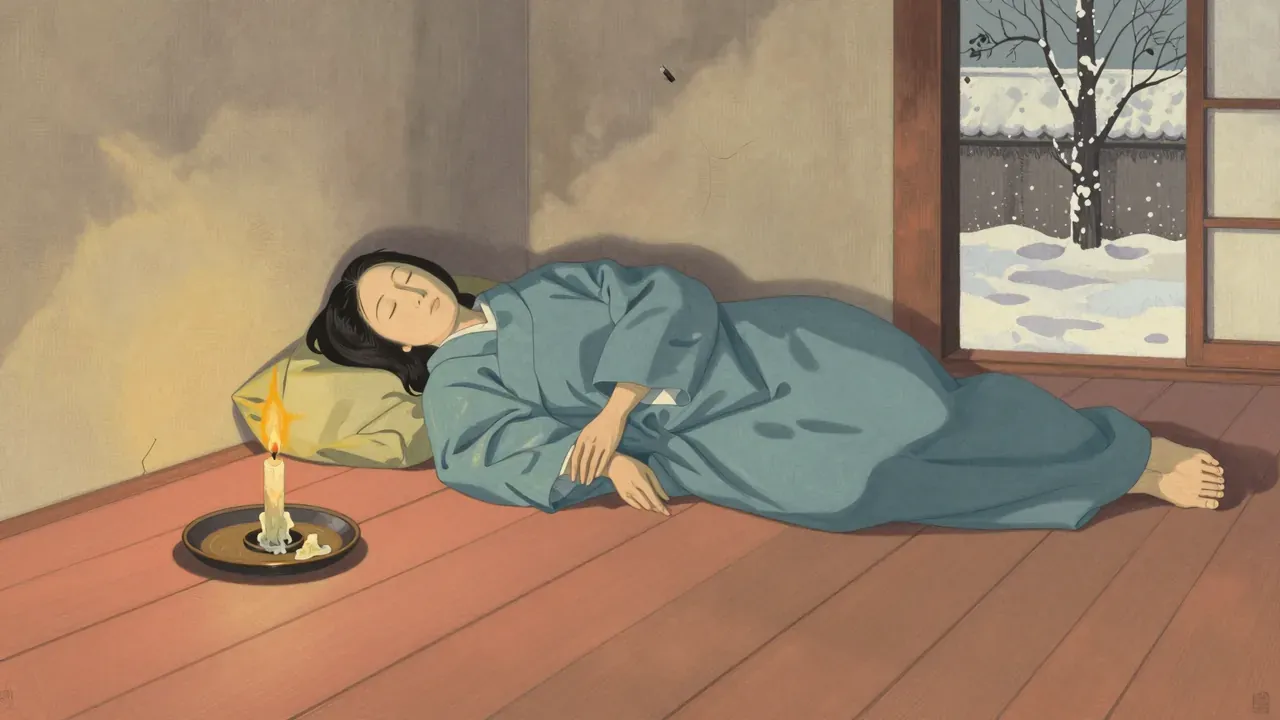
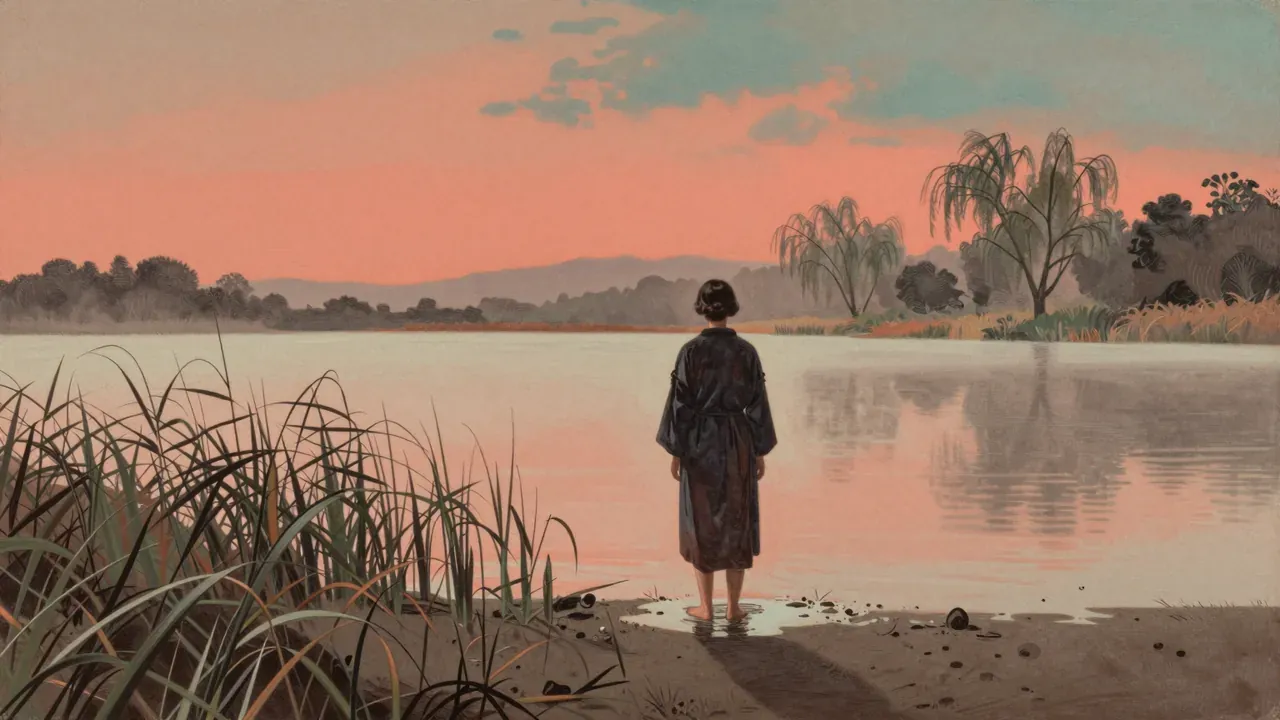
What lands most firmly is the film’s refusal to sentimentalise love or martyrdom. Mohei and Osan do not kiss in moonlight or declare vows — their bond is confirmed in shared exhaustion, in the way they fold a single blanket between them while hiding, in the hesitation before a hand reaches out not for comfort but for balance. The crucifixion parade is not framed as horror but as civic theatre: the crowd watches without comment, the lovers walk upright, and a bystander’s remark — that Osan looks happier than ever — lands not as irony but as quiet, devastating fact. The film’s visual grammar reinforces this: long takes hold both characters and background architecture in equal focus, so that a lover’s glance carries the same weight as the lattice screen behind it. Even the lake where they fake their deaths is shot without romantic haze — its surface flat, grey, indifferent. This restraint makes the emotional register credible: not because we feel what they feel, but because we see how little room they have left to feel anything else.
Where the frame slips
What does not land is the early exposition around Otama’s lie and Mohei’s refusal to collude. The moral pivot — that Mohei would rather endure false accusation than violate hierarchical protocol — arrives without sufficient grounding in his prior conduct or inner life. His loyalty feels procedural rather than earned, and the script gives him no moment of private doubt before he rejects Otama’s ruse. Similarly, Ishun’s hypocrisy lacks texture: he is consistently tightfisted and coercive, but never shown to believe his own rhetoric, which flattens his function from antagonist to obstacle. The subplot involving Isan’s conspiracy also sits uneasily — introduced late, resolved abruptly, and serving narrative convenience more than thematic necessity. These passages rely on audience familiarity with bunraku conventions or Edo-period legal codes, and without that context, they read as functional rather than felt. The film assumes knowledge it does not supply, and does not compensate with visual or rhythmic emphasis.
The ground it stands on
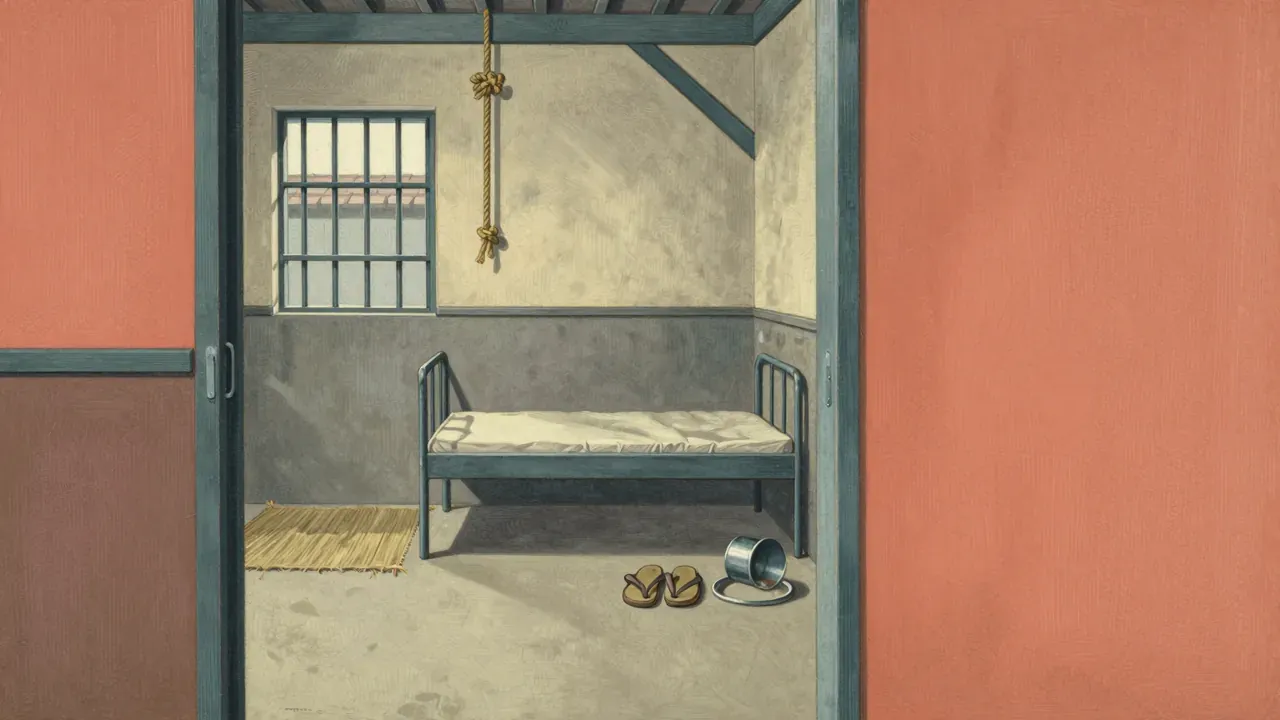
The themes that matter are not love versus duty, but the material conditions under which duty becomes self-annihilation. The film treats money not as symbol but as infrastructure: Ishun’s wealth allows him to withhold wages, control housing, dictate marriage, and silence dissent through collective punishment. Loyalty is priced, fidelity is policed, and honour is outsourced to the state’s scaffold. Gender is not abstracted into ‘oppression’ but rendered in daily mechanics — Osan’s mother arranges her marriage for capital; Otama’s body is treated as Ishun’s inventory; Mohei’s masculinity is defined by his capacity to absorb shame without protest. Class is visible in floor levels: servants sleep on tatami laid directly on packed earth, while masters rest on raised platforms; the camera lingers on the gap between them. Religion appears only in ritual form — incense, sutras, crucifixion — never doctrine. What endures is not belief, but the architecture of consequence: every action reverberates through kinship, debt and reputation, with no exit except disappearance — or death.
Who it is for
This film is for viewers who value precision over propulsion, who find tension in stillness and meaning in duration. It rewards attention to composition, pacing and the weight of silence — not as mood but as argument. It is not for those who require narrative momentum, psychological exposition or moral clarity. Some will find its pace inert, its characters opaque, its ending unresolved — and those objections are valid, not mistaken. A viewer expecting catharsis or character arcs will leave unsatisfied, because the film refuses both. Its structure is cyclical, not linear: the lovers flee, hide, are captured, paraded, and crucified — but the system that produced them remains intact. That is the point, not a flaw. Someone who values emotional immediacy or plot-driven stakes should look elsewhere. Nothing in the film changes that verdict — not restoration, not reputation, not critical acclaim. It asks for patience as a condition of understanding, not as a virtue.
Why it holds
Yes, it is worth your evening — provided you watch it as a study in constraint, not as entertainment. Its 102 minutes pass without hurry, but never waste time: each shot advances the logic of its world. You will not laugh, gasp or weep, but you may notice how often characters stand just outside doorways, half-in and half-out of rooms — a visual motif repeated seven times, always with different consequences. The film’s power lies in its consistency: no scene contradicts its premises, no performance betrays its social logic, no cut undermines its spatial grammar. It is not ‘accessible’ in the usual sense, but it is legible — if you accept its terms. Those terms are not negotiable: it will not speed up, explain itself or soften its gaze. If you meet it on those grounds, it repays attention with rigour. If you do not, no amount of prestige or restoration will alter that fact.