What the film is
The Circus is a silent comedy feature written, directed, produced, and starring Charlie Chaplin, released in January 1928. It attempts to sustain the Little Tramp’s comic persona within a tightly structured narrative framework — one that balances slapstick set-pieces with romantic subplotting and thematic self-reflection. Unlike The Gold Rush, which leaned heavily on pathos and visual poetry, this film narrows its focus to the mechanics of performance: how humour arises from failure, how stardom emerges from accident, and how an outsider becomes indispensable by being perpetually out of control. Chaplin builds the circus not as backdrop but as microcosm — a precarious, hierarchical world where dignity is negotiated through timing, visibility, and pay. The film does not seek realism, nor does it aim for satire of circus life; rather, it uses the circus as a stage on which to rehearse questions about authorship, labour, and obsolescence. Its ambition is structural and psychological: to make the audience laugh at the Tramp’s helplessness while feeling the weight of his isolation at the end. It is, above all, a film about being useful only when you are not trying — and what happens when the usefulness ends.
How it works
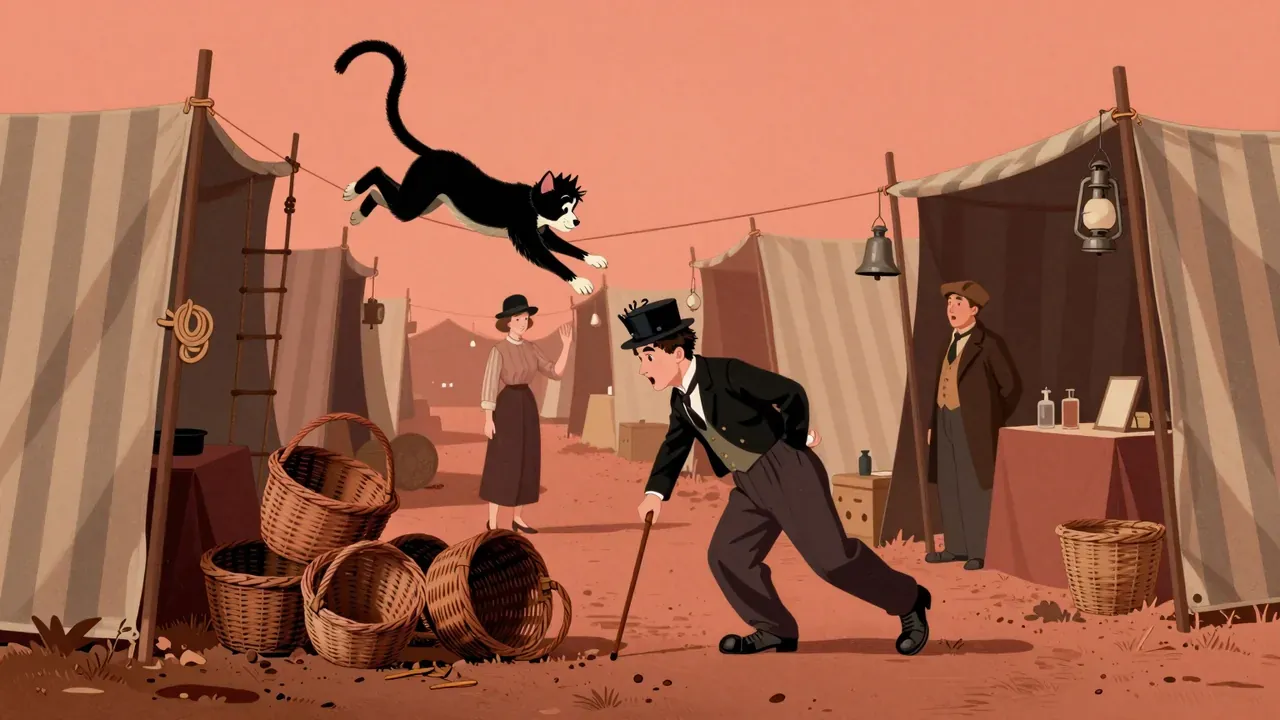
The story follows the Tramp’s accidental recruitment into a failing circus, his rise through unintentional chaos, his romantic misreading of cues, and his eventual expulsion after a moment of moral clarity. Chaplin’s performance remains economical and precise: no gesture is wasted, no reaction delayed beyond its comic or emotional necessity. Roland Totheroh’s cinematography keeps compositions clean and legible, favouring medium shots that preserve physical continuity during gags — the tightrope sequence, for instance, gains tension from unbroken spatial logic, not cutting. Chaplin edits with rhythmic discipline, allowing sequences like the monkey chase or the property-man scramble to breathe without over-cutting. The 1928 score — composed by Chaplin himself — is functional rather than expressive, underscoring action without sentimentalising it. Merna Kennedy’s horse-riding scenes are integrated cleanly into the ensemble, though her character’s agency remains circumscribed by plot function. Henry Bergman and Al Ernest Garcia offer grounded counterpoints as the old clown and ringmaster, their faces registering weariness and calculation without caricature. There is no improvisational looseness here; every beat is calibrated, even when pretending to be spontaneous.
What lands
What lands most firmly is the central comic paradox: the Tramp succeeds only when he fails. His value lies entirely in his inability to conform — whether as clown, property man, or suitor. The mid-film set-pieces hold up precisely because they derive from cause-and-effect logic: the monkeys escape because he startled them; the tightrope works because he has secretly practised, not because he is suddenly gifted. These moments do not rely on surprise alone but on accumulated character behaviour. The circus midway chase opens the film with urgent physical clarity, establishing both the Tramp’s vulnerability and his knack for stumbling into spectacle. Later, the fortune-teller scene lands not for its mysticism but for its cruel dramatic irony — the Tramp hears only half the sentence, and we see him misread it completely. Even the final image — the Tramp walking away alone — works because it arrives without fanfare, stripped of music or close-up, letting the empty ring speak for itself. Chaplin trusts the audience to register the shift from communal triumph to solitary departure without underlining it. That restraint gives the ending its quiet force.
What does not
What does not land consistently is the romantic thread between the Tramp and Merna Kennedy’s character. Their connection lacks the tactile specificity of Chaplin’s earlier pairings — there is little shared physical language, no mutual glances that build intimacy across scenes. Her affection appears more dutiful than earned, and his heartbreak feels abrupt rather than inevitable. The Rex character functions purely as plot device, entering late and exiting without psychological residue. Similarly, the ringmaster’s cruelty toward Merna is asserted rather than dramatised: we see one slap, but no sustained pattern of abuse that would justify the Tramp’s violent response or make his intervention feel morally necessary. Some gags overstay — the extended property-man montage, while technically impressive, repeats variations without escalating stakes. The film’s pacing also suffers from its production history: certain sequences feel stitched together, their tonal shifts less organic than deliberate. A viewer attuned to Chaplin’s tighter two-reelers may find the 69-minute runtime uneven, with stretches where narrative momentum yields to atmosphere without sufficient payoff.
The themes that matter
The themes that matter are labour, visibility, and impermanence. The Tramp is hired not for skill but for utility — first as scapegoat, then as unwitting entertainer, finally as moral witness. His wages rise only when his presence becomes inseparable from the circus’s survival, yet he remains unpaid until forced to demand it. This mirrors Chaplin’s own position in 1926–27: negotiating creative control amid studio fire, divorce litigation, and tax disputes. The circus is not escapism but infrastructure — a fragile economy held together by routine, hierarchy, and the constant threat of collapse. The Tramp’s final solitude resonates not just as personal rejection but as structural displacement: he built the show’s success, yet belongs nowhere in its future. The film quietly interrogates authorship — who gets credit when comedy emerges from accident? Who owns the laughter? And what happens when the apparatus that sustains you moves on — not because you failed, but because the system no longer needs your particular kind of usefulness? These are not stated but embedded in composition, editing rhythm, and the careful withholding of resolution.
Who should watch it
This film is for viewers who value choreographed physical comedy rooted in character logic, who appreciate silence as a compositional tool, and who are comfortable with narrative economy over exposition. It rewards attention to timing, framing, and the weight of a pause. It is not for those who require psychological exposition, romantic development, or rapid-fire gag density — the pacing assumes patience, and the emotional arc is implied rather than articulated. Some modern viewers may find the gender dynamics dated, particularly Merna’s passive role in her own storyline. Others may resist the lack of soundtrack irony or musical commentary — Chaplin’s 1928 score offers no winking distance from the material. Those who prefer The Gold Rush or City Lights for their richer pathos may find this comparatively lean. But for anyone willing to meet it on its own terms — as a study in controlled chaos, a portrait of performative labour, and a pre-echo of sound-era anxiety — it repays close viewing. Its limitations are structural, not incidental, and part of its argument.
Is it worth your evening
Yes, it is worth your evening — provided you watch it as Chaplin intended: on a screen large enough to register facial nuance, with no distractions, and with awareness of its place in time. It is not a casual background film; its pleasures are cumulative and rhythmic, not episodic. Those who expect continuous laughs may grow restless during the quieter passages; those who demand clear moral closure will be unsettled by the open-ended final walk. But its craftsmanship remains exacting, its comic intelligence undimmed, and its thematic resonance deepened by its historical position — released weeks after The Jazz Singer, it stands as both culmination and farewell. A viewer who dislikes silent film aesthetics altogether will likely reject it outright, but that is not a flaw in the film — it is a condition of its form. To dismiss it as ‘dated’ is to mistake formal constraint for deficiency. Its worth lies in how much it achieves with so little: no dialogue, no effects, no concessions — just movement, timing, and the quiet certainty of a man walking away.