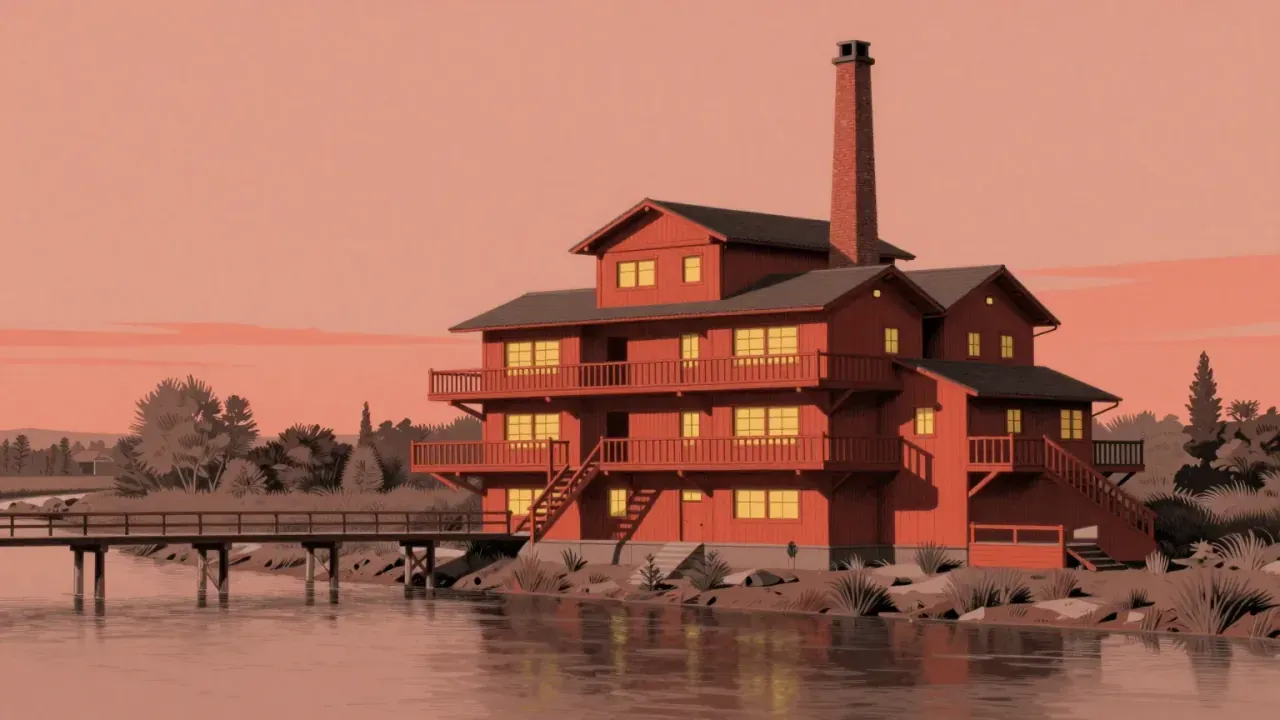
A child’s disappearance into a spirit bathhouse
Spirited Away follows ten-year-old Chihiro, who wanders with her parents into an abandoned amusement park that turns out to be the entrance to a spirit world, watches them transformed into pigs for eating food that wasn’t offered to them, and has to take a job in the witch Yubaba’s bathhouse to survive and find a way to reverse the curse. Hayao Miyazaki wrote and directed the film after two earlier project pitches were rejected, designing the story specifically for the young daughters of family friends who visited his mountain cabin each summer, having concluded the manga they read offered them little beyond stories about crushes.
A story built for real ten-year-olds, not a market
Production ran through most of 2000 on a budget that started at roughly ¥1.9 billion, with Miyazaki working alongside animators scene by scene to check results against his intentions, using computer tools sparingly enough that the effects stay in service of the story rather than announcing themselves. Chihiro’s design deliberately avoids conventional prettiness — Miyazaki has said he found her plain partway through production before coming around to that plainness as the character’s point. The bathhouse setting draws on an actual establishment near Miyazaki’s hometown that he’d been curious about as a child, and buildings in the spirit world borrow specifically from the Pseudo-Western architecture preserved at the Edo-Tokyo Open Air Architectural Museum.
Losing a name as the film’s real horror
The stripping of Chihiro’s name to Sen by Yubaba, and her growing forgetfulness of her own name and her parents’ faces, functions as the film’s clearest metaphor and its most effective device: identity loss here isn’t a fantastical curse so much as an exaggeration of what happens to anyone absorbed into an institution on someone else’s terms. No-Face, who starts as a silent, needy presence and turns monstrous once he’s fed the bathhouse’s greed back to it, gives the film’s critique of consumption a character rather than a lecture. The train sequence, where Chihiro rides in near-total silence past ghostly passengers, carries almost no dialogue and remains the film’s most quietly devastating passage.
Where the middle stretch slows down
At 125 minutes, the middle stretch inside the bathhouse occasionally slows to accommodate world-building that doesn’t always pay off later — several minor bathhouse workers are given screen time without much narrative return. The Haku subplot, involving his true identity as a river spirit, resolves with information delivered somewhat quickly relative to how much weight the film has put on their relationship up to that point, a consequence of Miyazaki’s process of cutting material to bring a much longer initial version down to length. A few of the visiting spirit customers, each given a strikingly specific design, appear once and vanish without that visual invention translating into any further story function.
Appetite without limit made literal
The film’s sharpest idea is that greed and self-forgetting are structural, not individual failings: the bathhouse runs on customers who want to be pampered without consequence, workers who trade their names for employment, and a No-Face who becomes dangerous only once he’s given exactly what the system rewards. Chihiro’s parents turning into pigs for eating unearned food sets the terms early — appetite without limit costs you your humanity literally, not metaphorically. Her survival depends not on defeating Yubaba but on remembering who she is closely enough to walk away with her name and her parents intact, which makes the ending a return rather than a triumph.
Who the slower pace and ambiguity suit
This suits viewers open to a slower pace than most animated features allow themselves, and anyone interested in a fantasy world built with the internal logic of folklore rather than franchise mechanics — nothing here is explained more than it needs to be. It also rewards viewers drawn to a child protagonist whose growth is measured in competence and memory rather than in a makeover or a romance. It’s a poor fit for anyone wanting fast pacing or a story explained as it goes, since much of the film’s atmosphere depends on ambiguity Miyazaki never resolves.
Why two hours in the bathhouse pays off
At over two hours, Spirited Away asks for a real evening’s commitment, and it earns that back: the film became the highest-grossing release in Japanese box-office history at the time and remains the only hand-drawn, non-English-language film to win the Academy Award for Best Animated Feature. Its Golden Bear win, shared at Berlin in 2002, reflects a critical consensus that arrived alongside the commercial one rather than after it. Worth the evening for the bathhouse’s internal logic alone, which holds together with a rigor most fantasy world-building doesn’t bother with.