The premise
The Damned is a historical drama set in Germany between January and July 1933, tracing the moral collapse of the Essenbeck family — industrialists who trade principle for survival as the Nazi Party consolidates power. It is not a chronicle of political events but a forensic study of complicity: how privilege, desire, and fear corrode kinship and identity when institutions crumble. Visconti treats fascism not as ideology but as atmosphere — thick with perfume, cigar smoke, and the metallic tang of blood on marble floors. The film’s ambition is structural and symbolic: to show authoritarianism not as imposed from outside but incubated within the family, the boardroom, the bedroom. Its German setting is incidental to its subject; the Essenbecks could be any dynasty that mistakes accommodation for prudence. The film belongs to no national cinema alone — shot in Italy, West Germany and Austria, spoken mostly in Italian with English dubbing, financed by Warner Bros., it is a transnational artefact of late-sixties European auteurism. Its project is neither didactic nor documentary, but operatic in scale and pitiless in gaze: to stage the fall of gods who never believed themselves divine until they were already damned. (154 words)
The construction
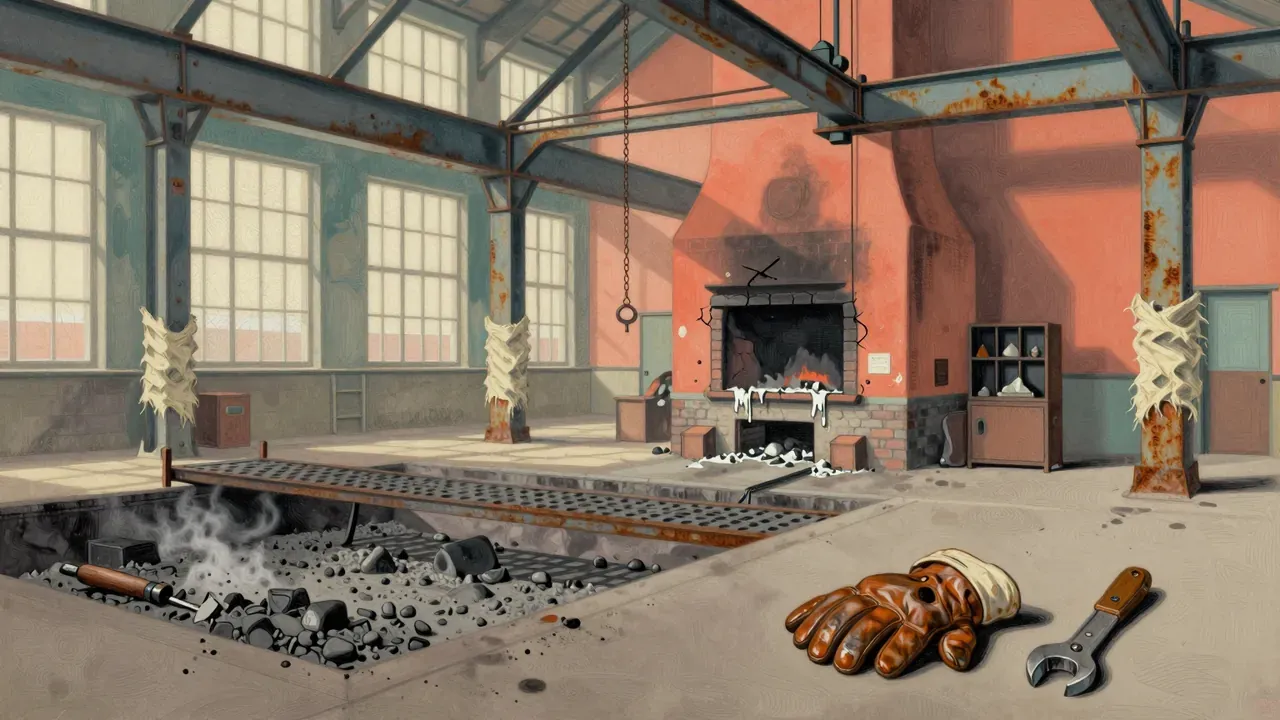
The story unfolds across three acts: Joachim’s murder, the Bad Wiessee purge, and the final dinner where Friedrich and Sophie consume cyanide at Martin’s command. Pasqualino De Santis and Armando Nannuzzi shoot in deep focus and slow lateral tracking, holding on faces long after dialogue ends — particularly during Martin’s drag performance or Sophie’s silent descent into catatonia. Dirk Bogarde’s Friedrich is coiled restraint; Ingrid Thulin’s Sophie is all suppressed tremor and brittle composure; Helmut Berger’s Martin is a feral, unmoored force, his physicality foregrounded in every frame. Maurice Jarre’s score — against Visconti’s wishes — layers brass and percussion over Mahlerian strings, often clashing with the image rather than supporting it. Ruggero Mastroianni’s editing sustains tension through duration: a single take follows Friedrich up the castle stairs before he kills Joachim; another holds on Martin’s face as he watches Konstantin’s execution without blinking. The production design — steelworks in Terni, Unterach standing in for Bad Wiessee — grounds abstraction in tangible surfaces: cold iron, damp stone, sweat-slicked skin. Every costume, every gesture, every pause is calibrated to reveal hierarchy, hunger, or humiliation. (158 words)
The effect
What lands is the suffocating continuity of decay: the way power shifts not in speeches but in glances, in who pours the wine, in whose hand holds the pistol first and whose hand drops it last. The Bad Wiessee sequence — drunken SA officers coupling in dim rooms before SS boots break down doors — works because it refuses caricature: their vulnerability precedes their slaughter, making the violence feel less like justice and more like mechanics. The film’s most enduring image is not the burning Reichstag but Sophie’s stillness after Martin assaults her — no music, no cut, just her eyes fixed on nothing while light bleeds from a high window. Bogarde’s quiet fury as Friedrich realises he has traded morality for a title, only to find the title meaningless without authority, lands with cumulative weight. The casting of Albrecht Schönhals — a veteran of Weimar cinema — as the dying patriarch adds historical texture no script could manufacture. Even the dubbed voice of Umberto Orsini (as Herbert) feels like a deliberate rupture: a man literally stripped of his own sound. These are not flourishes but functions — each choice tightening the film’s grip on the viewer’s nervous system. (156 words)
The gaps
What does not land is the film’s treatment of Jewish characters — Lisa Keller’s suicide and Elizabeth’s arrest are narrative devices, not dramatised lives. They appear only to disappear, their suffering instrumentalised to catalyse Herbert’s return or Friedrich’s guilt, which itself evaporates by the third act. The film’s sexual frankness — Martin’s abuse of his nieces, the SA orgy — risks sensationalism without deeper psychological scaffolding; Berger’s performance is compelling but not always legible as motive, more symptom than cause. Jarre’s score, though technically proficient, undermines Visconti’s intent: its romantic sweep contradicts the film’s clinical dissection of corruption, especially in scenes meant to feel hollow or grotesque. The English-language version’s dubbing inconsistencies — some actors speaking, others replaced — fracture immersion without irony or commentary. And while the ‘German Trilogy’ framing is useful for scholarship, the film itself offers no internal logic for its stylistic kinship with Death in Venice beyond shared names and composers; Ludwig would later make the connection explicit, but here it remains an external imposition. (152 words)
The substance
The themes that matter are inheritance and inversion: what is passed down is not wealth or name but degradation, and every act of ‘preservation’ accelerates ruin. Class is not backdrop but agent — the Essenbecks do not join Nazism out of conviction but because their factories require contracts, their titles require protection, their children require futures. Sexuality is neither liberation nor transgression but currency: Martin’s drag is tolerated until it threatens control; Sophie’s affair is acceptable until it demands marriage; Friedrich’s ambition is rewarded only when it serves Aschenbach’s agenda. The film treats fascism as a system of accelerated exchange — loyalty for impunity, silence for promotion, blood for board seats. There is no redemption arc, no moral pivot: even Herbert’s confession is transactional, not penitent. Visconti refuses the consolations of tragedy — no hubris, no nemesis, only entropy. The fall is not dramatic but administrative: minutes, meetings, memos, murders filed under ‘personnel’. What matters most is how thoroughly the film denies catharsis — not as omission, but as principle. (150 words)
The audience
This film is for viewers who tolerate long takes, resist narrative spoon-feeding, and accept that moral clarity is a luxury the 1930s denied its participants. It rewards attention to texture — the grain of leather gloves, the sheen of sweat on a collar, the way light catches dust motes above a dead man’s bed. It is not for those who need protagonists to be sympathetic, plots to resolve, or history to offer lessons. Anyone unsettled by prolonged depictions of psychological coercion, non-consensual sex, or institutionalised cruelty should not watch. Those expecting a conventional war film or biographical account of the Krupps will find the film frustratingly oblique. Some critics — notably Dirk Bogarde himself — have argued the film sacrifices Friedrich’s arc to foreground Berger’s Martin, and that imbalance remains visible in the final cut. A tighter edit restoring Bogarde’s excised guilt scene would shift the film’s centre of gravity, but that version does not exist in circulation. (151 words)
The duration
Yes, it is worth your evening — if you approach it as a chamber piece about corrosion, not a historical primer. Its 155 minutes pass with the weight of inevitability, not tedium, because every shot accumulates consequence. You do not watch it for plot momentum but for the slow, sickening realisation that no one in this world makes a free choice — only calculations within narrowing margins. It repays rewatching: the second time, you notice how often characters stand behind glass, or how often hands reach for weapons before faces register intent. Those who find it alienating are not wrong — its refusal of empathy is deliberate, not accidental. A shorter runtime would not improve it; its duration is its argument. If you prefer films that clarify rather than compound moral ambiguity, or that locate hope in extremis, then no — this is not for you. But if you believe cinema can anatomise evil without naming it, then yes: it is essential. (150 words)