The look of it
The Ice Storm is a 1997 American drama adapting Rick Moody’s 1994 novel, set over a single Thanksgiving weekend in 1973 in an affluent Connecticut suburb. It attempts to render the emotional hollowness of its characters not through plot propulsion but through accumulation: of withheld glances, misaligned expectations, and the quiet violence of routine betrayal. Ang Lee and James Schamus treat the early 1970s not as a period costume but as a psychological weather system — one where sexual licence, therapeutic fads, and suburban architecture all conspire to dissolve moral and familial boundaries. The film does not diagnose its era so much as inhabit it, letting mood, texture, and restraint do the work of exposition. Its ambition is structural and tonal: to hold two families in parallel drift, then fracture them with an event that arrives not as climax but as consequence — a death that feels inevitable only in retrospect. It seeks no redemption arc, no corrective justice, only the unvarnished weight of aftermath.
How it holds time
The story unfolds across three tightly interwoven domestic orbits: the Hoods, the Carvers, and the teenagers orbiting both. James Schamus’s script parcels dialogue with surgical precision — lines land because they are under-delivered, not underwritten. Kevin Kline’s Ben Hood moves through scenes like a man half-asleep in his own life; Joan Allen’s Elena carries grief before she knows its name. Frederick Elmes shoots interiors in muted ochres and greys, keeping lamps low and windows dark, so that even daylight feels filtered through exhaustion. Mychael Danna’s score avoids period pastiche, using sparse piano and string textures that hover just beneath speech. Tim Squyres edits with deliberate slackness: pauses linger, reactions delay, cuts often land on empty rooms or backs of heads. The teenage performances — Christina Ricci, Elijah Wood, Adam Hann-Byrd, Katie Holmes — avoid precocity; their confusion reads as lived-in, not performative. There is no score cue for irony, no camera tilt to signal absurdity. The craft serves stillness, not emphasis.
What settles in the silence
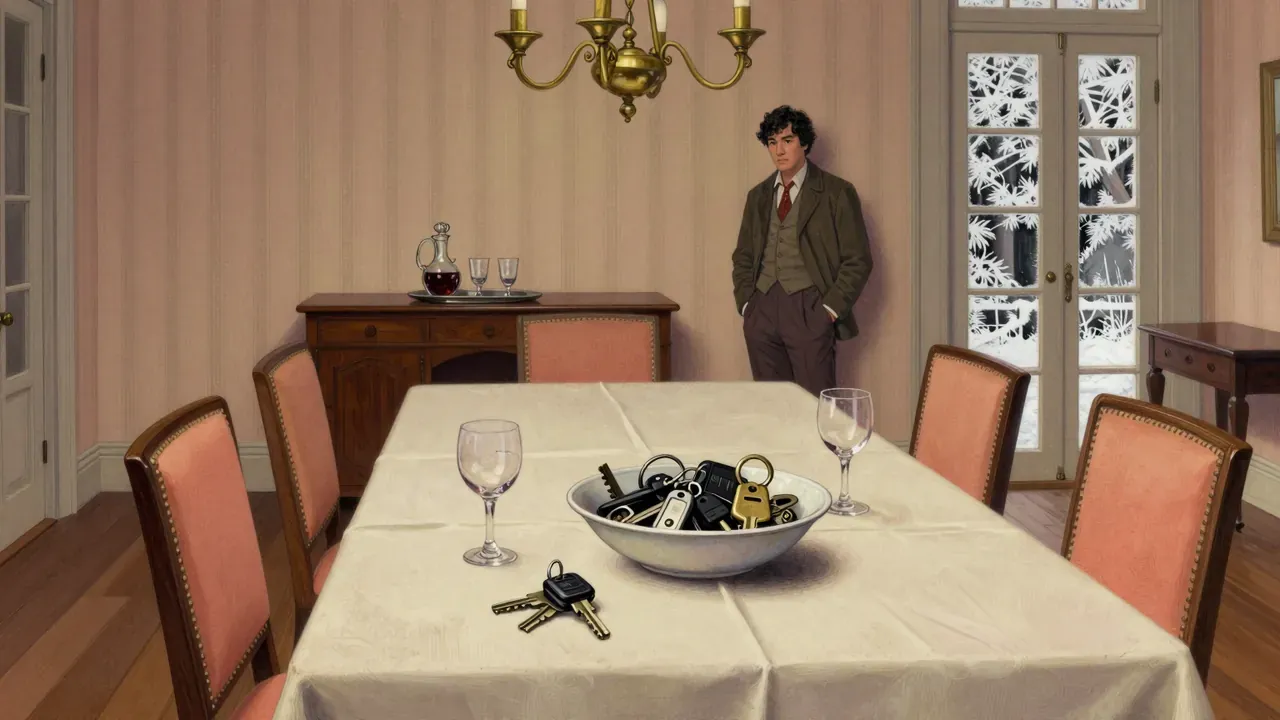
What lands is the film’s cumulative sense of atmosphere — the way a dropped cigarette, a stalled car, a half-unbuttoned blouse, or the creak of a floorboard in an empty hallway accrues meaning across scenes. The key party sequence works not as farce but as slow-motion social collapse: the bowl of keys becomes a deadpan ritual of consent deferred, desire displaced, and agency surrendered to group inertia. The ice storm itself is neither metaphor nor spectacle but a physical presence — branches groan, power lines hum, footsteps crunch and slip — grounding the emotional disarray in tangible cause and effect. Wendy’s quiet authority in her bedroom scenes, Paul’s muted disappointment at Libbets’s apartment, Jim’s stunned silence after Mikey’s death: none are underscored, yet each registers with accumulating force. Even minor moments — Janey folding laundry while listening to Ben’s voice on the phone, Sandy staring blankly at a toy grenade — settle into memory because they refuse explanation. The film trusts duration over revelation, and that trust pays off in sustained unease and quiet recognition.
Where the frame slips
What does not land is the framing device of Ben’s voiceover narration, which appears only in the opening and closing minutes. It is literary, measured, and tonally at odds with the film’s visual restraint — its polished cadence jars against the grain of the performances and Elmes’s naturalistic lighting. The subplot involving Francis and Libbets feels structurally necessary but emotionally thin; their dynamic lacks the specificity given to the Hood-Carver entanglements, and the boarding-school setting remains under-anchored in place or consequence. A few supporting characters — Henry Czerny’s unseen neighbour, David Krumholtz’s background teen — exist more as narrative placeholders than people. The film’s refusal to dramatise certain tensions (Elena’s inner life beyond her marriage, Janey’s ambivalence beyond duty) occasionally reads less as ambiguity and more as omission. And while the storm’s visual execution is technically assured, the digital removal of snow from five shots creates a subtle artificiality — a slight disconnect between the real and the constructed that lingers just long enough to register.
The air they breathe
The themes that matter are not listed but embedded: the corrosion of language in intimacy, the way domestic space can become both sanctuary and cage, and the particular exhaustion of privilege when it fails to deliver meaning. It treats adultery not as transgression but as symptom — a reflexive reach for sensation in a world stripped of shared purpose. Adolescence here is not rebellion but rehearsal: Wendy mimics adult detachment without its defences; Paul rehearses devotion without vocabulary; Sandy rehearses love without context. The film also examines how ideology — whether psychoanalytic jargon, sexual liberation rhetoric, or suburban self-help — functions less as belief than as furniture: something rearranged to fill silence. Crucially, it refuses to locate blame in individuals alone. The storm is literal, yes, but the deeper weather is historical: post-Vietnam disillusion, pre-Watergate distrust, the hollowing-out of mid-century consensus. The film’s quietest theme is time — not as progression but as suspension, where Saturday bleeds into Sunday without resolution, and grief arrives not with a cry but with a long drive in a silent car.
Who walks in, and who walks out
This film is for viewers who value sustained mood over momentum, who find emotional truth in hesitation rather than declaration, and who accept that some endings are not conclusions but continuations of the same unresolved condition. It suits those accustomed to arthouse pacing and comfortable with ambiguity — particularly viewers familiar with Lee’s earlier English-language work, or with American novels of suburban malaise like Cheever or Yates. It is not for viewers seeking narrative payoff, moral clarity, or character arcs that resolve cleanly. Those who require active protagonists, escalating stakes, or cathartic release will find it withholding, even inert. A viewer expecting satire may mistake its restraint for neutrality; someone needing psychological exposition may read its silences as evasion. Its value depends on tolerance for ellipsis — and if that tolerance is low, no amount of craft or performance will compensate. The verdict shifts only if the viewer’s priorities shift first: from what happens to how it feels to be there.
The drive home
Yes, it is worth your evening — provided you arrive prepared for its tempo and its terms. It repays attention not with twists or revelations but with layered texture: the way light falls on wallpaper, how a character’s posture changes across three scenes, the weight of a pause held two seconds longer than expected. Its 112 minutes pass without hurry, but never without consequence. You leave not with answers but with recalibrated perception — of how boredom masks panic, how politeness conceals rupture, how grief arrives in the back seat of a station wagon at dawn. It is not entertainment in the transactional sense, but it is deeply felt, precisely calibrated, and unusually honest about the cost of emotional drift. Those who dislike it tend to cite its stillness as emptiness; those who admire it see that stillness as the only honest register for the subject. Its worth is inseparable from its method — and that method demands, above all, patience.