The year she might die
Dim Sum: A Little Bit of Heart is a low-budget American independent film from 1985, directed by Wayne Wang and rooted in the everyday lives of a Chinese-American family in San Francisco. It is not an epic or a polemic, but a quiet, observant portrait of generational distance, cultural continuity, and the weight of unspoken expectation. The film sets out to hold space for small gestures — a shared meal, a hesitant question, a glance withheld — as vessels of feeling too complex for exposition. Its ambition lies in restraint: to treat immigrant life not as a crisis of assimilation but as a series of accumulated habits, compromises, and quiet loyalties. It avoids symbolic grandeur in favour of domestic specificity — the clink of mahjong tiles, the steam rising from a bamboo basket, the way a widow folds laundry while listening to her daughter’s voice crack on the phone. This is not cinema of revelation but of recognition; its aim is fidelity to tone, not argument.
The rhythm of the table
The story follows Julia (Cora Miao), a Chinese immigrant widow who learns, via a fortune-teller’s prediction, that the coming Lunar New Year may be her last. Her response is neither melodramatic nor mystical, but practical and tender: she begins quietly arranging her daughter Geraldine’s marriage, rekindling old friendships, and weighing a long-deferred trip to China. Victor Wong grounds the film as Uncle Tam with dry, unhurried timing; Cora Miao’s performance is calibrated in micro-expressions — a pause before agreeing, a hand resting briefly on a teacup. Joan Chen appears in a brief but resonant role as a younger version of Julia’s mother-in-law, anchoring memory without exposition. Gordon Willis did not shoot this film — the cinematography is by Remi Adefarasin, who uses natural light and shallow focus to soften edges without romanticising poverty. Editing by Michael R. Miller favours duration over rhythm: scenes breathe, sometimes too long, but never rush. There are no score swells, no montages — just ambient sound, overlapping dialogue, and silence that feels earned, not imposed.
What is left unsaid
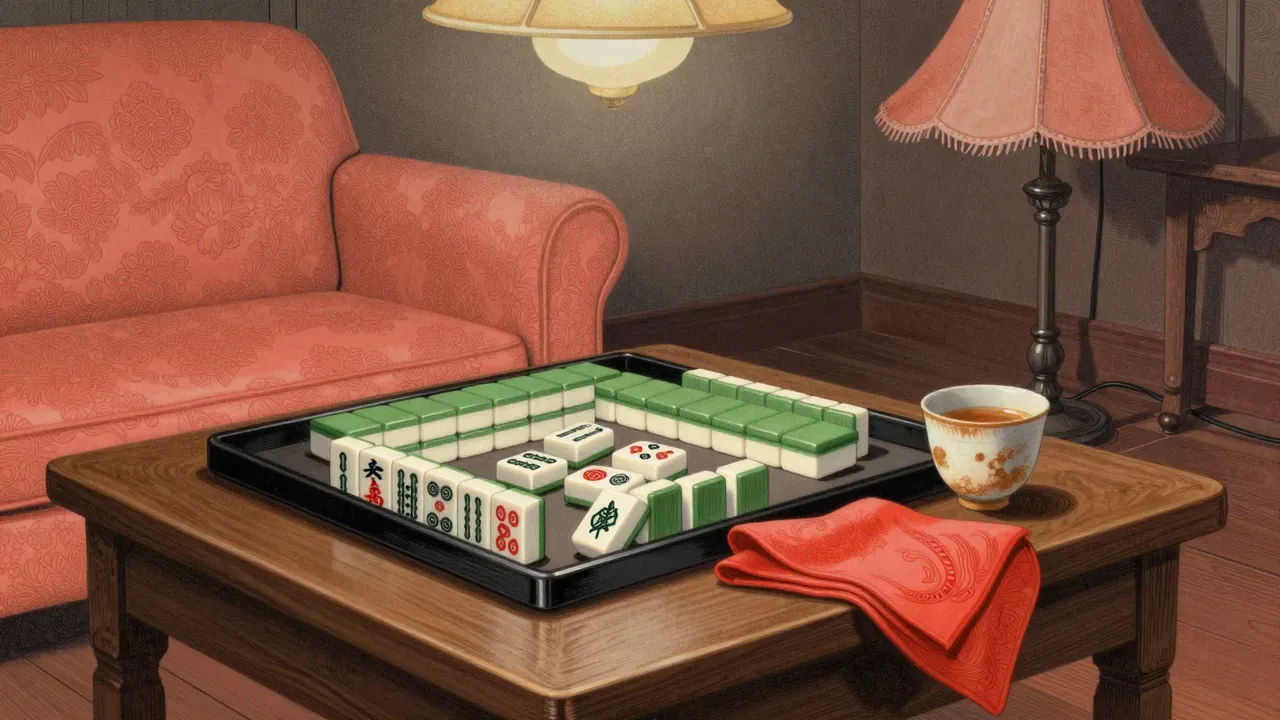
What lands is the film’s emotional honesty about ageing without pathos, and its refusal to reduce Chinese-American identity to conflict or caricature. The mahjong scenes — played by women of different generations, speaking English, Cantonese, and fragmented Mandarin — function as both social ritual and narrative engine, revealing character through banter, scoring, and unspoken alliances. The film’s warmth emerges not from sentimentality but from attention: how Julia irons her daughter’s blouse before the engagement dinner, how Amy Hill’s Amy Tam shifts between impatience and protectiveness, how Victor Wong’s Uncle Tam deflects grief with jokes that land just shy of cruelty. These moments accumulate without fanfare. The film also lands its tonal balance — it is gently comic, never mocking; melancholic, never despairing. Its modest scale becomes its strength: the stakes are personal, the victories small, the losses quiet. It does not ask for tears, but it earns quiet regard.
The loose ends
What does not land is the structural looseness around Geraldine’s storyline. Laureen Chew’s Geraldine is vivid in close-up but under-served by the script’s digressions — her career as a teacher, her ambivalence about marriage, her relationship with her fiancé Richard (John Nishio) all register as sketches rather than fully inhabited arcs. The subplot involving Julia’s desire to visit China remains unresolved, not as a deliberate ellipsis but as a narrative thread dropped without consequence. Some scenes — particularly extended mahjong sequences — risk monotony when their thematic purpose isn’t clearly anchored in character development. The film’s commitment to realism occasionally tips into inertia: a scene where Julia watches television alone for two minutes, though truthful, adds little beyond atmosphere. It is not that these choices are wrong, but that they lack the editorial discipline to justify their duration. The film trusts its audience’s patience, but not always their need for clarity.
Steamed buns and syllables
The themes that matter are filial duty as quiet labour rather than dramatic obligation, the weight of untranslatable feeling across language and generation, and the way ritual — whether cooking dim sum or playing mahjong — functions as both preservation and resistance. The film treats tradition not as static inheritance but as something actively, awkwardly, lovingly remade: Julia insists on serving steamed buns at the engagement dinner even though Geraldine prefers pizza; Geraldine teaches her students about Chinese history while correcting their pronunciation of ‘Confucius’. Ageing is framed not as decline but as recalibration — Julia’s awareness of mortality sharpens her attention to what remains within reach, not what has slipped away. There is no critique of assimilation here, only observation of its textures: the English-language church bulletin next to the Chinese herbalist’s sign, the bilingual gravestone, the way ‘American’ and ‘Chinese’ coexist in syntax, gesture, and silence without needing resolution.
Who sits with whom
It is for viewers who value behavioural realism over plot propulsion, who find emotional resonance in glances and silences, and who are comfortable with ambiguity as a mode of truth. It suits those familiar with diasporic family dynamics — not as exotic subject matter, but as lived texture — and those willing to sit with characters whose conflicts are internalised, whose resolutions are partial. It is not for viewers who require clear narrative cause-and-effect, heightened stakes, or stylistic flourish. Those expecting satire, broad comedy, or political commentary will find the film too muted; those seeking catharsis or closure may leave unsatisfied. Its pace and restraint assume a certain tolerance for stillness — a quality some associate with arthouse pretension, though the film itself makes no such claim. Change the editing rhythm or sharpen Geraldine’s arc, and the film would widen its appeal — but it would also lose its defining humility.
An evening well spent
Yes, it is worth your evening — not as entertainment but as replenishment. Its eighty-eight minutes pass without urgency yet leave a lingering sense of having witnessed something real and carefully held. It rewards attention not with spectacle but with accumulation: the way light falls on a kitchen wall at 4 p.m., the cadence of a mother-daughter argument that ends mid-sentence, the quiet pride in Julia’s hands as she folds dumpling wrappers. It does not demand your investment, but repays it with dignity. Some will find it too slender, too slow, too unadorned — and they are not wrong, only mismatched to its aims. Its value lies in what it refuses: to explain, to dramatise, to resolve. For those who trust subtlety as a form of respect — for characters, for culture, for time itself — it offers something rare: a film that treats ordinary life as worthy of sustained, unsentimental attention.