The look of it
Safe is a psychological drama set in 1987 Los Angeles, built around the slow, unexplained unravelling of Carol White, a suburban housewife whose body begins reacting violently to everyday environments. Todd Haynes does not aim to diagnose or explain her condition — it remains unnamed, medically unconfirmed, and socially unacknowledged — but to map the terrain where illness, identity, and ideology converge. The film treats environmental sensitivity not as a medical footnote but as a structural symptom: of late-capitalist domesticity, of Reagan-era denialism, of the therapeutic-industrial complex, and of the gendered expectation that women absorb toxicity without complaint. Haynes avoids exposition, causality, or catharsis; instead he constructs a world where surfaces are immaculate, dialogue is polite and hollow, and every room feels like a sealed chamber. His method is one of sustained withholding: no voiceover, no score that cues emotion, no camera that leans in. The film’s ambition is not narrative resolution but atmospheric fidelity to a kind of quiet, systemic suffocation — one that cannot be cured because it has no single source, only many overlapping ones. (158 words)
The way it moves
The story unfolds in two distinct movements: Carol’s life dissolving in the beige sterility of West LA, then her retreat into Wrenwood, a desert commune that promises healing but delivers only another kind of enclosure. Julianne Moore’s performance is calibrated with extraordinary precision — her posture slackens, her voice flattens, her breath shortens, all without gesture or emphasis. Alex Nepomniaschy’s cinematography keeps the camera at a fixed, medium distance, rarely pushing in, never lingering on faces; light stays even, colours muted, compositions rigidly symmetrical. Ed Tomney’s score is sparse and tonal, often absent for minutes at a time. James Lyons’ editing sustains long takes and deliberate pauses, letting silence accumulate weight. The script avoids psychologising Carol — her interiority is inaccessible, not because it is hidden, but because it is systematically eroded by the language and logic available to her. Even the New Age rhetoric at Wrenwood is rendered with clinical detachment, its affirmations sounding less like comfort than compulsory self-erasure. Every craft decision reinforces the film’s central formal principle: distance as both aesthetic strategy and political fact. (159 words)
What it makes you feel
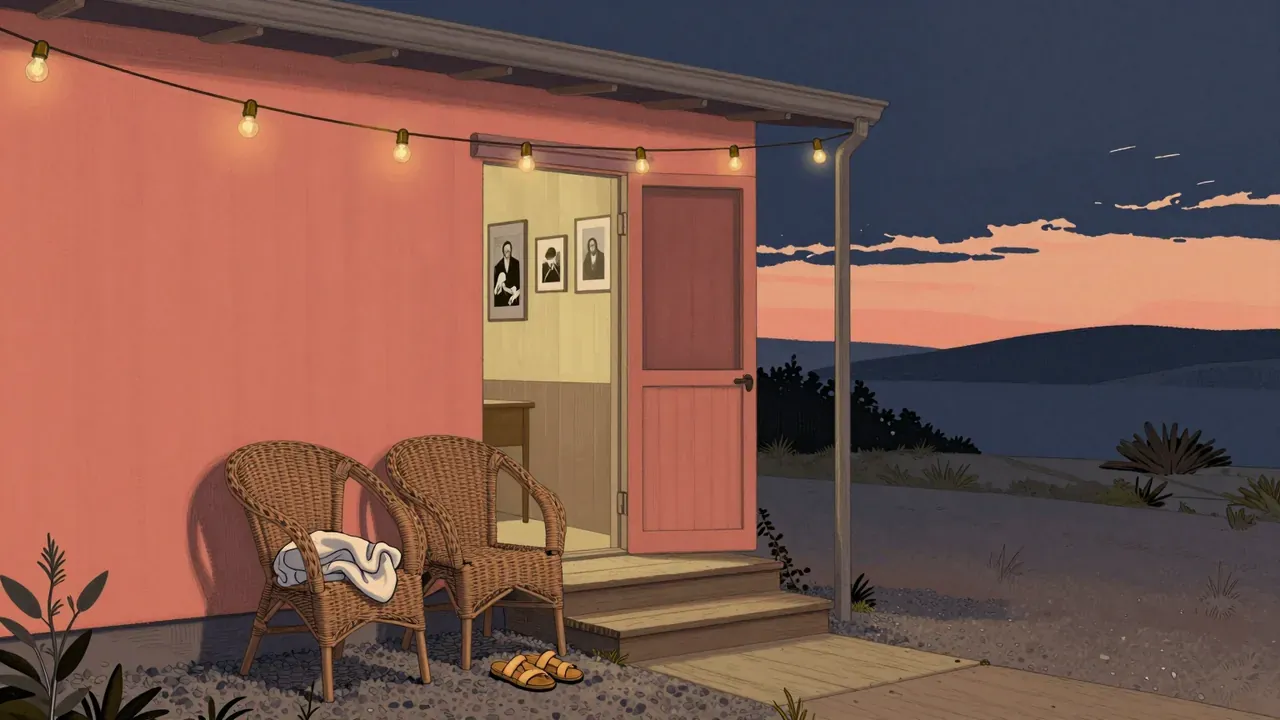
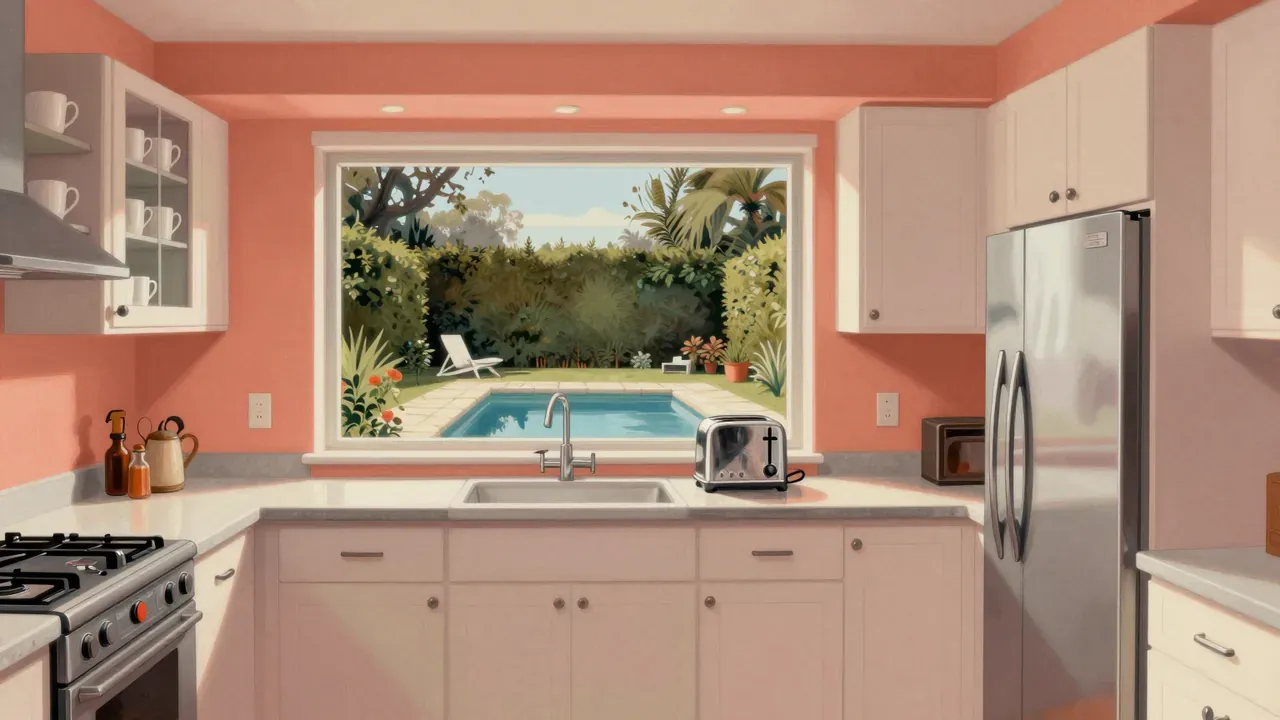
What lands most firmly is the film’s cumulative sense of unease — not through jump scares or melodrama, but through the sheer, unrelenting consistency of its restraint. The opening sequence, in which Carol endures a silent aerobics class while the instructor’s voice blares over loudspeakers, establishes the tone with surgical exactness: physical exertion without release, communal activity without connection. Her collapse at the dry cleaner — surrounded by masked workers spraying pesticides while she gasps unseen — is quietly devastating, not for its violence but for its banality. The birthday party monologue, drawn from real interviews with chemically injured people, lands with documentary gravity amid the film’s stylisation. Equally effective is the way Haynes uses architecture and interior design as active agents: the renovated kitchen’s glossy surfaces reflect nothing but emptiness; Wrenwood’s adobe buildings look warm from afar but feel airless up close. These choices do not ask for empathy so much as they enforce recognition — of how environments shape bodies, how language fails illness, and how care can become another form of control. The film’s power lies in its refusal to offer relief, making its austerity its authority. (156 words)
Where it pulls back
What does not land is the film’s second half, where the logic of its critique begins to fray. Wrenwood, though grounded in research, functions more as allegory than character — its leader Peter Dunning remains opaque, his motives unclear, his authority unexamined beyond surface-level irony. The shift from Carol’s alienation in mainstream society to her isolation within a community built for people like her risks flattening the complexity Haynes otherwise honours: real environmental illness advocacy involves fierce political organising, not just passive retreat. The mirror scene — Carol whispering ‘I love you’ to herself inside her dome — is formally striking but emotionally inert, its ambiguity feeling less like openness and more like evasion. Some viewers find the ending nihilistic; others see resignation. Neither reading feels fully earned, because the film declines to show how Carol’s understanding of herself changes, if it does at all. The absence of internal monologue or subjective sound design leaves her inner life permanently out of reach — a choice that serves the film’s themes early on, but grows frustrating when the stakes shift from observation to implication. It is not that the film refuses answers; it refuses even to frame the right questions in its final stretch. (158 words)
What it’s really about
The themes that matter are not those named in press releases — ‘isolation’, ‘illness’, ‘identity’ — but the quieter, harder ones embedded in the film’s structure: the burden of diagnosis placed on the undiagnosable; the way self-help discourse displaces structural harm onto individual failure; the gendered labour of absorbing ambient toxicity; and the complicity of affluence in producing conditions of chronic distress. Safe treats Carol’s body not as a site of pathology but as a register — one that records pesticide exposure, carpet fumes, psychoanalytic platitudes, and New Age affirmations with equal, indifferent fidelity. The film’s political force comes from its refusal to locate blame in any single institution — medicine, media, family, or alternative healing — instead showing how they all converge in rendering Carol unspeakable, unwell, and ultimately unmoored. Its enduring relevance lies less in its depiction of chemical sensitivity than in its anatomy of what happens when a society lacks the vocabulary, will, or infrastructure to name collective harm — and defaults instead to pathologising the person who feels it first. (157 words)
Who it’s for
This film is for viewers who value formal rigour over emotional access, who find tension in stillness and meaning in withheld information. It suits those familiar with minimalist cinema — say, Chantal Akerman or Robert Bresson — or with feminist film theory that treats narrative closure as ideological. It is not for viewers seeking narrative propulsion, psychological insight, or moral clarity. People who expect illness narratives to resolve in recovery, revelation, or rebellion will leave frustrated. Those who associate ‘drama’ with heightened emotion or interpersonal conflict may mistake its restraint for indifference. Even admirers of Haynes’ later work — Far from Heaven, Carol — may find Safe’s austerity uncompromising. Its resistance to catharsis is deliberate, not accidental; to call it ‘cold’ is to misunderstand its project. But if you believe that some truths are best conveyed through distance, repetition, and silence — and that a film can be urgent without raising its voice — then this is essential viewing. Its difficulty is not a barrier; it is the point. (159 words)
Is it worth your evening
Yes, it is worth your evening — provided you arrive prepared to sit with discomfort rather than be consoled by it. Its 119 minutes pass slowly, deliberately, and without concession; it asks for attention, not immersion. You will not leave uplifted, but you may leave unsettled in ways that linger — about how environments shape health, how language fails the sick, and how care can replicate the very systems it claims to oppose. Those who reject it tend to do so on grounds of emotional remoteness or narrative ambiguity — critics like Janet Maslin, for instance, found its chill fatal to engagement. A different verdict would follow if the film offered clearer insight into Carol’s subjectivity, or if its final act deepened rather than repeated its earlier logic. But its power resides precisely in its refusal to soften its terms. To watch Safe is to accept its terms: no answers, no heroes, no release — only the steady, unsettling pressure of a world that cannot hold certain kinds of pain. (159 words)