The look of it
Hour of the Wolf is a Swedish psychological horror film from 1968, written and directed by Ingmar Bergman, that attempts to externalise the interior collapse of an artist under insomnia, dread, and self-accusation. It does not seek to frighten through threat or shock but to inhabit the disintegration of perception itself — where hallucination, memory, folklore, and waking reality bleed without warning or hierarchy. The film’s ambition is structural as well as thematic: it builds a world in which time dilates, space warps, and causality unravels not as metaphor but as lived condition. Bergman frames this not as madness-as-plot-device but as a sustained, intimate descent — one anchored in the physical presence of Max von Sydow and Liv Ullmann, and in the stark, wind-scoured locations of Fårö and Hovs Hallar. Its method is not exposition but accumulation: sketches named by the protagonist, recurring figures with no origin, sounds that arrive before their source. It tries, deliberately and without concession, to make the hour between night and dawn feel like a place you can step into — and not leave unmarked. (158 words)
The shape of the story
The story follows Johan Borg, a painter on a remote island with his pregnant wife Alma, as his visions harden into fixed presences — the Birdman, the Lady With a Hat, the Insects — while his grip on shared reality loosens. Von Sydow performs this erosion with minimal inflection, letting the weight settle in posture and silence; Ullmann’s Alma is less reactive than porous, absorbing his disintegration without ever fully interpreting it. Sven Nykvist’s cinematography avoids expressionist distortion: he uses natural light, shallow focus, and long takes to ground the surreal in texture — damp stone, wool blankets, salt-crusted windows. The camera stays close, rarely cutting, as if refusing to grant the viewer distance or relief. Bach’s Partita No. 3 appears not as score but as diegetic presence — played on a harpsichord within the world — while Lars Johan Werle’s original music enters only late, sparingly, and always in service of rupture rather than mood. Sound design is sparse and precise: footsteps on gravel, a child’s scream, the scrape of a chair — each given acoustic weight. There are no jump scares, no musical stings, no narrative pay-offs. The craft serves one principle: continuity of unease. (159 words)
What holds the eye
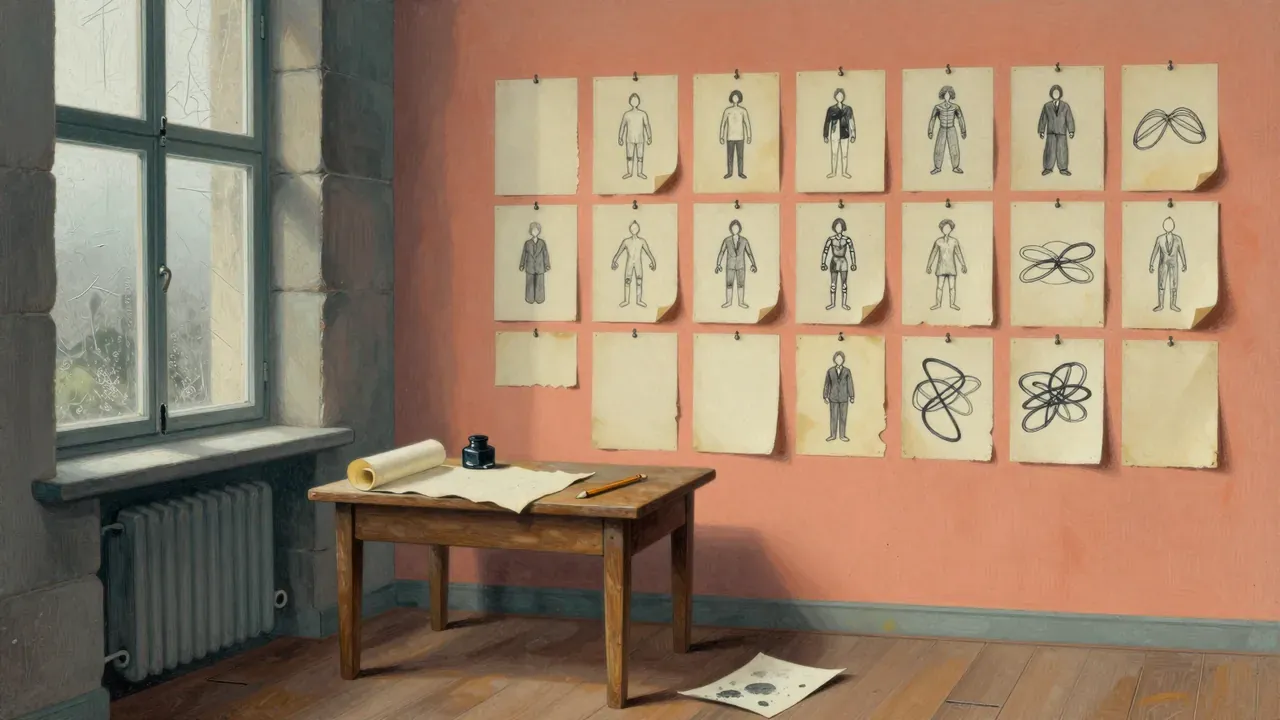
What lands is the cumulative pressure of isolation — not just geographical, but perceptual. The film makes the viewer feel the exhaustion of staying awake beside someone who is vanishing in real time. The recurring motifs — the ceiling-walking figure, the faceless woman, the dinner table where no one eats — gain force through repetition without explanation, operating like symptoms rather than symbols. The island setting is not backdrop but participant: its cliffs, fog, and narrow paths compress space until interior and exterior geography blur. Von Sydow’s sketches, shown plainly on screen, carry more narrative weight than dialogue; they are evidence of a mind mapping its own dissolution. Ullmann’s monologue — delivered directly to camera, unbroken — lands with quiet authority because it refuses catharsis or diagnosis; it simply reports what she saw. The film’s restraint in performance and editing means that when violence arrives, it does so without fanfare or aftermath, leaving the viewer unsettled not by what happens but by how little it is framed. This is horror stripped of genre scaffolding: it works because it treats delusion as physics, not pathology. (157 words)
What slips away
What does not land is the attempt to anchor the visions in folklore or literary allusion. References to Mozart’s The Magic Flute or Hoffmann’s The Golden Pot remain opaque, neither dramatised nor translated into visual logic — they sit as footnotes rather than foundations. The Birdman, for instance, gains no resonance from its Papageno origin; it functions only as a name attached to a shape. Similarly, the film’s stated folkloric title — ‘hour of the wolf’ — carries no cultural weight within the frame: there is no ritual, no communal belief, no shared understanding among characters that might root the term in practice. The prologue and epilogue, cut from final release, would have clarified the film’s status as constructed fiction; their absence leaves some sequences feeling unmoored, not ambiguous but under-contextualised. The ending, too, offers no resolution beyond disappearance — not mystery, but erasure — which may read as evasion to viewers expecting psychological closure or moral framing. Bergman’s refusal to distinguish between Johan’s subjective collapse and objective event also risks flattening consequence: actions lack gravity because their reality remains perpetually in question. That is a choice, not a failure — but it denies the film the emotional leverage it might otherwise achieve. (159 words)
The weight beneath
The themes that matter are insomnia as ontological crisis, the artist’s entanglement with their own creations, and the porous boundary between care and complicity in intimate relationships. Johan does not merely hallucinate; he names, sketches, and curates his visions — turning terror into output, then output into proof of decay. Alma’s role is not to heal or interpret but to witness without intervening, her pregnancy underscoring the paradox of creation amid collapse. The film treats sexuality not as transgression but as exposure: bodies are observed, touched, invaded — not erotically, but as sites of vulnerability and surveillance. Time is fractured not for effect but as symptom: the ‘hour’ is not a period but a state — one where birth and death, insight and delusion, occur in the same breath. Bergman’s own reported experience of this ‘hour’ during conception gives the film biographical weight, but the work resists autobiography as explanation; instead, it treats personal extremity as a lens for examining how perception structures reality — and what remains when that structure fails. These are not abstract ideas but embodied conditions, made visible in the actors’ fatigue, the grain of the film stock, the silence between lines. (156 words)
Who walks with it
This film is for viewers who accept that psychological horror need not involve threat, that ambiguity can be more unsettling than revelation, and that a film may refuse to explain itself without forfeiting coherence. It suits those familiar with Bergman’s earlier work — particularly Persona — or with European arthouse traditions where duration, silence, and unresolved tension are structural tools, not flaws. It is not for viewers who require narrative propulsion, clear cause-and-effect, or moral or psychological resolution. Those seeking conventional horror tropes — suspense built on danger, fear of the other, or cathartic confrontation — will find little here. Nor will those who expect the film to clarify whether Johan is ill, possessed, or simply cruel; it declines that arbitration. A viewer who values thematic rigour over plot mechanics, or who finds dread in stillness rather than motion, will engage deeply. Someone who needs the film to ‘say something’ about madness, rather than enact its texture, will leave frustrated — and that frustration is part of the film’s design, not a shortcoming. (158 words)
The time it takes
Yes, it is worth your evening — provided you approach it as an immersion, not a puzzle. Its 87 minutes pass with the weight of real time, not narrative time, and its power lies in that slowness: the way a glance lingers, a door creaks, a sketch fills the frame. It rewards attention not with answers but with recalibration — of how you register sound, how you read a face, how you hold space with another person on screen. It is not ‘enjoyable’ in any conventional sense, but it is consequential: few films render the exhaustion of vigilance so precisely, or make the act of witnessing feel so ethically charged. Those who dismiss it as obscure or self-indulgent often do so because they expect symbolism to yield meaning on demand — whereas Bergman treats symbol as symptom, not cipher. A different verdict would follow only if the film were recut to clarify causality, add exposition, or soften its tonal consistency — but that would not improve it; it would dissolve it. What it is, it is entirely. (157 words)