The shape of the story
Ugetsu is a Japanese period fantasy film set in the Azuchi–Momoyama era, adapting two tales from Ueda Akinari’s 1776 collection Ugetsu Monogatari. It is not a literal retelling but a structural and tonal distillation: Mizoguchi uses the ghost story framework to examine how war fractures domestic life, particularly for women. The film does not aim for historical realism or supernatural spectacle; instead, it treats the spectral as a psychological and social register — the uncanny as consequence, not ornament. Its ambition lies in sustaining a mood of quiet erosion: of time, memory, moral certainty, and the boundary between presence and absence. It avoids exposition, allegory, or didacticism, relying instead on sustained visual rhythm and restrained performance to convey loss that accumulates without fanfare. The film’s formal discipline — its scroll-like camera movement, low-key lighting, and deliberate pacing — serves this aim directly, not as style for its own sake but as syntax for a worldview in which suffering is diffuse, unremarked, and often invisible until it is too late. It is a film about what vanishes without sound.
The look of it
The story follows two men: Genjūrō, a potter who abandons his wife Miyagi to pursue wealth and status, and Tōbei, his brother-in-law, who trades domestic fidelity for samurai pretension. Their arcs unfold in parallel, each ending in hollow attainment — Genjūrō seduced by the spirit Lady Wakasa, Tōbei elevated while his wife becomes a prostitute. Masayuki Mori plays Genjūrō with minimal inflection, his face registering neither guilt nor revelation, only gradual disorientation. Machiko Kyō’s Lady Wakasa moves with Noh-inflected stillness; her hikimayu-styled brows and mask-like composure make her less a character than a condition — desire made architectural. Kinuyo Tanaka’s Miyagi, first living, then spectral, sustains emotional continuity across states without theatricality. Kazuo Miyagawa’s cinematography uses crane shots not for grandeur but for detachment: characters are often framed at a remove, dwarfed by landscape or architecture. Light is kept low, shadows deep and unbroken. The music — geza-style percussion, flutes, harp accents reserved for the supernatural — works as punctuation, not accompaniment. Every craft choice serves the same end: to hold the viewer at a distance that feels like gravity, not indifference.
What stays with you
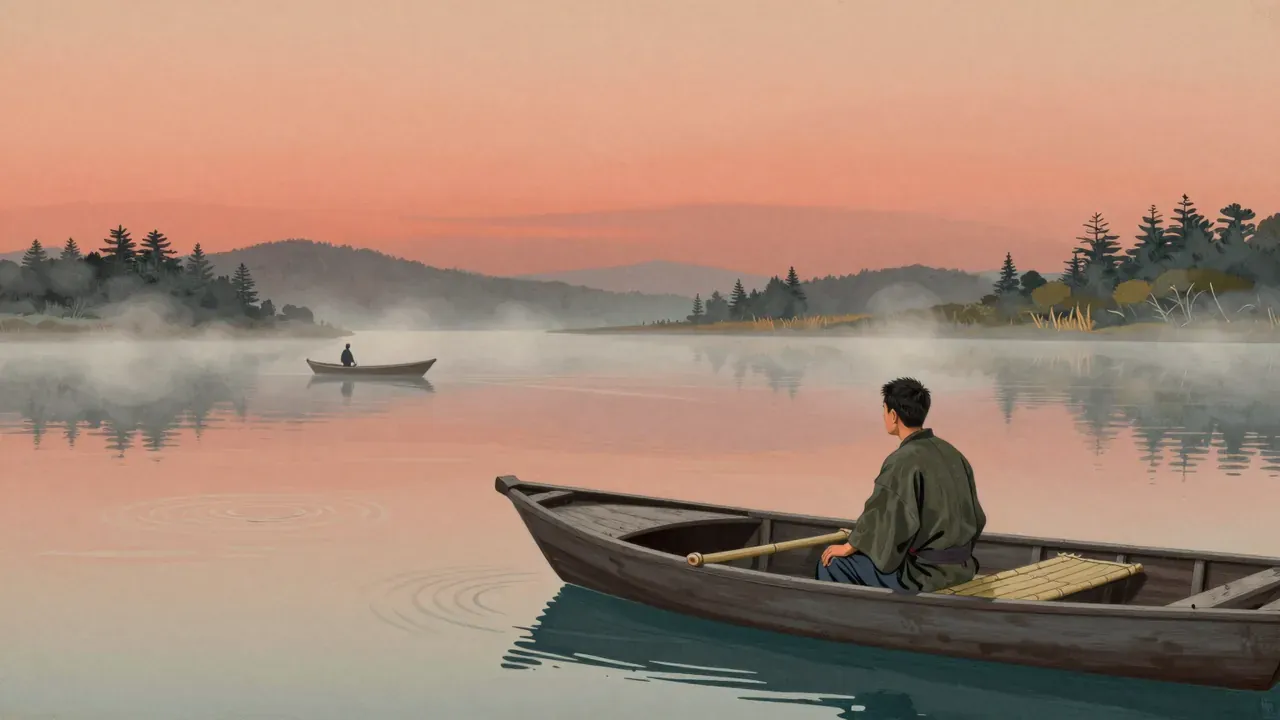
What lands most firmly is the film’s cumulative sense of quiet devastation. The scene where Genjūrō returns home to find Miyagi waiting — calm, practical, already dead — does not rely on shock or sentiment but on duration and silence: she folds laundry, speaks of their son, offers tea, all while the viewer slowly absorbs the impossibility of her presence. That sequence works because it refuses to underline its own horror; it trusts the audience to feel the weight of what is unsaid and unseen. Similarly effective is the lake crossing — shot on a studio pool, smoke diffusing the edges — which feels less like artifice than atmospheric truth: the world itself has thinned, become permeable. The performances land because they reject interior monologue; Mori’s blankness reads as exhaustion, not vacancy; Tanaka’s ghostliness emerges from stillness, not makeup. Even the score’s restraint lands: the harp does not announce the supernatural so much as mark a shift in air pressure. These elements cohere not through emphasis but through consistency — a shared grammar of understatement that makes the emotional impact arrive not as climax but as realisation, delayed and irreversible.
Where it loosens
What does not land is the subplot involving Tōbei’s rise to samurai rank, which remains structurally necessary but emotionally thin. His arc functions as counterpoint rather than counterpart: where Genjūrō’s descent is internal and metaphysical, Tōbei’s is external and satirical, yet the film gives him little interior life beyond ambition and shame. Eitarō Ozawa plays him with earnestness, but the script offers no equivalent to Miyagi’s spectral return or Lady Wakasa’s symbolic density — his wife’s fate is reported, not witnessed, and her off-screen prostitution lacks the tactile specificity of other losses. The film’s anti-war thrust also strains at points: while Mizoguchi stated his intent to show how violence ‘oppresses and torments the populace both physically and spiritually’, the civil war remains a distant rumble, never a visceral presence. There are no battle scenes, no soldiers on screen — only consequences. This is a deliberate choice, but it risks making the theme feel inferred rather than embodied. Some viewers may find the pacing too deliberate, the repetitions too insistent — the second boat journey, the third return home — not as ritual but as redundancy.
What it means
The themes that matter are those embedded in domestic erasure: how war displaces women not only physically but ontologically, reducing them to memory, myth, or absence. Miyagi’s ghost is not a haunting but a residue — the persistence of care after death, the continuation of duty beyond life’s end. Lady Wakasa embodies the seduction of escape: not lust per se, but the allure of a world unburdened by consequence, where desire has no cost. The film treats class not as hierarchy but as vulnerability — Genjūrō’s pottery is honest labour; his later success is built on illusion and exploitation. Time is another theme: not linear progression but layering — past and present coexist in the same space, as when Genjūrō walks through his ruined village and sees his wife as she was. The film’s spiritual dimension is not religious but phenomenological: it asks what remains when everything solid dissolves — not soul, not afterlife, but gesture, habit, the folded sleeve, the poured cup of tea. These are not abstract ideas but material facts, rendered visible through repeated, unadorned action.
Who it is for
This film is for viewers who value sustained mood over plot propulsion, who find emotional resonance in restraint, and who accept that ambiguity is not evasion but precision. It rewards attention to texture — the grain of wood, the fall of light on silk, the pause before a line is spoken — and tolerates longueurs as part of its logic. It is not for those who require narrative clarity, psychological exposition, or cathartic release. Viewers expecting folklore spectacle or ghost-story thrills will find it withholding; those accustomed to Western dramatic arcs may read its repetitions as indecision rather than design. Anyone needing explicit moral framing or closure will leave unsettled — not because the film is obscure, but because it refuses to resolve what history leaves unresolved. A viewer who values Hayao Miyazaki’s environmental patience or Robert Bresson’s ascetic economy may find common ground here; one who prefers Kurosawa’s kinetic urgency or Ozu’s domestic warmth will likely feel alienated. The film assumes its audience shares its belief that some truths are held in silence, not speech.
Why it lasts
Yes, it is worth your evening — provided you watch it as it intends to be watched: unhurried, in one sitting, with full attention to image and sound. Its 96 minutes do not pass quickly, but they accumulate weight like sediment. It repays rewatching not for hidden clues but for deeper attunement — to how Miyagawa’s crane shots isolate characters within space, how Hayasaka’s harp enters only when reality frays, how Tanaka’s gestures remain identical whether she is alive or dead. Those who dismiss it as ‘slow’ mistake tempo for emptiness; the slowness is the point — it mirrors the way grief and loss settle, not in moments but in intervals. Critics who gave it 100% on Rotten Tomatoes did not do so out of consensus but because the film’s coherence is total: every frame, note, and pause serves its central concern. To call it ‘masterful’ is not hype but description — it achieves exactly what it sets out to do, with no surplus, no shortfall. It earns its reputation not by impressing, but by persisting.