The weight of the first act
El Norte is a three-act dramatisation of forced migration from Guatemala to the United States, structured as a border triptych: flight from violence in San Pedro; transit through Mexico with its layered hostilities and makeshift alliances; and settlement in Los Angeles under the constant pressure of undocumented status. It attempts to render visible a population rendered statistically invisible — Central American refugees in early-1980s Southern California — by anchoring their experience in the specific bodies, speech, and silences of two Mayan teenagers. The film avoids allegory in favour of procedural realism: union organising, coyote negotiation, sewer-pipe crossing, day-labour queues. Its ambition is not symbolic uplift but structural clarity — to show how political terror, economic extraction, and racialised exclusion operate across national lines as a single system. It treats the US-Mexico border not as a line on a map but as a lived threshold where language, labour, and legality are all subject to sudden, violent recalibration. The film’s quiet insistence on indigenous presence — in voice, gesture, and worldview — counters the erasure common to both Guatemalan state narratives and US immigration discourse.
The middle is a border
The story unfolds in strict chronological sequence, divided into titled chapters that mark geographic and psychological thresholds. Performances avoid theatrical emphasis: Zaide Silvia Gutiérrez and David Villalpando, both non-professionals making their first film appearances, carry scenes through physical restraint — a flinch, a held breath, a glance away from authority. James Glennon’s cinematography favours medium shots and shallow focus, keeping faces legible but surroundings slightly indistinct, as if seen through exhaustion. Lighting is functional rather than expressive: fluorescent glare in LA kitchens, dusty afternoon sun in Chiapas villages, the greenish murk of the sewer pipe. Sound design is sparse — no score until the final hospital sequence, where a muted string motif enters only after Rosa’s death. Editing avoids cross-cutting or montage, holding instead on duration: the time it takes to scrub a floor, wait for a bus, count out pesos, or watch rats move across a concrete wall. Dialogue remains grounded in Spanish idioms, untranslated except where meaning is clear from context or action — a refusal of linguistic accommodation that mirrors the film’s broader resistance to assimilationist framing.
The look of it
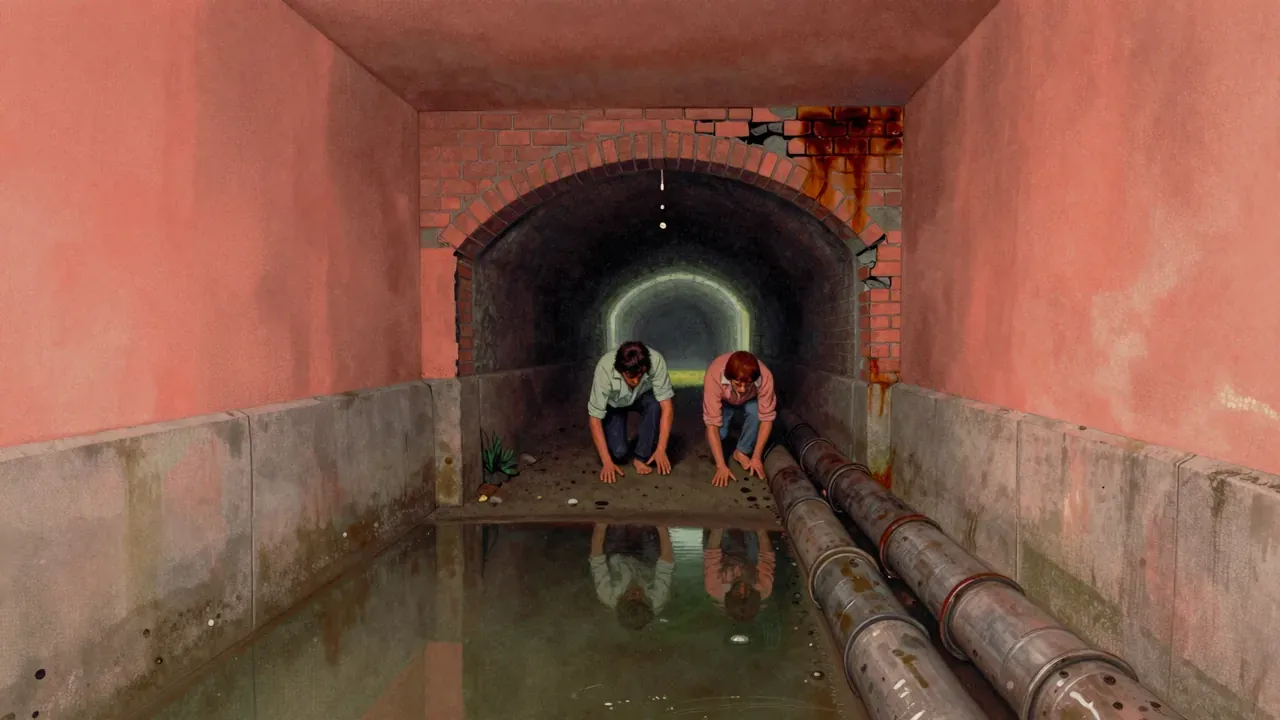
What lands is the cumulative weight of small, unremarkable choices made under constraint: Enrique choosing not to flee when Rosa falls ill, the godmother handing over coins wrapped in cloth, the truck driver who refuses to take them because they name the wrong town. These moments gain force from their refusal of dramatic escalation — they feel like things that actually happen, not things written to provoke. The film’s moral gravity comes not from outrage but from precision: the way a US Border Patrol officer’s uniform fits too neatly, the exact shade of rust on a fence post in Tijuana, the sound of a washing machine startling Rosa because she has never seen one before. The sewer crossing works not as spectacle but as physiological fact — damp concrete, lab-bought rats, Gutiérrez’s real panic — and so does the hospital scene, where bureaucratic silence replaces dialogue, and the camera stays at bed level, refusing to look up at doctors or charts. Even the ending — a return to the image of a severed head — lands not as irony but as recurrence: the same violence, relocated, recontextualised, but structurally unchanged.
The sound of silence
What does not land is the framing device implied by the title and the opening narration, which gestures toward mythic northward pilgrimage but never fully integrates it into the texture of the film. The Mayan cosmology suggested in Arturo’s speeches remains illustrative rather than operative — we hear about sacred geography but never see it enacted. Some transitions between sections feel abrupt: the shift from rural Guatemala to Mexican highway lacks the spatial continuity that would ground the journey geographically. A few supporting performances — particularly those of minor officials or employers — verge on caricature, relying on broad vocal inflection or costume shorthand rather than behavioural specificity. The film’s commitment to realism occasionally strains against its own budgetary constraints: the California-built ‘Mexican village’ reads as convincing only in long shot, and some interior scenes in LA apartments suffer from flat lighting and static blocking. Most notably, the final image — the severed head — risks collapsing the film’s careful accumulation of lived detail into a single, overdetermined symbol, undercutting the earlier insistence on ambiguity and process.
The work in it
The themes that matter are displacement as a condition without resolution, labour as identity and erasure, and language as both barrier and weapon. The film treats documentation not as paperwork but as ontological status: to lack papers is to lack legal personhood, medical access, housing security, even the right to grieve publicly. It shows how racism operates across hierarchies — Guatemalan elites dehumanising Mayans, Mexican authorities distrusting Central Americans, US employers exploiting undocumented workers — without flattening distinctions between them. Class is inseparable from ethnicity: Arturo’s observation that the rich see peasants as ‘strong arms’ echoes in Enrique’s final position in the parking lot, offering his body for hire. The film also treats time as unevenly distributed: years pass in minutes for the refugees, while institutions — courts, hospitals, borders — move with glacial indifference. There is no redemptive arc, no integration fantasy, no suggestion that arrival equals safety. Instead, the film insists on continuity: the same structures that kill Arturo in San Pedro shape Enrique’s life in Los Angeles, just with different uniforms and different names for the same violence.
The shape of the ending
This film is for viewers who expect narrative to serve inquiry rather than comfort — teachers using it in human geography or migration studies, students encountering Central American history outside textbook abstractions, and anyone willing to sit with unresolved endings and untranslatable grief. It is not for those seeking catharsis, character arcs, or stylistic flourish; its pacing assumes patience with stillness, its politics assume familiarity with Cold War context, and its Spanish-language dialogue assumes either fluency or willingness to read subtitles without translation crutches. Some will find its refusal of hope alienating — particularly those accustomed to films where perseverance yields reward. Others may object to its narrow focus on individual experience without explicit analysis of US foreign policy or corporate complicity. A viewer who needs exposition, moral clarity, or visual polish would likely leave frustrated. But for those who value rigour over reassurance, El Norte remains indispensable — not as entertainment, but as evidence.
The terms of watching
Yes, it is worth your evening — not because it is easy, but because it is rare: a film that treats refugee experience as material fact rather than metaphor, and does so without condescension or sensationalism. Its 141 minutes unfold with the weight of actual time — not rushed, not padded, but measured in breaths, footsteps, and silences. You will not leave uplifted, but you may leave less certain of borders, both literal and cinematic. Those who prefer tightly plotted thrillers or emotionally resolved dramas will find it withholding. Those who expect historical films to explain causes rather than inhabit consequences may feel adrift. But if you accept that some stories resist closure — that some journeys end not in arrival but in repetition — then El Norte repays attention with precision, dignity, and quiet, unblinking honesty. Its value lies not in what it promises, but in what it refuses to obscure.