The shape of it
O Brother, Where Art Thou? is a satirical comedy-drama that transposes the narrative architecture of Homer’s Odyssey onto the Depression-era American South. It does not aim for fidelity to the ancient text but uses its structural motifs — the wandering hero, the beguiling Sirens, the one-eyed Cyclops, the faithful wife waiting at home — as scaffolding for a self-aware, regionally grounded farce. The film treats myth not as solemn inheritance but as folk material: malleable, half-remembered, sung in barbershop harmonies or shouted over a prison chain gang’s rhythm. Its ambition is tonal and formal: to sustain a world where biblical gravity coexists with vaudevillian timing, where political corruption wears flour-sack suits and spiritual yearning sounds like a gospel quartet singing over a muddy riverbank. It is less an adaptation than a reharmonisation — borrowing the Odyssey’s cadence while replacing its dactylic hexameter with delta blues, bluegrass, and Baptist hymnody. The Coens treat the South not as a sociological case study but as a vernacular stage, thick with dialect, superstition, radio static, and the persistent hum of cicadas.
The sound of it
The story follows Ulysses Everett McGill and two companions escaping a Mississippi chain gang in 1937, chasing rumoured treasure while evading Sheriff Cooley and stumbling through a sequence of loosely episodic encounters — a blind prophet, a trio of seductive women by the river, a Ku Klux Klan rally, a radio studio, a flood. George Clooney’s Everett anchors the film with studied vanity and flustered intelligence; John Turturro’s Pete is sullen and literal-minded; Tim Blake Nelson’s Delmar is credulous and rhythmically precise. Their performances are calibrated to the film’s heightened register: broad enough for caricature, specific enough to feel lived-in. Roger Deakins’ cinematography sustains a dry, sun-bleached palette achieved through the first full digital intermediate in a Hollywood feature — desaturating greens into ochres, softening edges without blurring them. T Bone Burnett’s soundtrack is woven into the plot, not layered over it: songs advance character, punctuate irony, and sometimes replace exposition. Editing by the Coens and Tricia Cooke keeps pace with the music’s phrasing, cutting on beats rather than breaths.
The rhythm of it
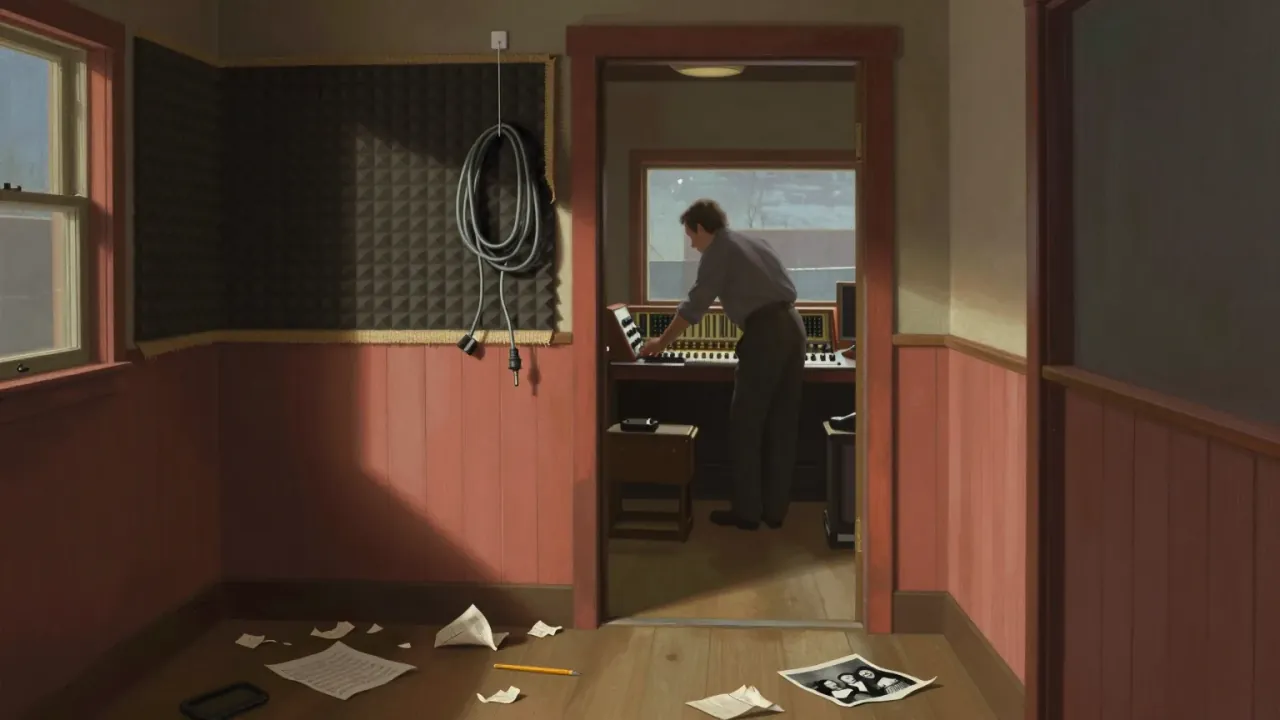
What lands most firmly is the film’s sonic and visual cohesion. The sepia-toned image — parched, grainy, faintly amber — feels like a photograph left too long in a tobacco tin, and it never wavers in tone or temperature. The music does not merely accompany action; it structures it. When the Soggy Bottom Boys record ‘Man of Constant Sorrow’, the scene works because the recording process is shown as laborious, technical, and strangely sacred — microphones hung from rafters, voices tested for timbre, silence enforced with a raised finger. Holly Hunter’s Penny, though given little screen time, registers with quiet, unyielding precision: her final line carries the weight of years withheld, not melodrama. The Klan sequence lands not through horror but through absurd ritual — the ceremonial dance, the cardboard horns, the bureaucratic fuss over membership forms — making its menace both real and ridiculous. Even the flood, arriving without warning or explanation, lands as a force of nature and narrative necessity, washing away old debts and resetting the moral ledger.
The weight of it
What does not land is the film’s attempt to balance satire with emotional stakes. Everett’s longing for Penny remains abstract, his paternal claim over his daughters untested until the final minutes — and even then, resolved through contrivance rather than consequence. The political subplot involving Governor Pappy O’Daniel and challenger Homer Stokes gestures toward populism and media manipulation, but reduces both men to cartoonish archetypes without probing their appeal or cost. Charles Durning’s Sheriff Cooley is menacing only in silhouette and reputation; he never fully occupies the same reality as the leads, becoming more a narrative device than a character. Some set pieces — the Bible-selling con, the radio station interlude — rely on period detail over dramatic logic, their humour dependent on recognition rather than surprise. The film’s refusal to settle into either pure farce or earnest allegory leaves certain emotional notes flat: grief, regret, and moral exhaustion are implied but rarely embodied. It is generous with texture, sparing with weight.
The voice of it
The themes that matter are those embedded in form and repetition: the endurance of song as cultural memory, the elasticity of truth in oral tradition, and the way power disguises itself as folksiness. Music here is not ornament but infrastructure — the means by which news travels, faith is sustained, and identity is forged. The recurring motif of recording — whether phonograph, radio broadcast, or church choir — points to a South in transition from communal storytelling to mediated performance. Political theatre is treated as indistinguishable from show business: O’Daniel sells flour and salvation with the same jingle; Stokes sweeps corruption with the same broom he uses to sweep dust from his platform. The film also probes the instability of names and origins: ‘Ulysses’ is a borrowed alias, ‘Soggy Bottom Boys’ a manufactured brand, ‘Pappy’ a title stripped of paternity. Myth is not inherited but improvised — patched together from fragments of scripture, radio ads, prison chants, and lullabies. What endures is not the story itself but the act of telling it, again and again, in whatever key the moment allows.
The ear of it
This film rewards viewers who listen closely to language, who recognise musical idioms across genres, and who find pleasure in formal rigour — the exactness of a fade-out, the placement of a cut, the calibration of a vocal harmony. It suits those comfortable with irony that does not preclude affection, and satire that does not require contempt. It is less suited to viewers seeking psychological realism, linear cause-and-effect, or moral clarity: the characters operate by folk logic, not motivation, and the film declines to judge them for it. Those expecting a straightforward Depression-era drama or a faithful Homeric retelling will find neither. Nor will those impatient with deliberate pacing, stylised delivery, or extended musical sequences that pause narrative momentum. A viewer who values emotional immediacy over tonal consistency may find the film emotionally distant — not cold, but reserved, like a well-polished heirloom kept behind glass rather than worn daily.
The time of it
Yes, it is worth your evening — provided you approach it as a crafted object rather than a story to be followed. Its 103 minutes pass with rhythmic certainty, each scene tuned to the same key: dry, warm, slightly off-kilter. The digital colour grade holds up; the soundtrack remains vivid and structurally essential; the performances gain resonance on repeat viewings. Those who dismiss it as ‘quirky’ or ‘style over substance’ miss how tightly craft and theme are wound — the sepia tint is not nostalgia but erasure; the a cappella harmonies are not decoration but communal resilience. A viewer who demands naturalistic dialogue or causal plotting will leave unsatisfied, and nothing in the film seeks to persuade them otherwise. Change the ratio of music to monologue, or ground the sheriff in tangible threat, and the verdict might shift — but as it stands, its coherence and control make it a rare kind of entertainment: precise, pleasurable, and quietly insistent.