What it is trying to do
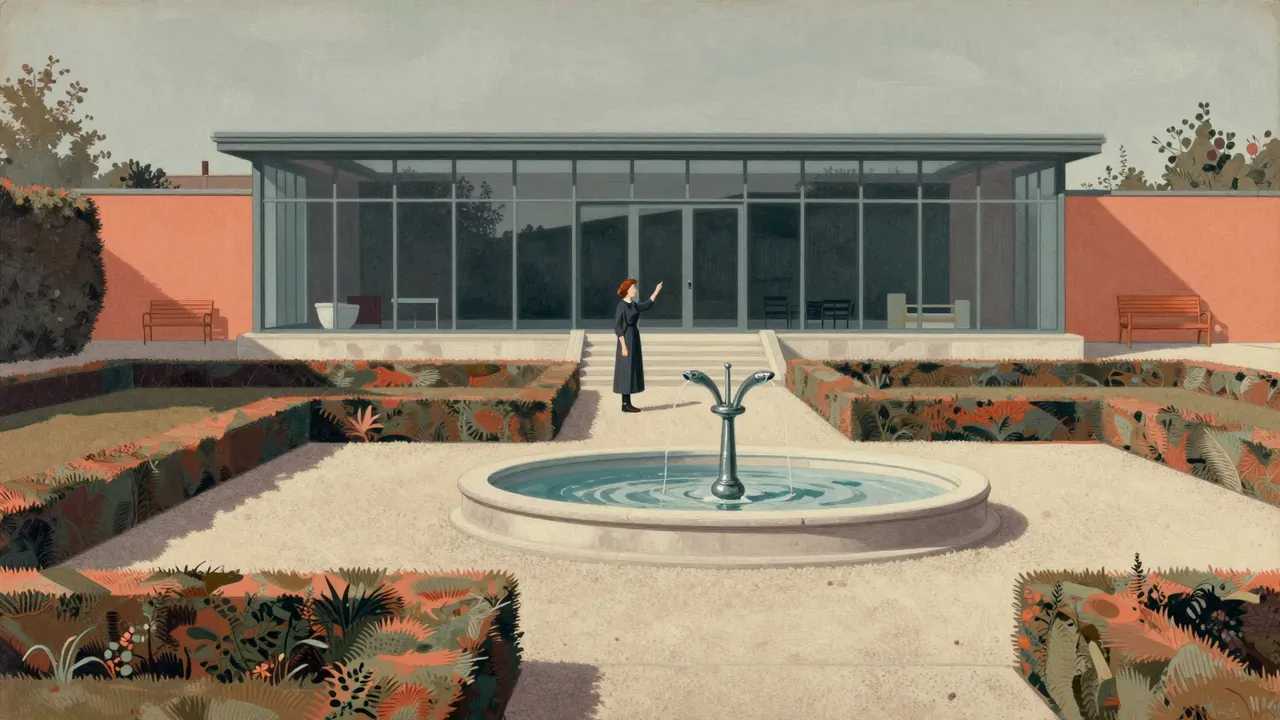
Mon Oncle is a French comedy film released in 1958, directed by and starring Jacques Tati. It uses visual satire to examine the friction between traditional social warmth and postwar France’s embrace of mechanised domesticity and architectural conformity. The film does not argue through dialogue — much of it is inaudible or treated as ambient noise — but through contrast: between the Arpels’ gleaming, geometric villa and the crumbling, lived-in streets where Monsieur Hulot lives; between rigidly timed routines and unscripted human error; between surfaces designed for display and spaces shaped by use. Tati’s aim is neither nostalgic nor polemical in the usual sense, but observational: to show how form, when divorced from function and feeling, produces alienation even in comfort. The film’s colour palette, sound design and choreography all serve this purpose, not as decoration but as structural elements of its critique. It is a comedy of misalignment — between intention and outcome, design and behaviour, modernity and humanity.
How it works
The story follows M. Hulot, an affable, unmoored uncle who drifts between his nephew Gérard’s sterile suburban home and his own ramshackle Parisian neighbourhood. Jean Bourgoin’s cinematography keeps the Arpel house crisp and shallow in focus, while the old quarter is shot with deeper space and softer edges. Alain Romans’ score distinguishes worlds: jaunty, slightly off-kilter music for Hulot’s sphere; repetitive, synthetic motifs for the villa’s appliances. Suzanne Baron’s editing sustains rhythm without hurry, allowing gags time to settle — like the fish fountain activated only for guests, or the kitchen gadgets that roar louder than conversation. Performances are understated and physical: Tati’s Hulot communicates through posture and hesitation; the Arpels through stiff gestures and rehearsed smiles. Non-professional actors populate both settings, their movements calibrated to environment rather than psychology. There is no voiceover, no exposition, no character backstory beyond what is visible in costume, gait or the way someone leans against a wall.
What lands
What lands most firmly is the film’s architecture of irony: every modern object in the Arpel house functions just well enough to frustrate, never well enough to serve. The stepping stones are too far apart, the chairs too angular, the automatic door too slow and too loud. These are not jokes about incompetence but about misplaced priorities — aesthetics over ergonomics, novelty over necessity. The contrast between Gérard’s boredom at home and his alertness around Hulot feels truthful, not sentimental. The film’s pacing, though deliberate, allows space for small discoveries: a dog’s reflection in a polished floor, steam rising from a manhole cover, the way light catches dust motes above a cluttered street corner. Even the English-language version’s minor staging differences — signs translated, background voices left in French — reinforce the idea that meaning resides in texture, not translation. The satire avoids caricature because it treats both worlds with equal attention: the old quarter is not idealised, only more forgiving of human imperfection.
What does not
What does not land consistently is the film’s middle stretch, where the satire risks flattening into repetition. Several sequences hinge on the same dynamic: a machine malfunctions, a person reacts with mild dismay, and the gag resolves without escalation or variation. The workplace scenes at Plastac, for instance, offer little beyond what the villa already establishes — uniformity, noise, abstraction of labour — and lack the visual specificity that makes the home sequences memorable. Some supporting characters, particularly M. and Mme. Arpel, remain schematic: their motivations are legible but not deepened, their personalities defined by function (host, wife, manager) rather than contradiction. The film’s refusal of psychological exposition works in its favour most of the time, but here it leaves certain relationships underdeveloped — especially the Arpels’ growing exasperation with Hulot, which shifts from polite concern to active scheming without clear emotional pivot. A tighter edit might have sharpened this arc without sacrificing the film’s unhurried tone.
The themes that matter
The themes that matter are not abstract ideals but material conditions: how design shapes behaviour, how silence and noise govern social interaction, how consumerism reshapes kinship. The Arpels do not reject Hulot out of malice but because his presence disrupts the calibrated performance of their status — his ill-fitting shoes scuff their floors, his pauses break their conversational rhythm, his bicycle leaves grease marks on their driveway. Tati treats modernity not as ideology but as infrastructure: the layout of a garden, the wiring of a kitchen, the placement of a doorway. Class appears not in income but in access to time — Hulot has too much of it; the Arpels have none. The film’s quietest theme is resilience: not of individuals but of places and habits that persist despite planned obsolescence. The old quarter survives not because it is cherished but because it is used — patched, adapted, inhabited. This is not a lament for the past but a demonstration of how environments absorb, rather than erase, human inconsistency.
Who should watch it
This film is for viewers who value precision of observation over narrative propulsion, who find humour in timing and texture rather than setup-punchline structure, and who are comfortable with long takes and minimal dialogue. It rewards attention to background action, shifts in light, and the physical grammar of movement. It is not for those who require psychological motivation, rapid pacing or verbal clarity — the film’s near-silence will feel like evasion, not choice, to some. Those who expect satire to name names or assign blame may find its refusal to moralise frustrating. Its critique is systemic, not personal, and its targets — automation, standardisation, conspicuous consumption — remain current, but its method is patient, not urgent. A viewer who values argument over atmosphere, or explanation over implication, will likely leave unengaged. The film assumes a willingness to watch people breathe, hesitate, fumble — and to find that revealing.
Is it worth your evening
Yes, it is worth your evening — provided you approach it as a study in contrast rather than a story with stakes. Its 117 minutes unfold at the pace of a stroll through a city you know well enough to notice new cracks in the pavement. It repays rewatching not because it hides clues but because its details accrue: the way Hulot’s hat tilts differently each time he walks past the same lamppost, or how the fish fountain’s water changes colour with the light. Those who dislike films that withhold interpretation will find it withholding; those who appreciate sustained tonal control and compositional wit will find it generous. Its endurance lies not in nostalgia but in its accuracy: the tension between convenience and comfort, between efficiency and ease, remains unresolved. If the film felt dated, it would be easier to dismiss — but its central friction is still live, still local, still visible in any new housing development or smart appliance showroom. That continuity is why it holds up.