What it is trying to do
The Game is a neo-noir thriller that sets out to unsettle the viewer by dismantling narrative certainty. It follows Nicholas Van Orton, a San Francisco investment banker whose controlled life fractures after he accepts a cryptic birthday gift: participation in a game run by Consumer Recreation Services. David Fincher does not aim for plausibility but for psychological pressure — the film’s structure mimics the sensation of being watched, misdirected, and gradually stripped of interpretive authority. It treats genre conventions as scaffolding to dismantle: the detective is both investigator and subject; the conspiracy may be real or a feedback loop of his own making; even time and space behave inconsistently, with cuts that skip logic rather than explain it. The film’s ambition lies not in solving a mystery but in sustaining a state of epistemic vertigo — asking how much coherence an audience will tolerate before rejecting the frame entirely. Its model is less traditional thriller than cinematic equivalent of a controlled panic attack, calibrated to test thresholds of trust in image, sound, and story. (158 words)
How it works
The story moves through escalating disorientation, anchored by Michael Douglas’s tightly coiled performance as Nicholas — a man whose rigidity makes every deviation from routine feel like physical injury. Sean Penn grounds the brotherly relationship in weary affection rather than exposition, while Deborah Kara Unger’s Christine remains deliberately opaque, her motives shifting with each edit. Haris Savides’s cinematography sustains this unease: interiors are richly textured but drained of warmth, lit with deep shadows and muted highlights; exteriors bleed into overexposed neon and smeared streetlight, especially once Nicholas leaves his gated world. Howard Shore’s score avoids melody, favouring low drones and abrupt stings that punctuate silence rather than fill it. James Haygood’s editing is precise and withholding — scenes often end before resolution, cutting away from reactions, omitting establishing shots, refusing to confirm spatial continuity. Fincher uses the ENR colour process to soften night scenes, giving them a viscous, dreamlike density. The craft never draws attention to itself; instead, it accumulates pressure, turning composition, timing, and tonal shift into instruments of sustained dislocation. (159 words)
What lands
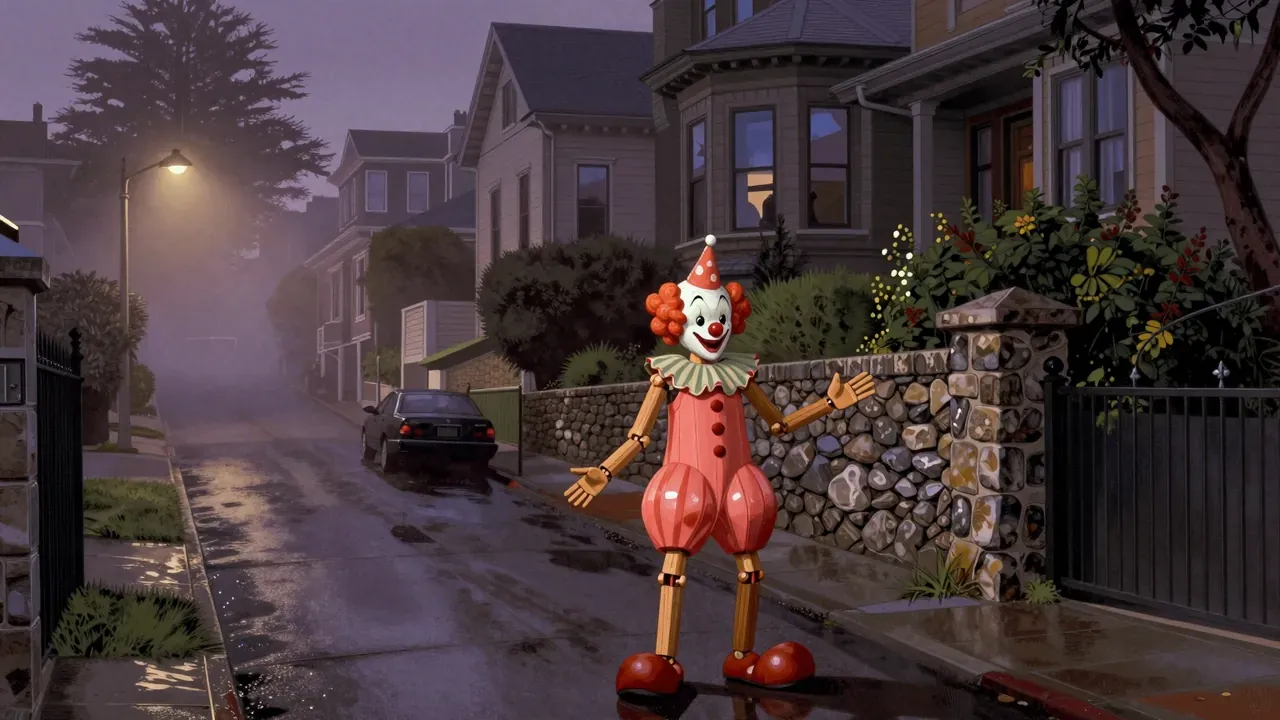
What lands is the cumulative effect of control eroding — not through spectacle, but through small, repeated violations of expectation. The taxi sinking into the bay works because it arrives without warning and without explanation, its horror rooted in physical helplessness rather than gore or shock. The wooden clown in the driveway lands because it is absurd, inert, and utterly unignorable — a visual non sequitur that refuses interpretation. The scene where Nicholas wakes in a hospital bed, unsure whether he has been drugged, kidnapped, or merely slept too long, lands because the camera stays at eye level, holding the ambiguity without commentary. The film’s best moments rely on duration and restraint: a long take of Nicholas walking through a silent office building, the hum of fluorescent lights growing louder, the floor tiles tilting imperceptibly. These are not set-pieces but slow leaks in the dam of certainty. The performances land because they avoid catharsis — Douglas never breaks down, only recalibrates; Penn never explains, only withdraws further. The film trusts the audience to sit with discomfort longer than most thrillers dare, and that patience is rewarded with visceral, unforced tension. (157 words)
What does not
What does not land is the final act’s pivot toward emotional resolution. Once the game’s mechanics are revealed — and especially once Conrad’s role is clarified — the film’s earlier ambiguity hardens into exposition, and the psychological texture gives way to plot mechanics. The rooftop confrontation feels narratively necessary but emotionally thin, its symbolism (the father’s suicide, the brother’s guilt) arriving too late and too neatly to carry the weight it’s asked to bear. Some supporting characters vanish without consequence — James Rebhorn’s CRS representative, Armin Mueller-Stahl’s doctor — their presence serving atmosphere rather than arc, which leaves structural gaps. The film’s refusal to define the rules of the game works for ninety minutes, but the last twenty require a kind of narrative accounting the film has spent its runtime resisting. Critics who found the ending unsatisfying — including some who praised the first two acts — did so not because it contradicts what came before, but because it trades sustained uncertainty for closure that feels grafted on rather than earned. The film’s greatest strength is its refusal to explain; its weakness is the moment it decides it must. (156 words)
The themes that matter
The themes that matter are loss of control, self-deception, and the architecture of privilege. Nicholas’s wealth insulates him not just materially but perceptually — he reads the world as legible, predictable, transactional. The game exposes how fragile that reading is, not by attacking his money but by hijacking his assumptions about causality, safety, and agency. His fear is not of poverty or violence but of irrelevance — of being observed, manipulated, and ultimately meaningless within a system he thought he mastered. The film treats class as a perceptual filter: the mansions, leather booths, and hushed restaurants aren’t backdrops but cognitive environments that shape how Nicholas interprets reality. When he enters the city’s underlit streets, it’s not just geography that changes but epistemology — the rules of evidence shift, memory becomes unreliable, motive dissolves. The film also interrogates masculinity as performance: Nicholas’s stoicism is not strength but avoidance; his brother’s impulsiveness is not weakness but a different kind of honesty. There is no redemption here, only recalibration — the ending offers not healing but a quieter, more porous form of vigilance. (154 words)
Who should watch it
This film is for viewers who value sustained mood over exposition, who find unease more compelling than revelation, and who trust a director to withhold meaning without betraying the viewer. It suits those familiar with Fincher’s work — particularly Seven and Zodiac — and those drawn to films where tone is the primary carrier of theme. It is not for viewers who require clear cause-and-effect, moral clarity, or character arcs that resolve through speech rather than silence. Those who dislike ambiguity in the first act will find the second unbearable; those who expect thriller payoffs in the third will leave frustrated. A viewer who values tight plotting over psychological texture — say, someone drawn to The Departed or Gone Girl — may find The Game’s resistance to explanation alienating. The film assumes patience, tolerates confusion, and rewards attention to framing and rhythm over dialogue. Its appeal is narrow but deep: it is not a crowd-pleaser, nor does it try to be. It asks for surrender, not engagement — and that demand excludes as many as it invites. (158 words)
Is it worth your evening
Yes, it is worth your evening — provided you watch it without expectation of resolution and with willingness to sit inside its disquiet for its full 128 minutes. Its power lies not in what it explains but in what it sustains: a prolonged, tactile sense of instability that few films achieve with such consistency. Those who find its pacing deliberate rather than sluggish, its opacity generative rather than evasive, will leave unsettled in the best way — with the lingering impression that the world outside the screen feels slightly less certain than it did before. It is not for casual viewing, nor for background consumption; it demands attention, but repays it with texture, precision, and quiet audacity. A viewer who dislikes it is not wrong — the film’s refusal to clarify is a formal choice, not a failure — but that choice is coherent, intentional, and executed without compromise. What would change the verdict? A shorter runtime would blunt its cumulative effect; a clearer ending would undermine its central proposition. As it stands, it earns its length and its ambiguity. (157 words)