The voyage begins
And the Ship Sails On is a satirical period comedy set aboard a luxury liner in July 1914, staged as a farewell voyage for the ashes of a legendary opera singer. It does not aim to reconstruct history or dramatise real events but to assemble a grotesque, self-aware pageant of European high culture on the brink of collapse. Fellini and his co-writers build the film as a floating opera house — part memorial service, part carnival, part rehearsal for catastrophe — where every passenger embodies a caricatured facet of Belle Époque society: voice teachers obsessed with vocal mechanics, aristocrats performing lineage like ritual, bureaucrats mistaking protocol for power. The film’s ambition is structural and tonal: to sustain a sustained, ornate absurdity that feels both archaic and knowingly artificial, using the ship as a closed world where decorum and disaster coexist without contradiction. It treats formality as its own kind of madness, and nostalgia as a stage direction.
The look of it
The story unfolds through Orlando, a journalist who speaks directly to camera, guiding the viewer through a procession of eccentric figures whose names and titles outweigh their psychology. Performances are broad, stylised, and deliberately un-naturalistic: Freddie Jones mugs amiably as Orlando; Pina Bausch appears as the Grand Duke’s blind sister, her stillness a counterpoint to the surrounding frenzy; Janet Suzman and Peter Cellier play aristocrats whose dialogue sounds like libretto fragments. Giuseppe Rotunno’s cinematography favours wide, shallow-focus tableaux, keeping faces sharp while backgrounds dissolve into painterly haze. Dante Ferretti’s sets dominate the frame — vast, symmetrical, and visibly constructed — reinforcing the film’s theatrical conceit. Gianfranco Plenizio’s score blends operatic pastiche with waltz-time irony, never settling into sincerity or parody alone. Ruggero Mastroianni’s editing sustains rhythm without urgency, letting gags breathe and silences linger.
What sticks
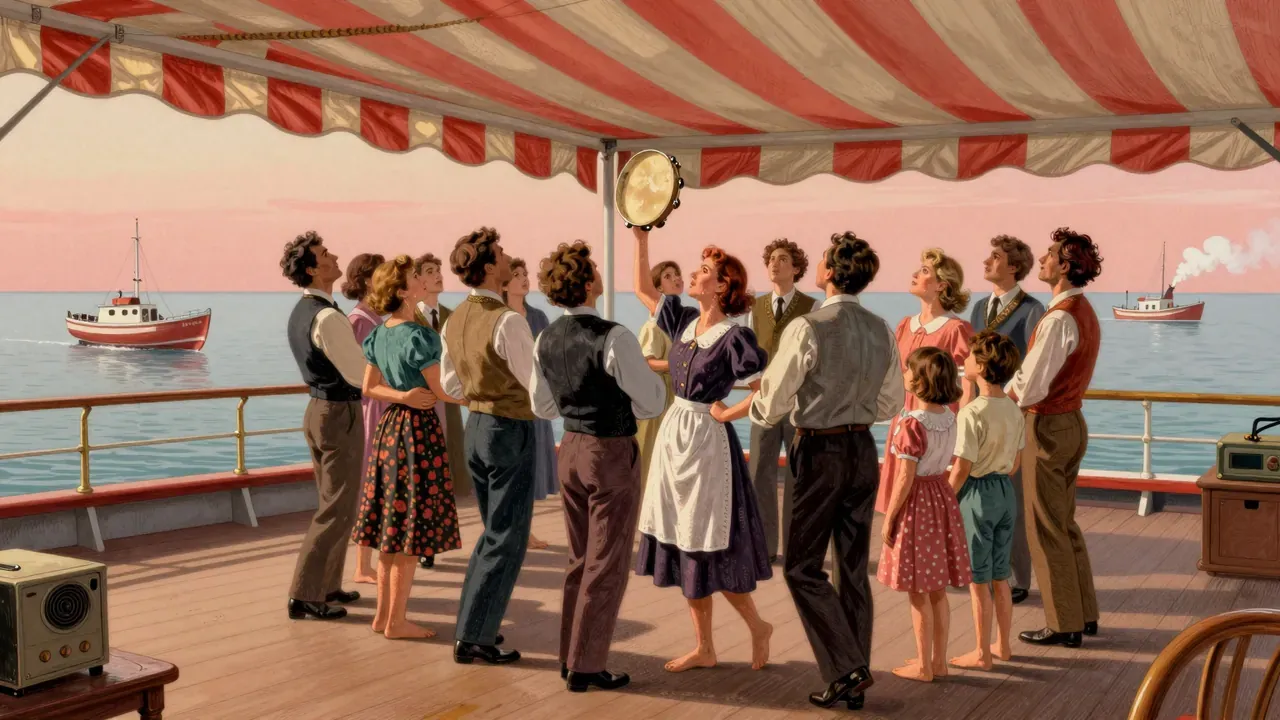
What lands is the film’s conviction in its own artifice. The opening sepia-to-colour transition establishes tone before a word is spoken, and the recurring motif of performers singing over machinery — opera voices echoing above coal-stoked furnaces — crystallises Fellini’s central irony: that high culture and industrial labour share the same vessel, same fate. The rhinoceros, absurd yet oddly tender, works as both physical gag and emblem of neglected vitality. The Serbian refugees’ arrival introduces genuine human texture without sentimentalising them; their folk dancing on deck is choreographed with warmth and specificity, not condescension. The final tracking shot — revealing the hydraulic jacks, plastic ocean, and smoke machines — lands not as a breaking of illusion but as an extension of it: the film acknowledges its own construction without undermining its emotional logic. This self-reflexivity feels earned, not coy.
Where it drifts
What does not land is the film’s reliance on caricature without sufficient variation in rhythm or consequence. Many characters — the jealous soprano, the voyeuristic English lord, the scheming prime minister — remain static sketches, their traits repeated rather than developed. The satire lacks bite because it rarely targets anything beyond surface manners; there is no moral friction, no character who questions the voyage or its purpose beyond comic obstruction. The Austro-Hungarian flagship’s appearance feels abrupt, its threat under-motivated by narrative logic and over-reliant on historical shorthand. Some set-pieces — the chicken-hypnotising basso, the actor seducing sailors — amuse briefly but leave no residue. The film’s refusal to anchor itself in psychological realism or political specificity means its critique of pre-war Europe stays decorative rather than incisive. It gestures at decay but rarely shows its weight.
What it’s really about
The themes that matter are the fragility of cultural consensus, the theatre of mourning, and the collusion between spectacle and oblivion. Fellini treats the ship not as a microcosm of society but as its last curated exhibition: every passenger performs grief, status, or expertise as if auditioning for posterity. The film insists that ritual — whether dispersing ashes, staging opera, or enforcing class boundaries — is how societies defer confronting their own endings. Its strongest idea is that formality is not the opposite of chaos but its most reliable disguise. The Serbians’ arrival disrupts this order not with violence but with presence — bodies too real for the ship’s aesthetic economy — and their expulsion confirms that shared humanity is negotiable when ceremony demands closure. The rhinoceros, ignored until crisis, stands for what culture chooses not to see until it blocks the corridor. These ideas are embedded in composition and pacing more than dialogue, making them felt rather than argued.
Who it’s for
This film is for viewers who value design over drama, who find pleasure in sustained tonal control and visual wit over narrative propulsion. It rewards attention to costume, framing, and the choreography of crowds. It is not for those who require psychological coherence, causal plotting, or moral stakes — the film offers none of these as priorities. Those expecting satire with teeth may find its gentleness frustrating; those seeking historical insight will find only allegory. A viewer who dislikes theatricality, resists artifice, or expects characters to evolve will likely disengage by the second act. What would change the verdict is tighter rhythmic variation — a sharper contrast between stillness and chaos, or a single character allowed interiority — but Fellini’s choice is deliberate: he builds a monument, not a portrait.
Is it worth your evening
It is worth your evening if you accept it as a chamber piece of cinematic theatre — ornate, unhurried, and self-contained. Its 128 minutes pass without strain because it refuses urgency, trusting its imagery and rhythm to hold attention. It is not demanding, but it is particular: it asks for patience with repetition, tolerance for ambiguity, and appreciation of craft as content. Those who watch films for plot or catharsis may feel adrift; those who watch for texture, timing, and the pleasure of watching skilled artisans at work will find it generous. Its value lies not in revelation but in consistency — a fully realised, unapologetically artificial world that holds its shape from first frame to last. It does not argue, persuade, or unsettle. It simply sails — and that is enough.