The shape of the story
Sansho the Bailiff is a Japanese period drama set in eleventh-century Heian Japan, adapting Mori Ōgai’s 1915 short story — itself drawn from older oral tradition — about two aristocratic children sold into slavery after their father’s political exile. It does not aim to reconstruct history but to test moral endurance across time and status: how mercy persists, fractures, or reassembles under systemic cruelty. Mizoguchi treats the story as a parable of ethical inheritance, centring the father’s injunction — ‘Without mercy, man is like a beast’ — not as doctrine but as a fragile, contested object passed between generations, geography, and memory. The film refuses psychological exposition; motivation is shown through posture, silence, and repeated gesture rather than interior monologue. Its ambition is structural and philosophical: to trace the slow, irreversible deformation of conscience under coercion, then its partial, costly restoration. It assumes no prior knowledge of Japanese history or sekkyō-bushi, yet presumes the viewer can hold contradiction — that Zushiō’s brutality is neither excused nor dismissed, but held alongside his father’s statuette of Kannon, which remains unbroken even when forgotten.
The look of it
The narrative unfolds in measured, unbroken sequences: Kazuo Miyagawa’s cinematography favours deep-focus long takes, often tracking laterally across landscapes or holding fixed on faces as decisions settle. Performances avoid emphasis; Kinuyo Tanaka’s Tamaki speaks little after her separation, her grief registered in the angle of her shoulders and the rhythm of her breathing. Kyōko Kagawa’s Anju carries conviction without flourish; her final act is not declamatory but quiet, deliberate, and physically unadorned. Eitarō Shindō’s Zushiō moves from boyish deference to numb authority to anguished reawakening — all without vocalised crisis. Yoshikata Yoda and Mori Ōgai’s script omits exposition: we learn the slave camp’s rules by watching branding, not hearing them recited. Fumio Hayasaka’s score is sparse, using koto and shakuhachi only at moments of rupture — the lake, the beach, the burning manor — never to underscore emotion but to mark thresholds. There are no close-ups for revelation; meaning accrues in the space between shots, in what characters do not say while walking, waiting, or kneeling.
What holds the eye
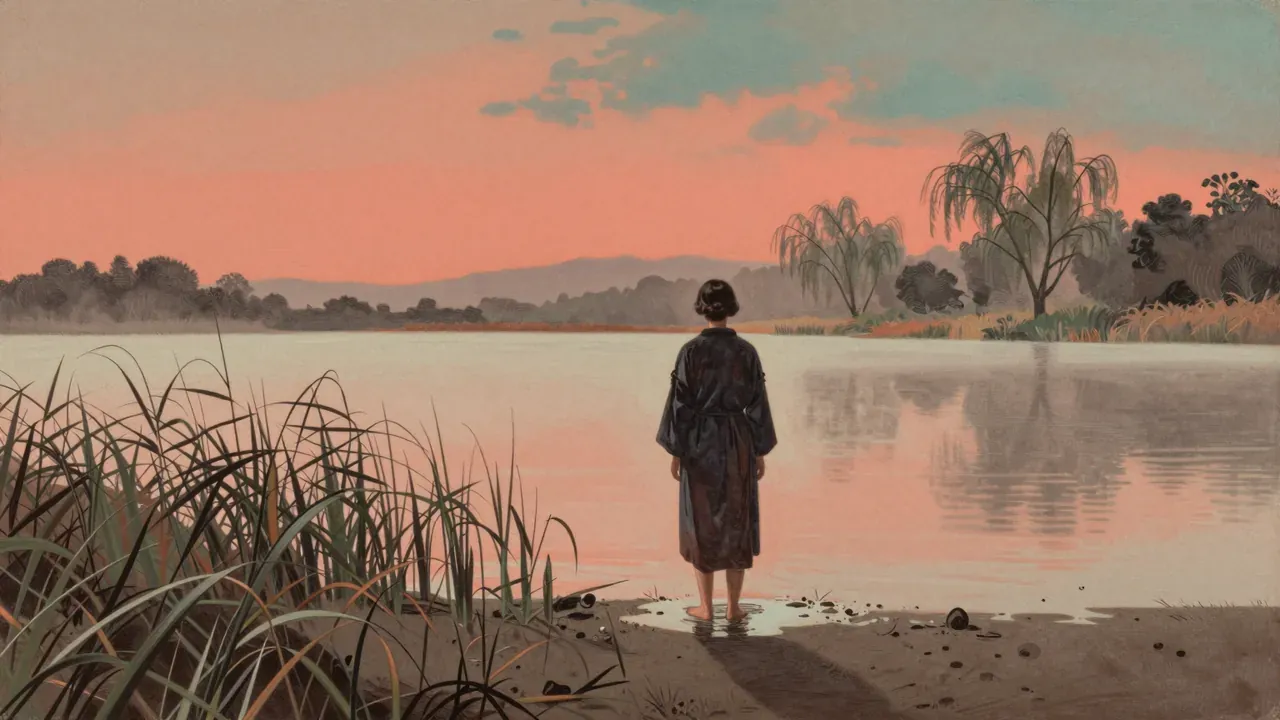
What lands most decisively is the film’s refusal to separate justice from memory. Zushiō’s governorship is not triumphant but exhausted; his edict abolishing slavery is met with disbelief, not celebration, because the system it opposes has shaped every character’s reflexes. The lake scene works not for its symbolism but for its physical logic: Anju’s walk into water is neither theatrical nor rushed — she removes her sandals, steps in, and disappears beneath still surface. The beach reunion lands because Tamaki’s blindness is treated as fact, not metaphor: she identifies her son by touch, not sight, and accepts his words only after confirming the statuette’s grooves with her fingers. These moments avoid sentiment by anchoring feeling in tangible detail — the weight of a wooden statuette, the sound of reeds snapping underfoot, the way smoke rises from burning thatch without wind. The film trusts duration: a ten-second pause before Zushiō turns away from Namiji’s body carries more consequence than any soliloquy could.
Where the frame narrows
What does not land — or lands uneasily — is the framing device of the father’s exile and moral instruction. His brief appearance establishes the film’s ethical axis, but his banishment feels narratively expedient rather than dramatically necessary; the political context remains vague, unnamed, and unexamined. Sanshō himself is less a character than a function — an embodiment of institutional indifference — and though Ichirō Sugai plays him with chilling stillness, the film gives him no interiority, no motive beyond administrative routine. This is deliberate, but it risks flattening the antagonist into abstraction, making his defeat feel procedural rather than earned. Tarō’s humane intercession also lacks grounding: his compassion appears without antecedent, unearned by prior action or dialogue. The film’s austerity serves its themes, yet in these instances it sacrifices dramatic causality for thematic purity. A viewer attuned to psychological realism may find these omissions frustrating, not disciplined — mistaking restraint for omission, or economy for evasion.
What it asks of us
The themes that matter are mercy as practice, not principle; memory as embodied habit, not recollection; and freedom as relational, not individual. The film treats mercy not as sentiment but as labour — Zushiō’s choice to carry Namiji is preceded by hours of gathering branches, his hands raw and slow. Memory is tactile: the song from Sado returns not as flashback but as heard melody, triggering recognition in Anju’s posture before her mind catches up. Freedom is never solitary: Zushiō escapes only because Anju stays; he governs only because Tarō shelters Namiji; he finds his mother only because a stranger names the tsunami. Slavery here is not merely legal status but a condition of severed relation — between parent and child, master and servant, self and past. The film’s closing image is not liberation but return: Zushiō kneeling beside his mother on the shore, both silent, both blind to the world but seeing each other clearly. That final alignment — of touch, voice, and shared history — is the film’s quiet argument: ethics are sustained not in doctrine, but in continuity.
Who it meets
This film is for viewers who accept that emotional intensity need not require volume, that moral clarity can emerge from ambiguity, and that historical distance does not dilute human stakes. It suits those accustomed to long takes, minimal scoring, and narratives that withhold explanation. It is not for viewers who rely on exposition, character backstory, or clear antagonists; those expecting catharsis through confrontation or resolution may find its endings too quiet, its victories too partial. Anyone needing narrative propulsion or psychological signposting will likely disengage within thirty minutes. Those who value visual precision over verbal exposition, or who find gravity in stillness rather than speech, will meet the film on its terms. A viewer who prizes tight plotting over cumulative effect, or who reads restraint as emptiness, would reasonably reject it — but that rejection would stem from different priorities, not misreading.
What it costs
Yes, it is worth your evening — provided you watch it whole, undistracted, and without expectation of entertainment. Its 120 minutes ask for patience, not endurance: the pacing is deliberate, not sluggish; the silences are functional, not vacant. It repays attention not with rewards but with recalibration — altering how you register gesture, weight, and duration in subsequent films. It is not ‘accessible’ in the commercial sense, but it is legible to anyone willing to attend to what is shown, not just what is said. Those who watch it expecting momentum or closure may leave dissatisfied; those who watch it as a study in ethical persistence will find it resonant long after the credits. Its value lies not in what it delivers, but in what it trains the eye and ear to hold — a sustained, unsentimental attention to how people remain human under erasure.