The shape of the farewell
Modern Times is Charlie Chaplin’s final silent film and his last appearance as the Little Tramp — a deliberate farewell to a character defined by physical expressiveness, not speech. It is a part-talkie made at a moment when sound had become industry standard, yet Chaplin chose to retain near-silence: dialogue appears only in sparse, mechanically distorted intertitles or as sung nonsense. The film sets out to satirise industrial capitalism without abandoning comedy, to trace the human cost of automation while keeping the rhythm of slapstick intact. Its ambition is structural as much as thematic: it stitches together set-piece gags — the assembly line, the feeding machine, the department store burglary, the café floor show — into a loose picaresque that follows the Tramp and Ellen through unemployment, incarceration, hunger and precarious shelter. It does not aim for realism but for symbolic precision: each sequence isolates a pressure point — efficiency, surveillance, labour discipline, commodity fetishism — and renders it legible through movement, timing and contrast.
The look of it
The story moves episodically, held together by the Tramp’s persistence and Ellen’s quiet resilience, not by plot logic. Chaplin’s performance remains rooted in economy and clarity: a twitch of the eyebrow, a delayed reaction, a stumble timed to the beat of factory machinery. Paulette Goddard gives Ellen a grounded dignity; her glances carry fatigue and resolve without exposition. Roland Totheroh and Ira H. Morgan’s cinematography favours medium shots and steady framing, letting Chaplin’s blocking and pacing dictate emphasis. The editing, by Chaplin himself, uses rhythmic cuts within gags — especially in the assembly-line breakdown — but avoids montage as argument. The score, composed by Chaplin and arranged with Edward B. Powell and David Raksin, functions as emotional punctuation: lyrical during the shack scenes, frantic during chases, wistful over the final walk down the road. Matte paintings, like the false cliff edge in the skating scene, are deployed not for spectacle but for controlled peril — illusion serving narrative safety, not visual dazzle.
What sticks in the memory
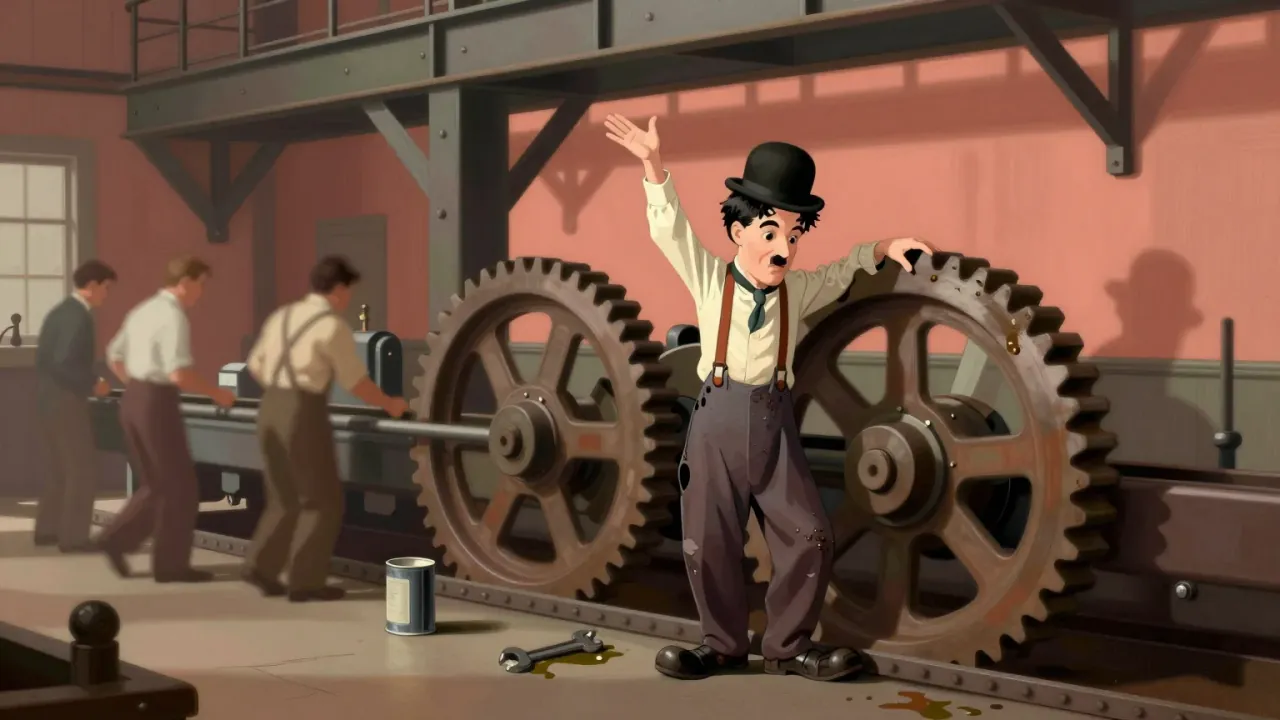
What lands most securely is the film’s physical intelligence. The assembly-line sequence remains unmatched in its compression of dehumanisation into gesture: the Tramp’s twitching fingers, his involuntary screw-turning, his entanglement in gears — all communicate alienation without a single word. The feeding machine gag works because its absurdity is anchored in real ergonomic failure; the department store night-watchman sequence lands because the Tramp’s drunkenness is never caricatured, only calibrated to the space he occupies. Even the ‘nonsense song’ finale succeeds not as novelty but as culmination: Chaplin’s gibberish singing is both surrender to linguistic collapse and reassertion of expressive autonomy. These moments land because they derive from observation — of factory rhythms, of institutional indifference, of how bodies respond to stress — then distil them into repeatable, legible actions. The humour never asks the audience to laugh at suffering, but at the mismatch between human scale and systemic rigidity.
Where the thread frays
What does not cohere is the film’s tonal drift between satire and sentiment. The prison sequences — particularly the cocaine-induced delirium — feel tonally dissonant, their surrealism unmoored from the film’s prevailing logic of cause-and-effect physical comedy. The shift from jailbreak heroics to café waiter clumsiness lacks connective tissue; the Tramp’s repeated arrests begin to read less as social critique and more as narrative convenience. Some transitions are abrupt: the leap from department store arrest to the shack feels narratively thin, sustained only by Chaplin’s willingness to let silence hold space. The romance, though tender, remains underdeveloped — Ellen’s backstory is implied but never dramatised, her agency often subsumed by the Tramp’s forward motion. The ending’s hopeful walk down the road is earned emotionally but not structurally; it resolves mood, not plot. These are not failures of craft, but of proportion — moments where the film’s desire to be both elegy and polemic pulls its focus.
What it says about now
The themes that matter are automation, unemployment, and the erosion of individual agency under systems designed for throughput, not people. Chaplin does not oppose technology per se, but its deployment without regard for human consequence — the feeding machine is not mocked for being ingenious, but for treating digestion as an engineering problem. Class is rendered not through rhetoric but through spatial hierarchy: the Tramp climbs ladders to reach the factory floor, sleeps on park benches, is hauled into paddy wagons, while executives remain off-screen or seen only in intertitles. Surveillance recurs as motif — the factory foreman’s binoculars, the department store’s hidden cameras, the police’s relentless pursuit — all suggesting power operates through observation and classification. The film’s quietest theme is endurance: not heroic resistance, but the daily recalibration required to stay upright in a world that treats stability as obsolete. That endurance is shared, fragile, and embodied — it lives in the way Ellen holds the Tramp’s arm as they walk away, not in any declaration.
Who it meets, and who it passes by
This film rewards viewers who accept its hybrid form — those comfortable with silent-era syntax, attuned to physical timing, and willing to sit with ambiguity rather than demand resolution. It suits audiences familiar with early cinema’s grammar, or those approaching it as cultural archaeology rather than pure entertainment. It is less suited to viewers who require continuous narrative propulsion, psychological realism, or explicit political exposition. Those expecting a straightforward Great Depression document may find its allegory too light; those seeking Chaplin’s full emotional range may miss the deeper pathos of City Lights. A viewer who dislikes extended slapstick, or finds its pacing unhurried to the point of slackness, will likely disengage. Its value shifts if watched without context: with programme notes on interwar labour conditions or Chaplin’s production choices, its specificity sharpens; without them, some gags risk reading as quaint rather than pointed.
Why it still walks with you
Yes, it is worth your evening — not as light diversion, but as a precisely engineered artefact of its moment, still legible in ours. Its ninety-nine minutes move deliberately, but never sluggishly; every sequence has been shaped for impact, not filler. You will need patience for its episodic structure and tolerance for its refusal to explain itself, but what it offers — a sustained meditation on work, dignity and resilience, delivered through choreographed movement and carefully scored silence — remains rare. Those who dismiss it as ‘old-fashioned’ mistake formal restraint for absence of intent. It is not diminished by age, but clarified by it: the anxieties it names — about machines replacing hands, about systems overriding persons — have only intensified. To skip it is to miss one of cinema’s clearest statements on what happens when efficiency forgets the human body. Its worth lies not in nostalgia, but in recurrence.