The shape of it
The Wrestler is a tightly wound drama about endurance without reward: a man clinging to identity through performance long after the audience has thinned and the body has begun to fail. It does not seek to mythologise wrestling, nor to dissect its spectacle or economics in depth; it uses the ring as a stage for a quieter, more persistent kind of collapse — one measured in tremors, scar tissue, and unpaid bills. The film’s aim is narrower than biography or exposé: it asks how a person sustains selfhood when every external marker — fame, health, family, income — erodes at once. Its structure follows no arc of redemption or reinvention. There is no comeback, no second act beyond the next match, no resolution that softens the terms of survival. It works within strict physical and emotional limits: a fixed geography (New Jersey towns, a Philadelphia arena, a strip club, a supermarket), a narrow social circle (two women, a handful of wrestlers), and a single, unrelenting rhythm of repetition and decline. That discipline is the film’s method and its subject.
The look of it
Robert Siegel’s script gives Mickey Rourke a character who speaks in clipped, weathered phrases, avoids exposition, and rarely explains himself — a choice reinforced by Darren Aronofsky’s direction, which keeps the camera close but never intrusive, letting silence hold as much weight as dialogue. Maryse Alberti shoots on 16mm, favouring natural light and shallow focus; interiors are often dim, exteriors washed out or grainy, matching Randy’s blurred perception. Clint Mansell’s score is sparse, built around piano motifs that recur like half-remembered themes, while diegetic rock songs — ‘Round and Round’, ‘Metal Health’, ‘Sweet Child o’ Mine’ — function less as nostalgia than as sonic scaffolding for Randy’s internal world. Rourke’s performance is physically exact: his posture, his breathing, the way he moves through doorways and lifts weights all register accumulated damage. Marisa Tomei’s Pam is neither idealised nor pitied; her weariness is specific, her boundaries clear. Evan Rachel Wood’s Stephanie carries resentment without melodrama, her silences calibrated to the weight of years of absence.
The weight of it
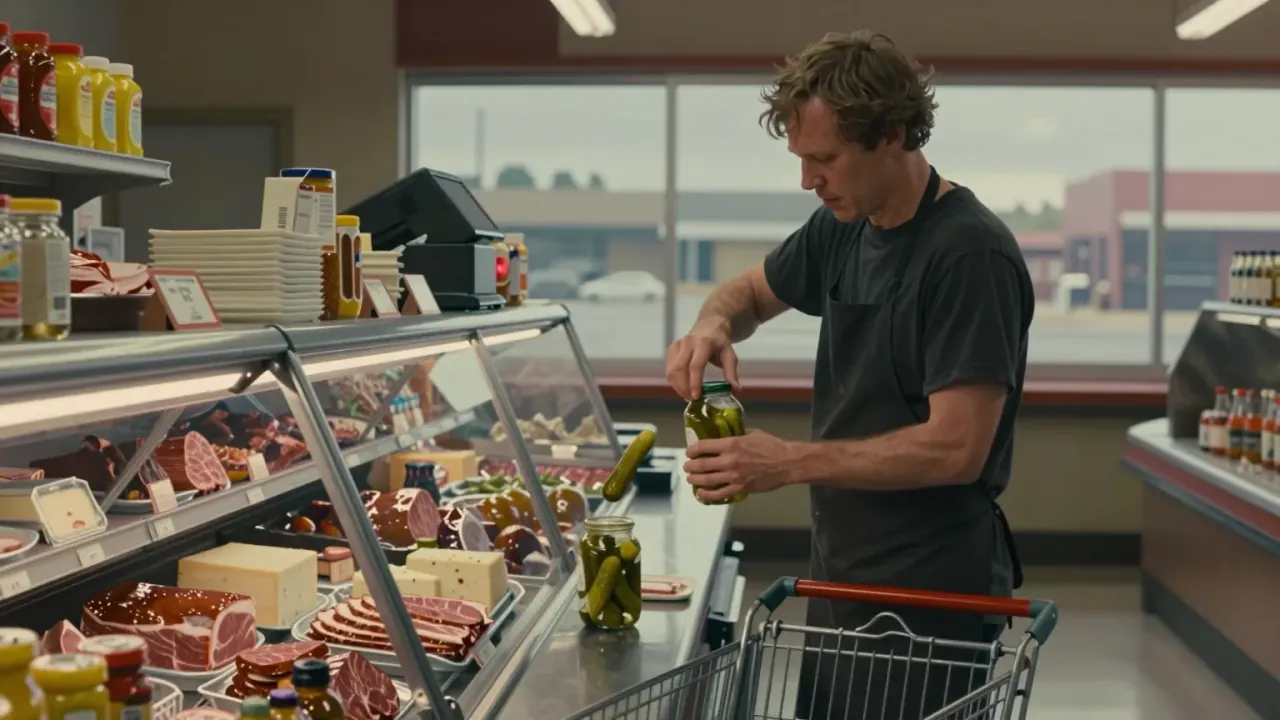
What lands is the cumulative effect of small, unvarnished choices: Randy’s hands shaking as he opens a jar, the way he flinches when stepping into a ring spotlight, the quiet exhaustion in Tomei’s eyes during a pole-dance rehearsal that runs thirty-six takes. The film’s restraint makes its few moments of rupture feel earned — not the final match itself, but the stillness just before it, when Randy sits alone in the locker room, listening to his own breath. The supporting wrestlers — real performers playing versions of themselves — ground the film in lived texture: their banter, their injuries, their offhand talk about pay and bookings all resist caricature. Even the supermarket scenes, shot with non-actors and improvised dialogue, avoid condescension; they show work as routine, not metaphor. The film trusts its audience to read meaning in gesture and duration rather than explanation, and that trust pays off in scenes where nothing happens except time passing — a phone call unanswered, a letter folded and put away, a walk down a boardwalk with no destination.
The gaps in it
What does not land is the film’s occasional drift into schematic contrast: Randy’s world of greasepaint and blood versus Stephanie’s clean, quiet apartment feels less like lived difference than thematic shorthand. The father-daughter reconciliation remains underdeveloped — not because it is implausible, but because the script gives Stephanie little interior life beyond her role as rebuff or receptacle. Her final scene, though affecting, arrives without sufficient groundwork in her own perspective or agency. Similarly, the subplot involving Randy’s estrangement from his ex-wife exists only as background noise; it adds weight but no dimension. The film’s refusal to explain also occasionally tips into opacity: motivations for certain decisions — why Randy chooses one match over another, why he rejects medical advice — are left so vague they risk feeling arbitrary rather than stoic. These are not flaws of execution but of scope: the film’s narrow focus means some relationships exist only as pressure points, not as fully realised exchanges.
The bones of it
The themes that matter are not spectacle or sport but embodiment and obsolescence: how identity becomes inseparable from physical capacity, and what remains when that capacity frays. It treats masculinity not as ideology but as habit — the way Randy touches his face, adjusts his belt, checks his reflection — gestures repeated until they become ritual. Ageing here is not gradual but episodic: a sudden dizziness, a missed cue, a doctor’s diagnosis delivered without inflection. The film also examines labour as performance: not just in the ring, but in the supermarket deli, the strip club, the hospital corridor — each space demanding a version of self that must be maintained, however briefly. Nostalgia is present but unromanticised; the 1980s references — Wrestle Jam ’88, the soundtrack, the hair — are artefacts, not invitations to sentiment. What endures is not memory but residue: the muscle memory of a move, the echo of a chant, the ache in a knee that remembers a fall it can no longer replicate.
The terms of it
This is a film for viewers who value precision over propulsion, who find tension in stillness and resonance in repetition. It suits those accustomed to Aronofsky’s earlier work — Requiem for a Dream, π — or to the restrained realism of Ken Loach or the Dardenne brothers. It is not for those who require narrative momentum, psychological exposition, or catharsis that resolves rather than lingers. Some will find its austerity alienating, its pacing too deliberate, its ending too quiet to satisfy. A viewer expecting a sports triumph or a sentimental reunion will leave disappointed. Others — particularly those familiar with working-class performance cultures, or with the slow attrition of chronic pain — may recognise its rigour as fidelity. The film does not ask for empathy as a default; it demands attention as a condition. Those unwilling to meet it on those terms will not find it worth their time — not because it fails, but because it refuses to accommodate.
The cost of it
Yes, it is worth your evening — not as entertainment but as reckoning. Its 105 minutes pass without hurry, yet leave a physical afterimage: the sound of tape being torn, the smell of antiseptic, the weight of a robe draped over a chair. It earns its gravity not through scale but through consistency — every frame, every line, every edit serves the same unblinking observation. Those who dismiss it as grim or narrow mistake austerity for emptiness; its power lies in what it refuses to say or show. A viewer who values craft over convenience, specificity over sweep, will find it quietly devastating. Someone seeking uplift, explanation, or closure will not. Nothing in the film would change that verdict — not a longer runtime, not a different ending, not more backstory. Its worth lies precisely in its refusal to soften its terms. To watch it is to accept its conditions, and in doing so, to feel the weight of what it holds steady.