The house it holds
Howards End is a film adaptation of E. M. Forster’s 1910 novel, made by Merchant Ivory Productions in 1992. It seeks to translate Forster’s precise social anatomy — the friction between intellect and property, idealism and inheritance, personal ethics and class obligation — into visual and behavioural terms. It does not aim for psychological realism in the modern sense, nor does it pursue narrative velocity. Instead, it holds steady on the weight of unspoken agreements: who may speak, who may inherit, who may stay in a room after tea. The film treats Edwardian England as a system of calibrated pressures, where a telegram, a burnt note, or a withheld name carries structural consequence. Its fidelity is not to plot mechanics but to the novel’s moral architecture — the idea that houses, like people, accumulate meaning across generations, and that ownership is never neutral. It assumes the viewer will attend to pauses, glances, silences between sentences. It asks for patience with exposition, not as filler, but as evidence. (148 words)
The look of it
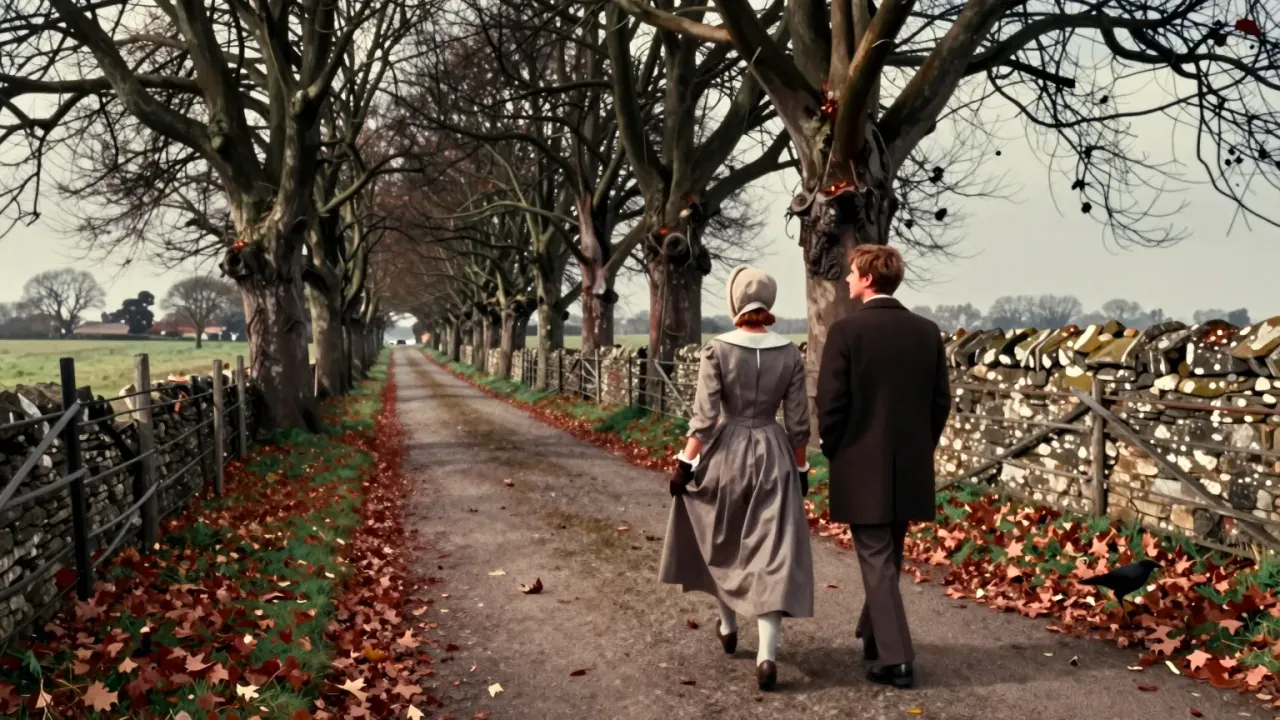
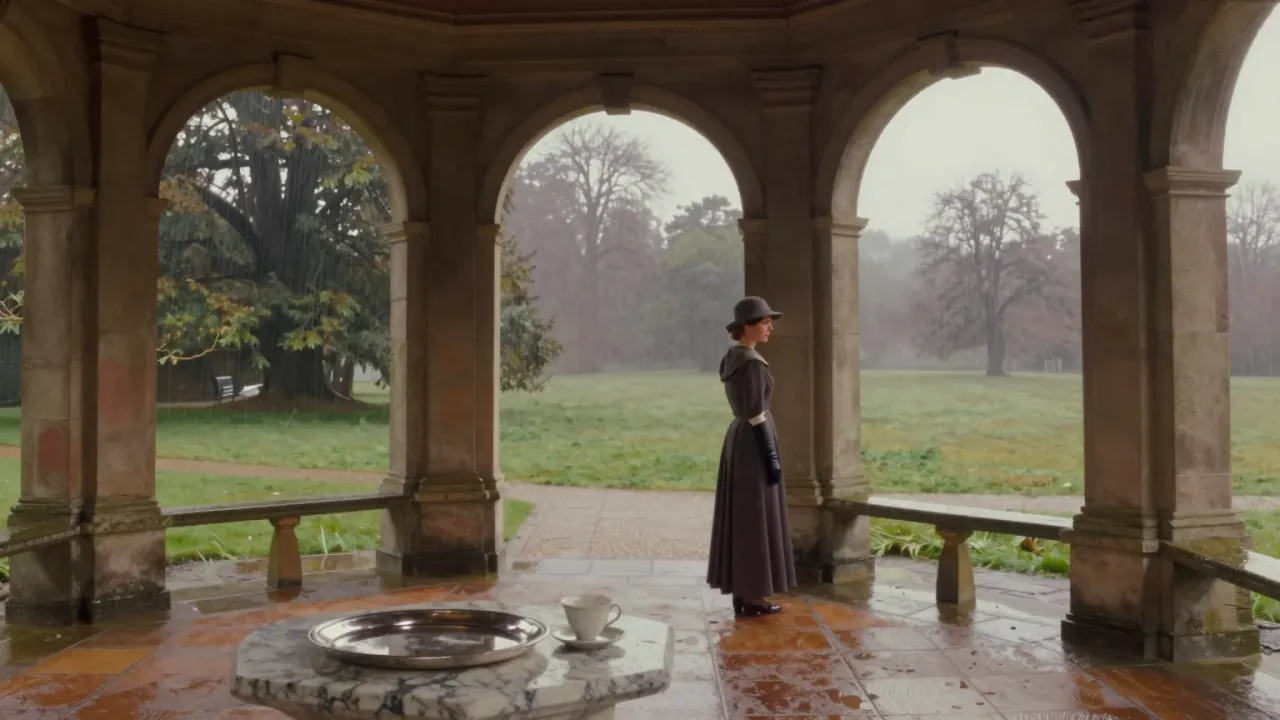
The story unfolds across three families whose orbits intersect through misapprehension, generosity, and quiet betrayal. Emma Thompson’s Margaret Schlegel anchors the film with restrained authority; her performance builds conviction not through outbursts but through incremental shifts in posture and vocal register — a lowered chin, a held breath before correcting Henry Wilcox. Anthony Hopkins gives Henry a brittle, self-protective rigidity, his charm worn like a stiff collar. Vanessa Redgrave’s Ruth Wilcox appears in few scenes but lingers in memory for her stillness and the physical fragility she conveys without affectation. Tony Pierce-Roberts’ cinematography favours natural light and shallow depth, keeping faces legible even in candlelit interiors. Luciana Arrighi’s production design grounds every setting in period plausibility: the Schlegels’ cluttered Victoria Square flat, the Wilcoxes’ austere Mayfair drawing room, the layered textures of Peppard Cottage. Richard Robbins’ score uses Percy Grainger motifs sparingly, letting silence carry much of the emotional load. Editing by Andrew Marcus avoids rhythm for its own sake; cuts follow thought, not tempo. (157 words)
The weight of what’s unsaid
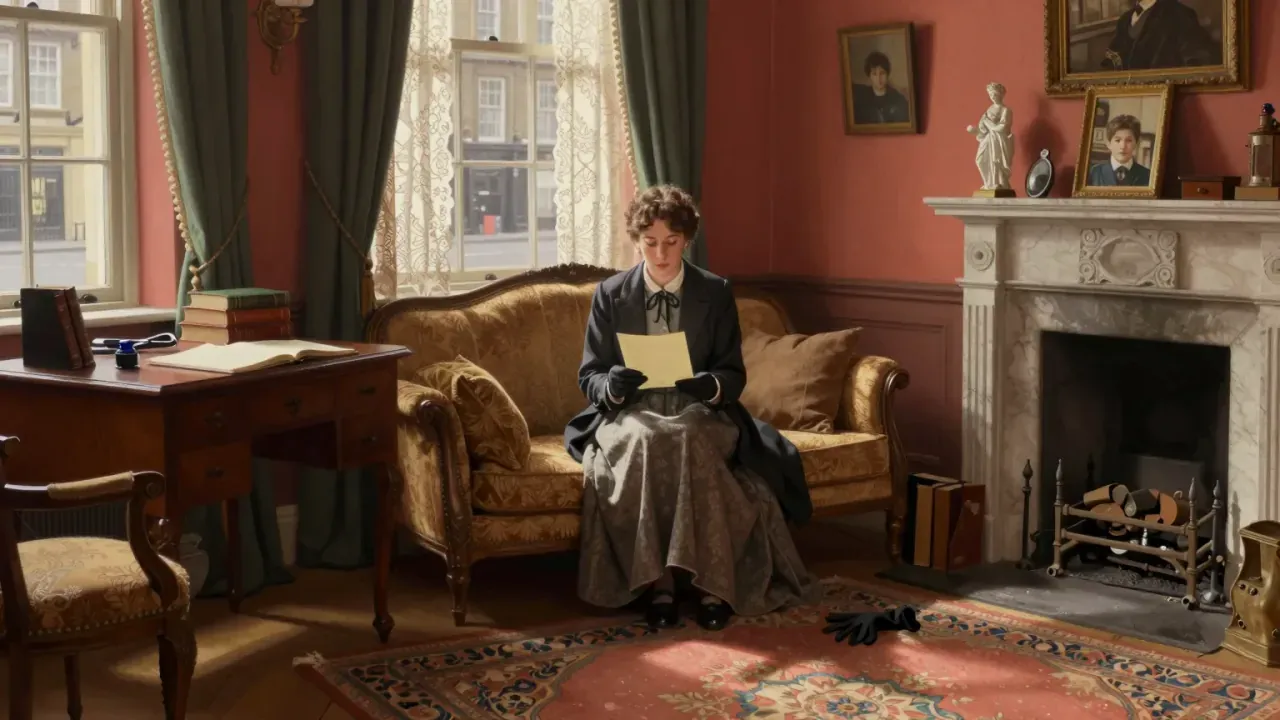
What lands is the film’s cumulative sense of consequence. A decision made off-screen — Ruth’s bequest, Henry’s dismissal of Leonard’s job — reverberates through later scenes with quiet inevitability. The moment Margaret reads Ruth’s note and then watches Henry burn it is not played for shock but for quiet devastation: the camera stays on Thompson’s face as comprehension settles, not as grief but as the dawning of a new, harder kind of knowledge. The scene at Evie’s wedding, where Jacky names Henry as her former lover, works because it arrives without melodramatic build — it is simply spoken, and its truth is confirmed not by reaction shots but by Henry’s immediate, wordless retreat from the room. The bluebell wood sequence, where Leonard walks alone in dreamlike isolation, lands precisely because it refuses symbolic overstatement: the light is soft, the framing unforced, the music absent. These moments do not shout their significance. They settle, like dust in sunlight, and remain visible long after the scene ends. The film trusts its audience to hold multiple contradictions — Margaret’s forgiveness, Helen’s fury, Henry’s shame — without resolution. That trust is repaid. (152 words)
Where the frame slips
What does not land is the film’s handling of Leonard Bast. Samuel West performs with sincerity, but the character remains underwritten, more emblem than individual — a vessel for thematic concern rather than a person with interior logic. His descent feels less like cause and effect than narrative necessity, especially when contrasted with the richly textured lives of the Schlegels and Wilcoxes. The subplot involving Jacky lacks grounding; her sudden appearance at the wedding, while dramatically functional, arrives without sufficient prior texture to make her agency feel earned. The film also struggles with time: the jump from Helen’s engagement to Paul to her later arrival with Leonard is compressed to the point of opacity. Some viewers will find the pacing inert, particularly in the middle stretch, where exposition about insurance companies and property law accumulates without dramatic counterweight. James Ivory’s direction avoids theatricality, but in doing so, occasionally drains scenes of urgency — notably Margaret’s confrontation with Henry after Jacky’s revelation, which plays as muted where a sharper tonal shift might have clarified moral stakes. The film presumes familiarity with Forster’s concerns; those unfamiliar may read politeness as passivity, restraint as emptiness. (156 words)
What it’s really about
The themes that matter are inheritance — not just of houses or money, but of language, silence, and unspoken duty — and the porous boundary between private morality and public consequence. Class is not presented as a backdrop but as grammar: it dictates who initiates conversation, who leaves a room first, who may touch whom. The film interrogates liberalism not as ideology but as habit — Margaret’s belief in connection, Helen’s faith in rupture, Henry’s reliance on precedent. It treats property as memory made material: Howards End is not real estate but a repository of lived experience, passed down not through legal certainty but through fragile human intention. Gender operates as both constraint and conduit: Ruth’s quiet authority, Margaret’s negotiation of marriage as both surrender and strategy, Helen’s impulsive idealism — all reflect different responses to the same structural limits. The film’s central tension is between continuity and change: whether institutions, families, or individuals can absorb new values without dissolving. It offers no answer, only the image of Margaret standing at the gate of Howards End, looking out — neither triumphant nor resigned, but present. (149 words)
Who it’s for
This film is for viewers who value precision over pace, who find emotional weight in hesitation and moral complexity in compromise. It suits those accustomed to literary adaptation as interpretation rather than illustration — readers of Forster, James, or Woolf; students of interwar British social history; anyone attentive to how rooms, clothes, and pauses shape character. It is not for those who require narrative propulsion, clear antagonists, or cathartic release. Those expecting a romance will be disappointed by its restraint; those seeking political polemic will find its critique embedded in behaviour, not speech. A viewer who values explicit moral framing — who needs villains punished or virtues rewarded — will leave unsatisfied. The film’s refusal to simplify its characters’ contradictions means some may read Margaret’s forgiveness as weakness, Helen’s anger as immaturity, Henry’s shame as insufficient penance. That reading would miss the point: the film insists that ethical life is lived in the grey, not the black and white. Change the emphasis from accumulation to climax, and the verdict changes. (152 words)
Is it worth your evening
Yes, it is worth your evening — provided you watch it as the film intends: slowly, without distraction, allowing its rhythms to settle. Its 140 minutes unfold like a measured conversation, not a sprint. The rewards are cumulative: the way light falls across a staircase in Victoria Square, the weight of a single line delivered by Prunella Scales, the quiet dignity of Thompson’s final walk through the garden at Howards End. It repays attention not with spectacle but with resonance — moments that linger because they feel true, not because they are loud. Those who watch impatiently, or against its grain, will find it dull. But for those willing to meet it on its terms — to sit with its silences, parse its hesitations, accept its lack of easy answers — it offers rare clarity about how people live inside systems they did not choose but must navigate. It is not entertainment in the transactional sense. It is sustenance. (147 words)