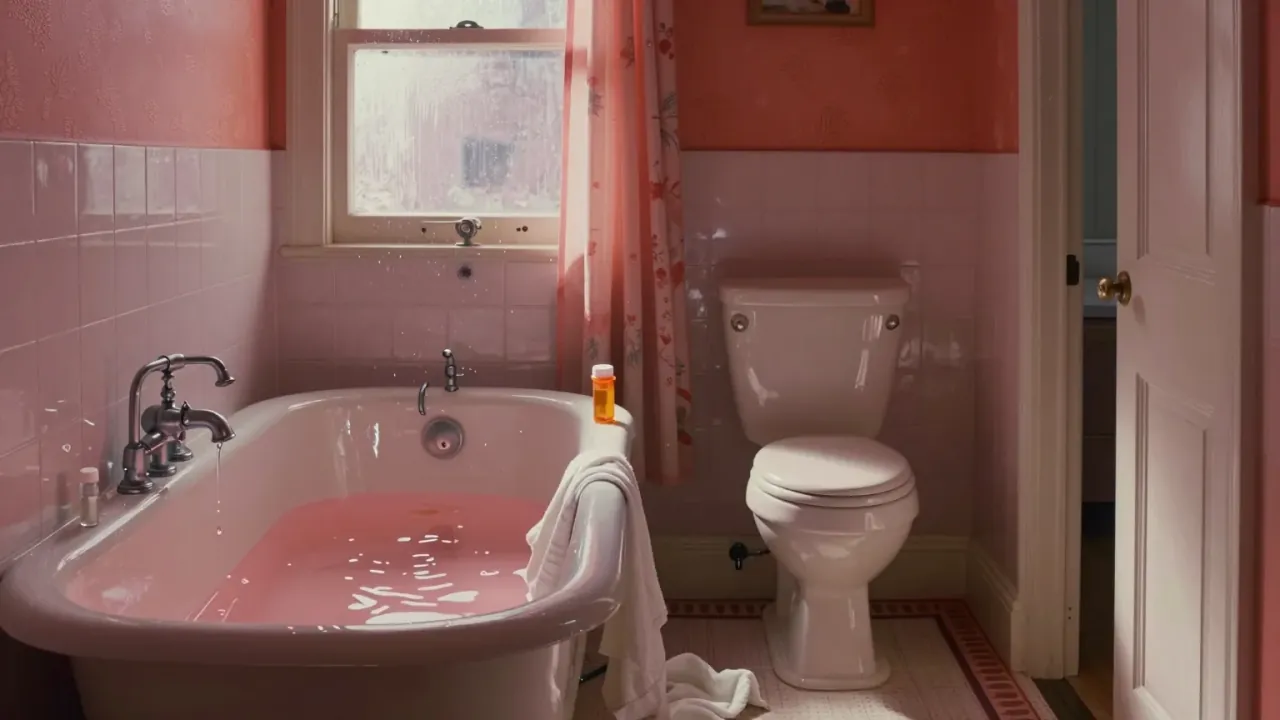
The look of it
The Virgin Suicides is a 1999 adaptation of Jeffrey Eugenides’ 1993 novel, Sofia Coppola’s feature debut, and a sustained meditation on memory’s unreliability, adolescent longing, and the opacity of other lives. It does not aim to explain the Lisbon sisters’ deaths, nor to reconstruct motive or psychology with forensic clarity. Instead, it constructs a hushed, amber-toned world in which five girls recede further the more the neighbourhood boys try to grasp them — their bodies glimpsed through windows, their voices filtered by telephone static, their agency flattened into rumour and projection. Coppola treats the suburban setting not as backdrop but as atmosphere: airless, sun-bleached, thick with unspoken rules and stifled feeling. The film’s central gesture is refusal — to diagnose, to dramatise crisis as catharsis, to grant narrative mastery over grief. It insists that some silences are structural, not gaps to be filled. The boys’ narration, delivered in adult voices over images of their teenage selves, underlines how time distorts as much as it clarifies. This is not a mystery to be solved, but a mood to be held. (158 words)
The voice of it
The story unfolds through fragmented vignettes, anchored by the collective memory of five unnamed boys who watch the Lisbons from across the street. Their narration frames events without interpreting them; scenes linger on surfaces — wallpaper, ceiling fans, rain-streaked glass — rather than interior states. Kirsten Dunst’s Lux carries the film’s emotional weight with minimal dialogue, her gestures and silences calibrated to suggest both defiance and exhaustion. James Woods and Kathleen Turner play the parents with quiet rigidity: he passive, she brittle, neither villainous nor comprehensible. Edward Lachman’s cinematography avoids dramatic lighting or movement; he holds wide shots until they grow uncomfortable, lets focus drift, favours soft focus and shallow depth. The editing by James Lyons sustains a dreamlike rhythm — cuts often land on stillness, not action. Air’s score is woven into the texture, not layered on top: synth tones hover like heat haze, repeating motifs like half-remembered phrases. There are no close-ups of tears, no confrontations that resolve. Everything is held at arm’s length, as if the camera itself shares the boys’ inability to get closer. (159 words)
The memory of it
What lands is the film’s consistent tonal discipline: its refusal to sensationalise tragedy or romanticise rebellion. The Lisbon house feels physically and emotionally sealed, its interiors lit as if seen through frosted glass. The use of still photographs — inserted mid-scene, sometimes blurred or double-exposed — works not as gimmick but as analogue for how memory operates: discontinuous, affectively charged, visually unstable. Dunst’s performance remains resonant precisely because it resists archetypes: Lux is neither innocent nor corrupt, neither victim nor agent, but a teenager testing boundaries in a space where every boundary is absolute. The soundtrack’s restraint — no period hits, no swelling strings — reinforces the sense of suspended time. Even small details land: the way light catches dust motes in the Lisbon living room, the slow pan across a row of identical bedroom doors, the silence after a record needle lifts. These are not flourishes but structural choices, reinforcing the film’s thesis that meaning resides in what is withheld, not what is shown. The result is a sustained, low-frequency unease that lingers beyond the final frame. (157 words)
The rebellion of it
What does not land is the boys’ narration when it veers toward poetic abstraction without grounding. Some lines — about ‘the yearning for something else’, ‘the unbearable lightness of being watched’ — risk sounding like notes from a film studies seminar rather than lived reflection. The decision to keep the narrators anonymous and faceless works thematically but weakens emotional investment: we never learn who they are, what they became, or how the event shaped them beyond this single recollection. A.J. Cook’s Mary and Hanna R. Hall’s Bonnie register less distinctly than Dunst’s Lux or Leslie Hayman’s Therese; their personalities blur under the film’s even-handed diffusion. The rooftop sex scenes, though deliberately muted, lack physical specificity — they feel like ellipses rather than moments, and the ambiguity occasionally reads as evasion rather than restraint. The film’s resistance to exposition also leaves key dynamics underdeveloped: Mr. Lisbon’s passivity is clear, but his internal conflict remains opaque; Mrs. Lisbon’s rigidity is palpable, yet her fear or faith is never articulated. These omissions serve the theme, but they cost the film some human traction. (156 words)
The place of it
The themes that matter are memory’s unreliability, the gendered architecture of surveillance, and adolescence as a condition of enforced illegibility. The Lisbons are not misunderstood — they are systematically rendered unknowable by parental control, social expectation, and the boys’ own projections. Their Catholicism is present as ritual, not doctrine; their class is visible in wallpaper and lawn care, not stated. The film treats suburbia not as satire but as ecosystem: one where safety and suffocation share the same grammar. Time is not linear but palimpsest — 1975 bleeds into the boys’ adult present, then into the film’s own 1999 release, then into the viewer’s now. The recurring motif of windows — crossed, curtained, fogged — speaks to vision as both privilege and limitation. There is no critique of religion or patriarchy as ideology; instead, the film shows how those structures settle into domestic routine, becoming as ordinary and inescapable as humidity. Grief here is not cathartic but cumulative, ambient, absorbed into the grain of everyday life. The suicide is not a climax but a pivot — after it, the house tightens, the light dims, and the girls recede further, not because they vanish, but because the boys’ capacity to see them was always partial. (159 words)
The telling of it
This film is for viewers who value atmosphere over exposition, who find resonance in restraint, and who accept that some stories resist resolution. It suits those familiar with slow cinema, literary adaptation, or films that treat adolescence as psychological terrain rather than plot engine. It is not for viewers seeking narrative propulsion, character arcs, or moral clarity — those who expect cause-and-effect logic or psychological explanation will find it frustratingly withholding. Fans of conventional teen dramas or trauma narratives built around revelation will likely feel alienated by its refusal to name motives or assign blame. Its pacing and visual reticence also make it inaccessible to younger audiences unaccustomed to sustained ambiguity. Those who prize strong female subjectivity may object to the sisters’ near-total erasure from their own story — though that erasure is precisely the point. To find it unsatisfying is not wrong; it is designed to withhold satisfaction. A viewer who demands closure, or who reads the film as a critique of Catholic parenting rather than an anatomy of collective memory, would reasonably reject it. (158 words)
The end of it
Yes, it is worth your evening — but only if you arrive prepared to sit with absence, not fill it. Its ninety-seven minutes unfold like a held breath: unhurried, precise, resistant to easy interpretation. It rewards attention to texture — the grain of film stock, the hum of Air’s synth, the weight of a pause — more than plot mechanics. It is not entertainment in the transactional sense; it offers no uplift, no twist, no catharsis. What it gives is a sustained, intelligent evocation of how memory distorts intimacy, how suburbs flatten difference, and how teenage girls become myth when denied voice. Those who dismiss it as ‘slow’ or ‘empty’ mistake its economy for emptiness. Its power lies in what it refuses: to explain Cecilia, to redeem Lux, to indict the parents, or to let the boys understand anything. That refusal is its integrity. To call it ‘overrated’ is to misunderstand its aims; to call it ‘boring’ is to miss its quiet insistence. It earns its place not through force, but through persistence — a film that stays with you because it refuses to tell you what to feel. (159 words)