A hunter’s daughter sent to finish off the last wolves
Wolfwalkers sets its story in seventeenth-century Kilkenny under English occupation, where Robyn’s hunter father has been summoned by the town’s Lord Protector to exterminate the last wolf pack blamed for keeping the surrounding forest untamed. Tomm Moore and Ross Stewart direct the third instalment of Moore’s Irish folklore trilogy, following The Secret of Kells and Song of the Sea, and from its opening the film ties the hunt for wolves directly to a broader campaign of control, land clearance ordered by an authoritarian ruler who wants the forest gone as much as the wolves in it.
A bite that puts her on the other side
Robyn’s curiosity leads her into the forest against her father’s wishes, where she meets Mebh, a girl whose spirit leaves her sleeping body and runs as a wolf, part of a tribe of Wolfwalkers rumoured but not confirmed by the townspeople. A bite during their encounter secretly transforms Robyn as well, and her double life, English hunter’s daughter by day, wolf by night, becomes the personal stakes underneath the film’s wider political plot, forcing her to choose between the world her father serves and the one she has been quietly pulled into.
Two drawing styles standing in for two worldviews
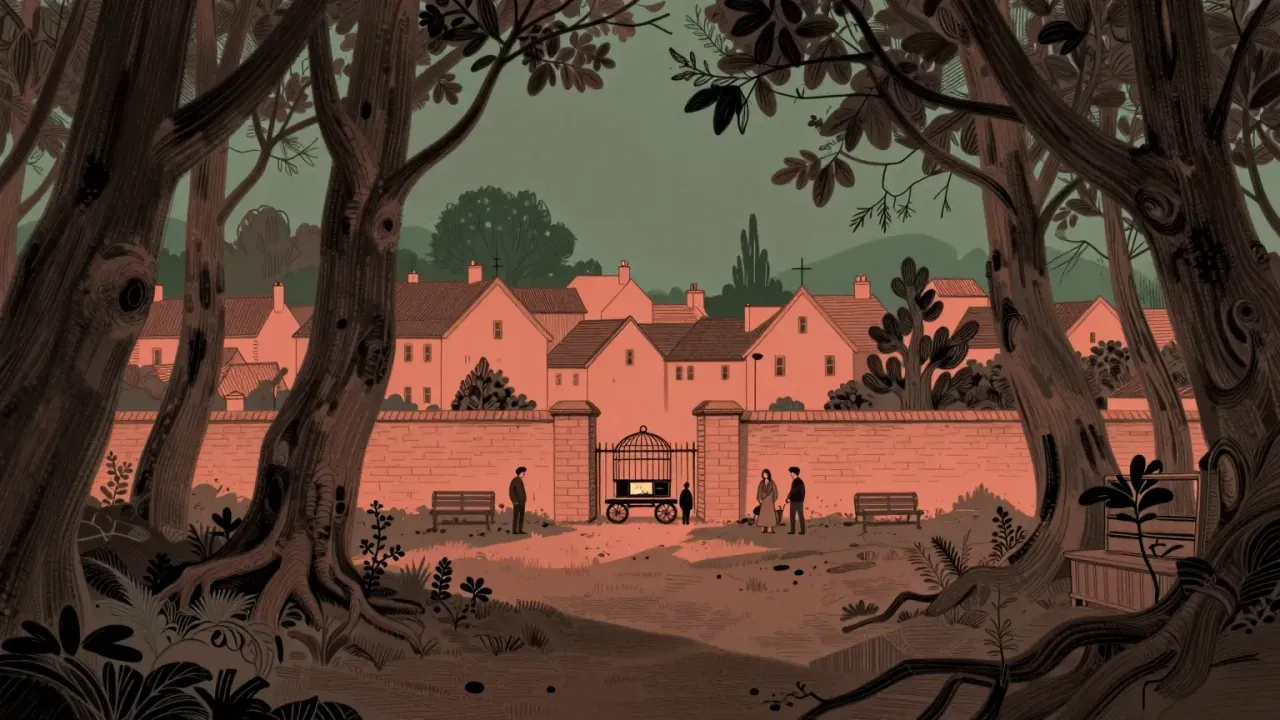
The film’s visual design does real narrative work rather than simply decorating the story: Kilkenny and its Lord Protector are drawn using thick, angular lines derived from seventeenth-century woodcut printing, evoking rigidity and confinement, while the forest, the wolves, and the Wolfwalkers use loose, sketchy, curving pencil lines meant to convey freedom and life. Robyn’s own character design shifts visibly across the film, beginning in the town’s stiff woodblock style and gradually adopting the forest’s looser linework as her sympathies and identity change, making the animation itself a record of her transformation.
A first-person wolf’s-eye view built by hand and by computer together
Sequences depicting Robyn’s point of view as a running wolf, termed wolfvision internally, were built through an unusual hybrid process: a 3D-modelled forest environment, constructed in virtual reality painting software and refined in Blender, let animators plan dynamic camera movement before each frame was printed out in magenta and redrawn over by hand in pencil and charcoal to preserve the film’s hand-crafted look at the speed and fluidity the sequences needed. It is a technically ambitious solution to a problem, matching hand-drawn texture to a moving, running camera, that most traditionally animated films simply avoid.
Colonial control staged as a war on the forest itself
The Lord Protector’s campaign against the wolves is inseparable from his campaign to clear and control the land itself, and the film keeps that colonial dimension present throughout without ever pausing its plot to spell it out as a lesson. Kilkenny’s rigid, walled geometry against the forest’s untamed sprawl carries the political argument visually, letting a young audience absorb the shape of the conflict, control against freedom, occupier against occupied, without the film needing dialogue to state it directly, and without ever losing the more immediate, personal stakes of Robyn’s own divided loyalties.
A film built for viewers who will watch the drawing, not just the story
Children can follow the friendship between Robyn and Mebh, and the rescue plot involving Mebh’s captured mother, as a satisfying adventure on its own terms without needing to register the colonial subtext underneath it. Older viewers, and anyone interested in animation as a storytelling tool rather than mere decoration, get considerably more: a film where the choice of line style is doing sustained, deliberate work, and where noticing that work changes how several scenes read, particularly the moments where Robyn’s own design sits uneasily between the two visual worlds she is being pulled between throughout the film.
A hundred and three minutes with a visual argument as strong as its story
Wolfwalkers received near-universal critical acclaim, including a BAFTA Children and Young People Award and nominations at the Academy Awards, Golden Globes and BAFTAs for Best Animated Feature, and the reception reflects a film where the visual argument carries as much weight as the plot itself. At a hundred and three minutes, it does not need its political subtext explained to work as pure story, but the depth is there for anyone looking, and that combination is exactly what makes it worth an evening regardless of which layer a given viewer is watching for.