The tone of it
La Strada is a deliberately pared-down Italian drama about a young woman named Gelsomina, bought from her mother and taken on the road by a strongman named Zampanò. It does not aim to explain her, nor to resolve her situation. Instead, it holds her presence — her gestures, silences, small songs — as an irreducible fact against which brute force, indifference and even kindness are measured. The film avoids exposition, psychological cause or narrative payoff; its structure follows no arc but a slow, weathered drift across rural Lazio and Abruzzo. Fellini co-wrote it with Pinelli and Flaiano as a distillation of personal imagery: falling snow over sea, circling clouds, a nightingale’s cry — all translated into physical terms: a cart, a drum, a tightrope, a cracked smile. It is not a story about escape or transformation, but about endurance as a form of witness. There is no moral framing, no authorial irony to soften the blows. What it tries to do is make visible the weight of being unremarkable in a world that only registers strength, spectacle or madness — and to do so without recourse to pity or uplift. (158 words)
The look of it
The story unfolds in sparse episodes: Gelsomina’s purchase, her training as a clown’s assistant, her mute rapport with the wandering Fool, her repeated failures to grasp Zampanò’s violence or Il Matto’s despair. Giulietta Masina’s performance is physically precise — wrists bent just so, eyes blinking slowly, voice pitched low and uninflected — never sentimentalising Gelsomina’s simplicity but treating it as a condition, not a deficit. Anthony Quinn gives Zampanò a blunt, lumbering physicality: he moves like stone settling, his face rarely opening beyond irritation or exhaustion. Richard Basehart’s Il Matto is all nervous grace, his clowning stripped of laughter, his acrobatics edged with panic. Otello Martelli’s cinematography keeps the frame uncluttered, favouring medium shots and shallow focus; landscapes are wide but drained of grandeur, roads stretch flat and indifferent. Nino Rota’s score uses solo trumpet and muted strings to underscore fragility, not pathos. Leo Catozzo’s editing avoids rhythm or momentum — scenes end when light fades or breath catches, not when logic demands. (159 words)
The weight of it
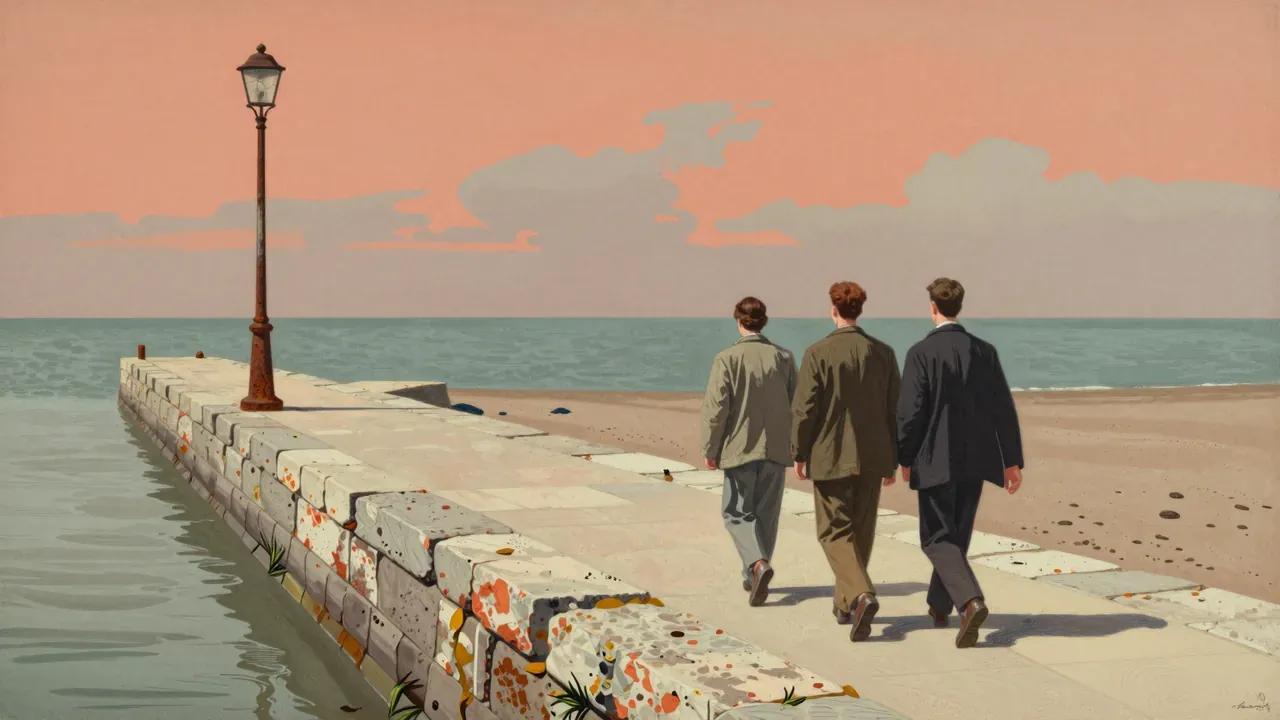
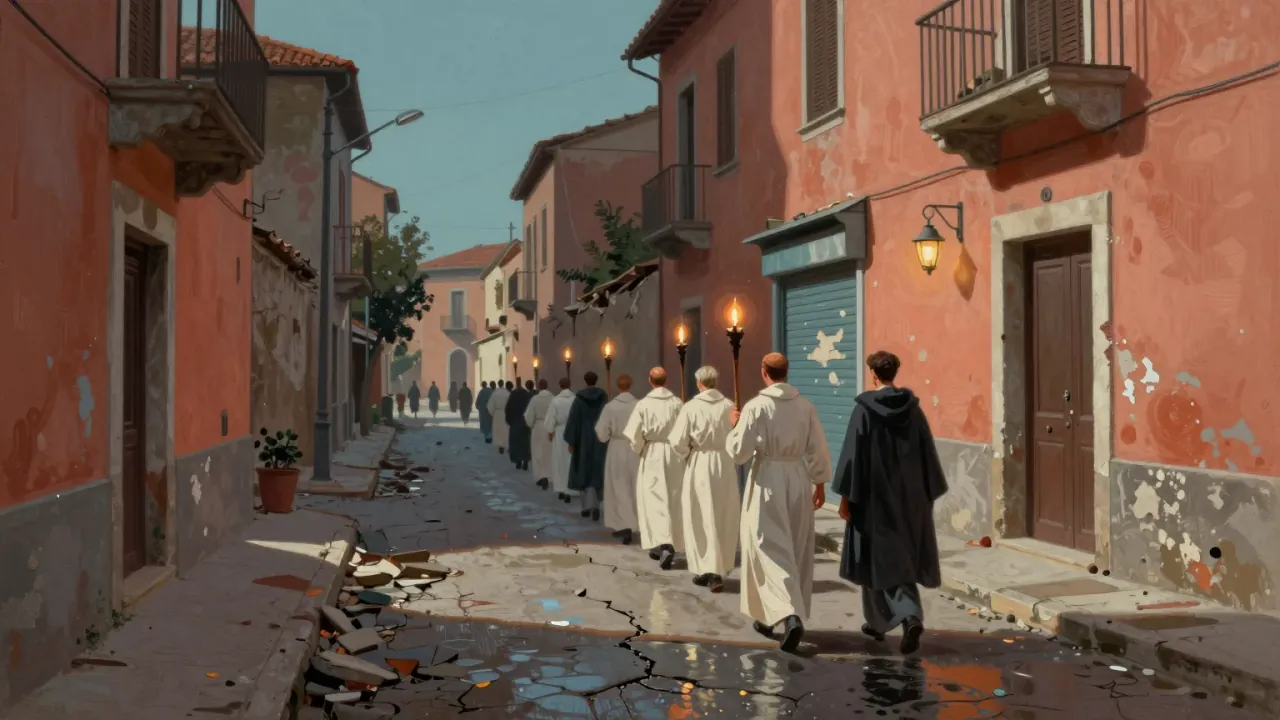
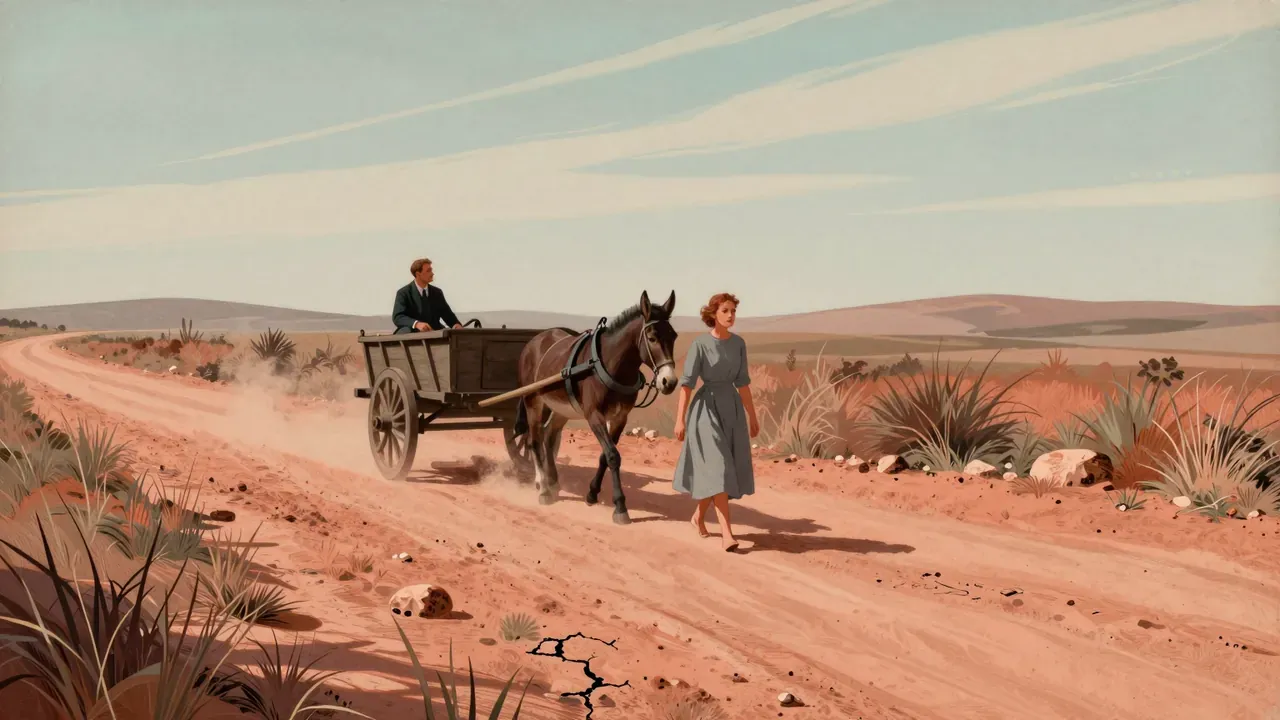
What lands is the cumulative weight of Gelsomina’s quiet persistence. Her humming, her attempts to mimic Il Matto’s juggling, her habit of touching Zampanò’s arm after he strikes her — these are not gestures of hope but of unshakable, uncomprehending continuity. The film’s emotional register is not sorrow but disquiet: the unease of watching someone remain present in circumstances that erase them. Masina’s face, especially in close-up, registers no internal monologue — only a kind of alert vacancy, like a child who has learned not to name what she feels. The roadside settings — mud, wind, thin smoke from campfires — feel lived-in, not picturesque. Even the circus sequences avoid spectacle: the strongman’s act is perfunctory, the tightrope walk brief and uncelebrated. The film’s restraint makes its few eruptions — Zampanò’s sudden rage, Il Matto’s final collapse — land with physical force. There is no music swell before tragedy, no cut to black after loss. It simply stops where the road ends, leaving the silence intact. (157 words)
The silence in it
What does not land is any attempt to read Zampanò as psychologically legible. His cruelty lacks motive, his grief arrives too late and too thinly to function as redemption. The film refuses to grant him interiority beyond posture and habit, and some viewers will find this withholding unsatisfying — a refusal of narrative accountability. Il Matto’s philosophical rants, delivered while juggling or balancing, risk abstraction without grounding in action; they hang in the air like unanswered questions rather than dramatic pivots. The pacing, deliberate by design, can read as inert where it intends suspension — particularly in the middle stretch, where Gelsomina’s routines repeat without variation or escalation. Some may also find the absence of social context alienating: there is no mention of postwar Italy, no reference to poverty as systemic, only as ambient fact. The film treats class and exploitation as givens, not subjects — a choice that deepens its austerity but narrows its field of address. Those expecting psychological realism or historical anchoring will leave unmoored. (156 words)
The shape of it
The themes that matter are endurance without purpose, presence without recognition, and the asymmetry between those who perform and those who watch. Gelsomina is never granted the dignity of a role — she is apprentice, prop, burden, then ghost. The road is not liberating but exposing: it strips away pretence, leaving only bodies in motion and the space between them. Fellini treats myth not as allegory but as residue — the Fool’s red nose, Zampanò’s chain, Gelsomina’s drum — all carry symbolic weight without explanation. The film interrogates how meaning accrues to gesture when language fails: a shrug, a whistle, a dropped coin become charged not because they signify something else, but because they are all that remains. There is no theology here, only ritual without doctrine; no politics, only power as physical fact. Mortality enters not as climax but as erasure — a vanishing point on the horizon, a silence after the drum stops. The film’s central question is not ‘why?’ but ‘what remains when nothing answers back?’ — and its answer is a single, unadorned image: a woman walking alone, then not walking, then gone. (159 words)
The demand of it
It is for viewers who tolerate long stillness, who trust silence as narrative material, and who do not require characters to be legible in order to care. It suits those familiar with mid-century European art cinema’s grammar — the weight of the gaze, the refusal of closure, the privileging of texture over plot. It is not for those who need motivation explained, causality affirmed or emotional payoffs calibrated. Anyone seeking catharsis, character growth or social critique will find La Strada withholding, even obstinate. Those who expect Italian neorealism’s documentary impulse or Fellini’s later baroque flourishes will misread its austerity as emptiness. A viewer who values clarity over resonance, explanation over evocation, or narrative propulsion over sustained atmosphere will leave frustrated. The film assumes patience as a condition of attention — and that assumption is non-negotiable. Without it, the film collapses into monotony. With it, every frame accumulates gravity. (159 words)
The end of it
Yes, it is worth your evening — but only if you arrive prepared to sit with discomfort that has no resolution, and to accept that some presences exist not to be understood but to be witnessed. Its 104 minutes unfold with the inevitability of weather: slow, unarguable, irreversible. Those who object will say it mistakes slowness for depth, or that its emotional austerity borders on cruelty — and they are not wrong, only out of step with its terms. What would change the verdict? A different cultural contract — one that prizes explication over implication, or sees ambiguity as evasion rather than precision. But within its own logic, La Strada holds its ground without concession. It does not ask for empathy; it demonstrates how empathy might begin — not with understanding, but with the simple, stubborn act of looking without turning away. That is its labour, and its reward. (159 words)