The shape of survival
Man of Aran is a staged documentary: Robert J. Flaherty’s deliberate reconstruction of island life on Inishmore, one of the Aran Islands, intended to portray human endurance against elemental forces. It does not record contemporary reality but reassembles fragments of tradition, memory and invention into a mythic narrative of subsistence — farming on rock, fishing from currachs in gales, hunting basking sharks for oil. Flaherty worked with Michael Balcon at Gainsborough Pictures to produce a British film that would assert cultural seriousness amid Hollywood’s dominance, and the project was conceived as both aesthetic statement and industrial demonstration. The film avoids direct commentary on poverty, land tenure or the Irish Free State’s policies; instead it presents struggle as timeless, unmediated by politics or history. Its ambition is not sociological accuracy but symbolic coherence — a vision of man shaped entirely by geography and weather, stripped of modernity’s complications. That vision is neither neutral nor incidental: it is the film’s central argument, rendered in image and rhythm rather than exposition.
The look of it
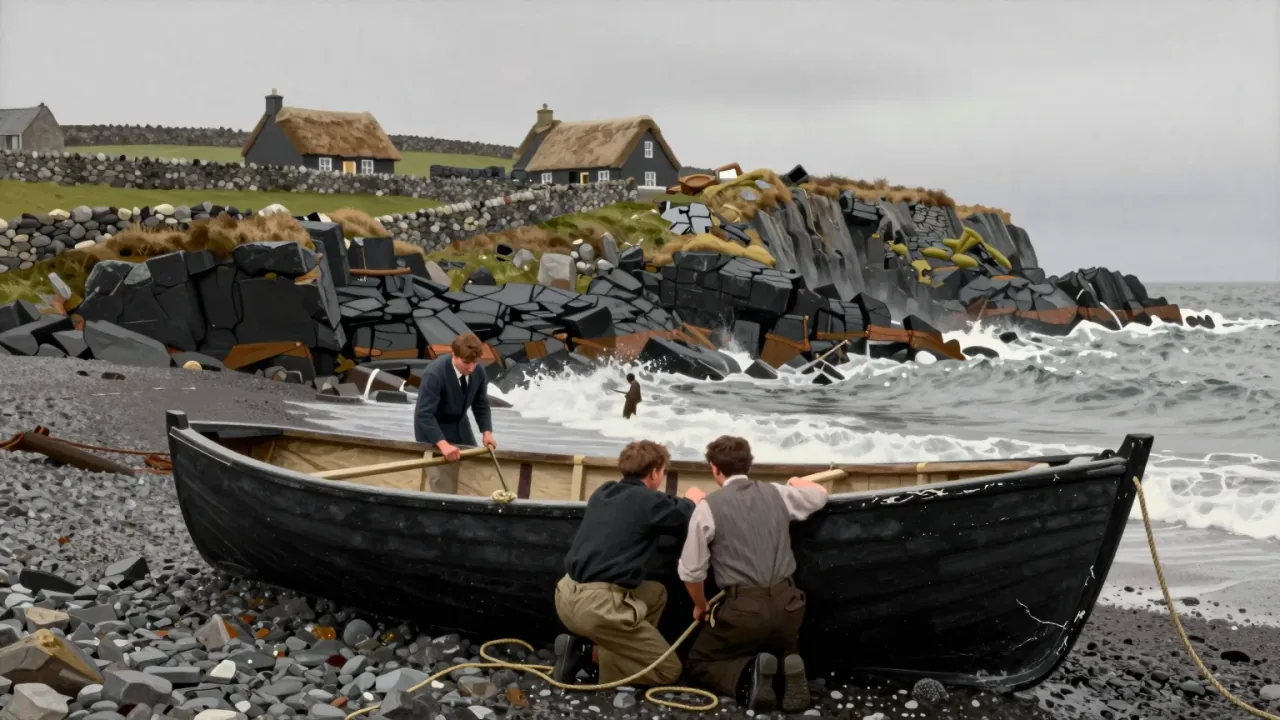
The film unfolds through a sequence of ritualised actions — building a field, mending a boat, catching fish, harpooning sharks — linked by repetition, duration and scale. Colman ‘Tiger’ King, Maggie Dirrane and Michael Dirrane play archetypal roles, not themselves; their performances are restrained, physical, often wordless, shaped by Flaherty’s direction and John Monk Monck’s tight editing. Flaherty’s cinematography dominates: he uses long lenses — up to seventeen inches — to compress space and isolate figures against sea or cliff, holding shots until movement becomes effort, effort becomes endurance. The silent format means sound is secondary: John D. H. Greenwood’s score and sparse effects serve the image, never interpret it. There are no interviews, no voiceover, no titles explaining context. Instead, meaning accrues through juxtaposition — a boy baiting a line beside a churning wave, a shark carcass hauled onto stone while more shadows pass beneath the surface. The editing is concise but not economical; it lingers where it needs to, returning to the same gesture across cuts to deepen its weight. This is craft built on accumulation, not exposition.
The weight of repetition
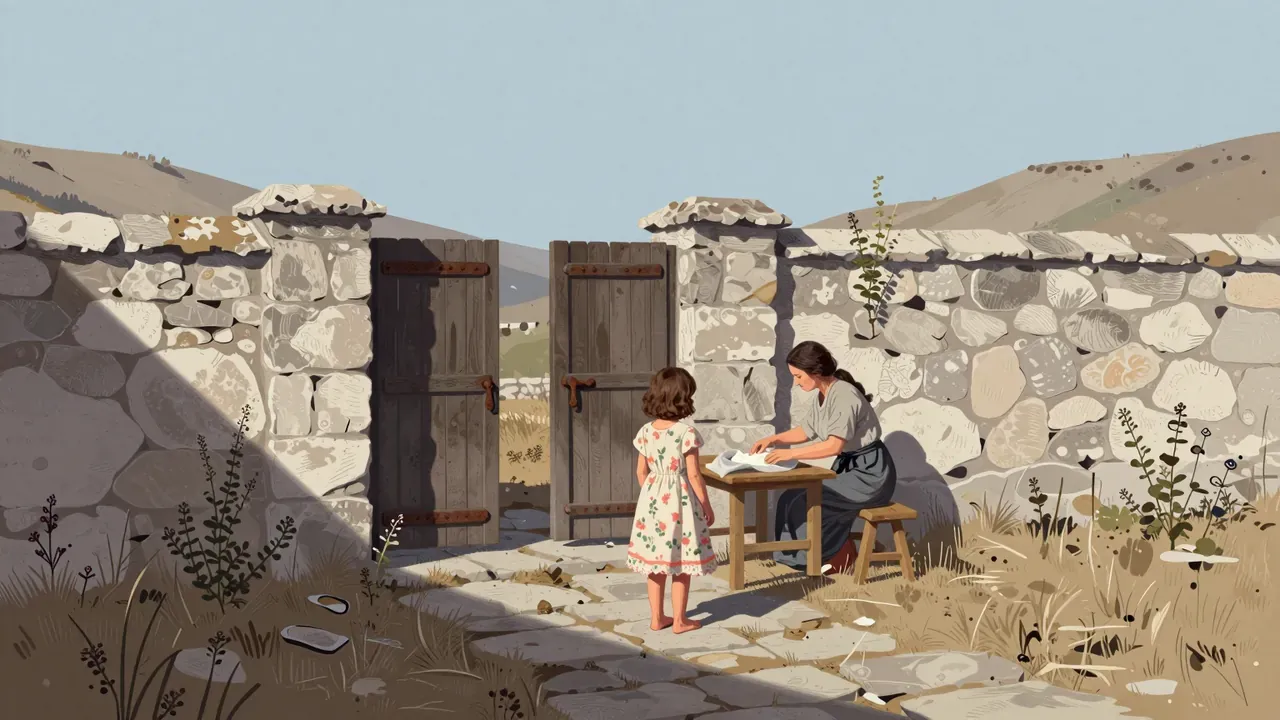
What lands is the sheer physical presence of the place and its people. The cliffs, the sea, the currachs, the rocks — all feel materially real, not illustrative. Flaherty’s framing makes geology palpable: the camera stays low, close, often static, letting wind and water assert themselves without mediation. The shark hunt, though fabricated, gains conviction through duration and detail — the straining ropes, the slow drag ashore, the communal labour on the beach. Even knowing the harpoons were taught by Scottish fishermen, the sequence works as visceral theatre: bodies pitted against bulk, time stretched to breaking point. The final storm sequence lands with particular force — not because it is plausible, but because its staging — the wife and son watching, the boat’s disintegration, the return to the cottage — condenses everything the film values: resilience without triumph, continuity without progress. These moments do not persuade intellectually, but register somatically. They endure because they are anchored in texture, weight and repetition, not argument or explanation.
The silence around the frame
What does not land is any claim to ethnographic fidelity. The shark hunting had not been practised for decades; the family unit is assembled, not observed; the potato fields are made not farmed; the weathered faces are selected for photogenic severity, not representative of island demography. Flaherty omits class conflict, absentee landlords, the Depression’s reach, the island’s actual economic ties to Galway and Dublin. He also sidesteps the sound revolution then transforming cinema: the film was shot silent, with music and effects added later as ornament, not integration. Paul Rotha’s criticism — that it avoids the urgent questions sound raised — holds. More fundamentally, the film’s refusal to name its own artifice undermines its authority without replacing it with irony or self-awareness. It presents itself as revelation, not construction. When viewed as record, it misleads; when viewed as parable, it feels incomplete — too invested in struggle to ask why the struggle persists, or who benefits from its depiction. Its omissions are not accidental but structural: the film requires isolation to function, and so erases connection.
The rule of weather
The themes that matter are endurance, elemental sovereignty and the myth of self-sufficiency. Man of Aran treats landscape not as setting but as agent — the sea drowns boats, the wind scours soil, the rock yields only to relentless labour. Human agency appears only as repetition: mending, hauling, waiting, watching. There is no innovation, no adaptation beyond what the past already contains. This is not conservatism but anti-historicism: the film suspends time to make struggle eternal, stripping it of cause or consequence. The theme of isolation recurs formally and thematically — the islanders are cut off not just geographically but temporally, placed outside modernity’s flow. That isolation serves nationalist and fascist readings alike: Éamon de Valera saw confirmation of rural virtue; Nazi critics praised its ‘blood-and-soil’ purity. But the film’s deeper theme is abstraction — reducing life to gesture, environment to force, society to family unit. It is less about Ireland than about Flaherty’s idea of what humanity looks like when stripped to bone and weather.
Who it is for
This film is for viewers who value formal discipline over factual fidelity, who find power in sustained observation and are comfortable with myth-making as method. It suits students of documentary history, film aesthetics or interwar cultural politics — those who want to see how a genre’s rules were written, broken and rewritten. It is not for those seeking social analysis, historical record or ethical transparency. Anyone requiring context, citation or accountability will find it evasive. Those who reject constructed reality as documentary — or who see fabrication without acknowledgment as betrayal — will rightly resist it. A viewer’s stance on whether truth belongs to fact or feeling determines whether Man of Aran feels revelatory or reactionary. Change the framing — add titles naming the stagings, include islanders’ testimony from the 1930s, integrate sound as witness not accompaniment — and the film becomes something else: pedagogical, reflexive, even reparative. As it stands, it asks for surrender, not scrutiny.
What it asks of your time
Yes, it is worth your evening — but only if you watch it as Flaherty’s artefact, not the island’s. Its seventy-seven minutes hold some of the most concentrated visual thinking in British cinema: every frame weighs intention against accident, control against chaos. It repays attention not for what it says about Aran, but for how it reveals Flaherty’s belief that form could carry truth where language failed. Those who expect documentary to explain will leave frustrated; those who accept it as incantation will find it unforgettable. It is not diminished by knowing the sharks were imported, the family invented, the storms rehearsed — those facts clarify its method, not discredit it. What would change the verdict is mistaking it for reportage. Watch it for its rigour, not its realism. Watch it to see how much can be held in silence, how much meaning built without words. That effort remains singular, demanding and worth the time — provided you go in knowing it is a monument to vision, not verification.