The shape of it
Spencer is a psychological portrait of Diana, Princess of Wales, set over three days at Sandringham in December 1991. It does not reconstruct history but compresses and distorts it to articulate an interior state: dislocation, surveillance, and the erosion of self under institutional expectation. Pablo Larraín and Steven Knight treat the royal family not as political actors but as a closed system of ritual and silence — one that absorbs individuality without trace. The film’s ambition is neither biographical fidelity nor exposé, but sensory translation: rendering anxiety as grain, isolation as shallow focus, inherited trauma as recurring visual motifs — the scarecrow, the pearls, the staircase. It follows Diana’s real-time withdrawal from that system, framing her decision to leave not as resolution but as rupture. The script avoids exposition; backstory arrives through gesture, costume, or offhand reference. There is no voiceover, no archival footage, no attempt to explain the wider monarchy. Its method is associative, not linear — less ‘what happened’ than ‘how it felt to be there, then, inside her skin.’
The look of it
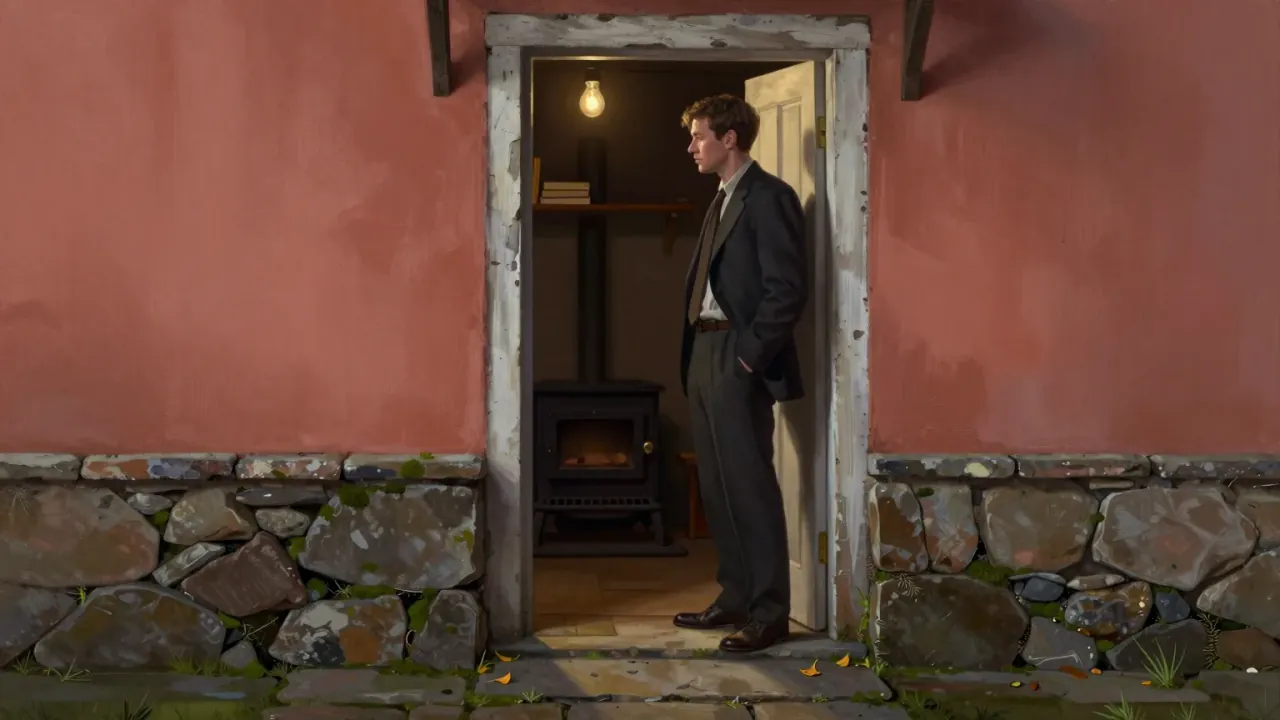
The story unfolds as a tightening coil: each Christmas ritual — the carol service, the pheasant shoot, the formal dinner — becomes a site of quiet defiance or internal collapse. Kristen Stewart’s performance anchors this with physical precision: her posture shifts between deference and recoil, her eyes darting just beyond frame, her hands rarely still. Timothy Spall’s Major Gregory and Sally Hawkins’s Maggie operate as counterweights — one enforcing protocol, the other offering fragile intimacy. Claire Mathon’s cinematography uses Super 16mm’s grain and shallow depth to flatten hierarchy: Diana is never visually separated from walls, doorways, or staff. Jonny Greenwood’s score avoids melody, favouring dissonant strings and abrupt silences that mimic tinnitus or dissociation. Sebastián Sepúlveda’s editing sustains unease through asymmetrical cuts and lingering holds — a glance held half a second too long, a door closing just before we see who enters. The production design treats Nordkirchen Castle not as stand-in for Sandringham but as architectural metaphor: grand, cold, acoustically hollow, its corridors echoing with unspoken pressure.
The weight of it
What lands most decisively is the film’s tactile discomfort: the scratch of wool uniforms, the weight of pearls against collarbone, the muffled thud of footsteps on thick carpet. Stewart’s performance works because it refuses imitation — she does not mimic Diana’s voice or mannerisms but locates the exhaustion behind them, the way fatigue reshapes speech and gait. The hallucinations — Anne Boleyn at table, the scarecrow wearing Diana’s coat — land not as surreal flourishes but as logical extensions of sustained psychological pressure. The film’s refusal to moralise Charles or Camilla also lands: Jack Farthing plays the Prince with weary entitlement, never caricature, making his emotional detachment more chilling than any villainy. The final sequence — KFC by the Thames, the song playing over cracked audio — lands because it rejects catharsis. It offers relief, yes, but also ambiguity: no triumph, only release into uncertainty. That restraint, that commitment to unresolved feeling, gives the film its quiet authority.
The edge of it
What does not land is the film’s occasional drift into abstraction without sufficient grounding. Some of the Boleyn sequences lack narrative purchase — they feel like mood boards rather than psychological logic, their symbolism too literal (pearls = purity, staircase = suicide) to earn their repetition. The royal family as a collective remains deliberately faceless, but that choice risks flattening them into décor rather than antagonists: Charles’s cruelty needs more texture than clipped dialogue and averted glances, and the absence of William and Harry’s perspective limits the stakes of Diana’s choice. The film’s resistance to exposition also leaves structural gaps — we are told little about the mechanics of divorce, the legal constraints, or even the precise nature of Diana’s access to her sons post-separation. This isn’t carelessness, but the cost of its narrow focus: when every frame serves interiority, external consequence recedes. Some viewers will find that imbalance frustrating — not because the film is unclear, but because it declines to answer questions it has no interest in asking.
The air of it
The themes that matter are containment, inheritance, and the violence of ritual. Spencer treats the monarchy not as institution but as architecture — built to constrain movement, regulate breath, suppress affect. Diana’s childhood home, Park House, functions not as nostalgia but as negative space: proof that selfhood existed before protocol. The pearls, the tiara, the uniform — all are inherited objects that demand performance, not possession. The film interrogates how gendered duty calcifies into pathology: the expectation to smile while swallowing grief, to eat while nauseous, to hold still while vibrating internally. Anne Boleyn is not a ghost but a mirror — another woman whose body was managed, whose marriage was instrumentalised, whose survival depended on compliance until it did not. The film’s central tension is between visibility and erasure: Diana is endlessly watched, yet fundamentally unseen. Her rebellion is not loud but kinetic — a run across frozen grass, a ripped necklace, a car accelerating away — gestures that reclaim agency through motion, however small.
The reach of it
This film is for viewers who value sustained atmosphere over plot propulsion, who respond to performance as physical language, and who accept ambiguity as a condition of truth. It rewards attention to texture — the grain of film, the tremor in a hand, the pause before a sentence finishes. It is not for those who require narrative clarity, historical context, or moral resolution. Viewers expecting a conventional biopic or a critique of royal power structures will find it withholding. Those who dislike slow pacing, subjective sound design, or scenes where little ‘happens’ beyond internal shift may grow impatient. The verdict changes if the viewer prioritises factual accuracy over emotional fidelity — but that is not this film’s contract. It assumes you already know the outline of Diana’s life; what it offers is not new information, but a recalibration of scale: from headline to heartbeat, from archive to artery.
The leaving of it
Yes, it is worth your evening — provided you approach it as a chamber piece, not a chronicle. Its 117 minutes unfold with the deliberation of a held breath, and its impact accumulates in increments: a glance, a silence, a change in light. It does not entertain; it occupies. You leave it not with answers but with residue — the echo of Greenwood’s strings, the memory of Stewart’s knuckles whitening on a steering wheel. It earns its runtime by refusing shortcuts: no montage summarises Diana’s despair, no voiceover explains her motives. Its value lies in that rigour — in treating a globally known figure not as icon but as subject, vulnerable and volatile. Those who find such intensity exhausting may prefer something more discursive. But for anyone willing to sit with discomfort, to trust image over exposition, to accept that some truths are best conveyed in grain and gesture — this film repays the time, fully and quietly.