The nature of the thirst
Thirst is a South Korean vampire film that adapts Émile Zola’s Thérèse Raquin into a Catholic moral parable about desire, guilt and biological compulsion. It does not aim to reinvent the vampire mythos but to test its capacity as a vessel for psychological realism and theological unease. Park Chan-wook treats vampirism not as supernatural curse or gothic ornament, but as irreversible physiological corruption — a virus with metaphysical side effects. The film’s ambition lies in sustaining tension between Sang-hyun’s priestly vocation and his predatory biology, and between Tae-ju’s yearning for agency and her entanglement in Sang-hyun’s moral collapse. It is neither satire nor allegory, but a tightly wound domestic tragedy accelerated by bloodlust. Its formal rigour — long takes, symmetrical framing, deliberate pacing — serves this purpose: to make the grotesque feel inevitable, not sensational. It assumes familiarity with Catholic ritual and Korean familial hierarchy, but never explains them. Its project is not accessibility but fidelity — to Zola’s fatalism, to Park’s own visual grammar, and to the slow burn of irreversible choice.
The weight of each choice
The story unfolds in measured, cause-and-effect steps: infection, relapse, seduction, murder, betrayal, mutual ruin. Song Kang-ho modulates Sang-hyun’s descent with granular physicality — the tremor before feeding, the flinch from sunlight, the hollowing of his voice as faith erodes. Kim Ok-vin gives Tae-ju a restless, unvarnished intelligence; her shifts from boredom to terror to exhilaration are registered in posture and silence more than dialogue. Chung Chung-Hoon’s cinematography avoids chiaroscuro cliché: interiors are lit like hospital wards, exteriors bleached and flat, daylight treated as an active antagonist. Jo Yeong-wook’s score uses sparse piano motifs and low-frequency pulses rather than orchestral dread. Kim Sang-bum’s editing sustains duration without indulgence — a five-minute mahjong sequence feels taut, not stretched. The film’s craft is unified in its refusal of genre shorthand: no fangs are bared until late, no bats appear, and the blood is clinical, not eroticised. Even the nudity — historically noted as the first mainstream Korean male frontal exposure — is functional, not provocative: it underscores vulnerability, not spectacle.
The logic of the ash
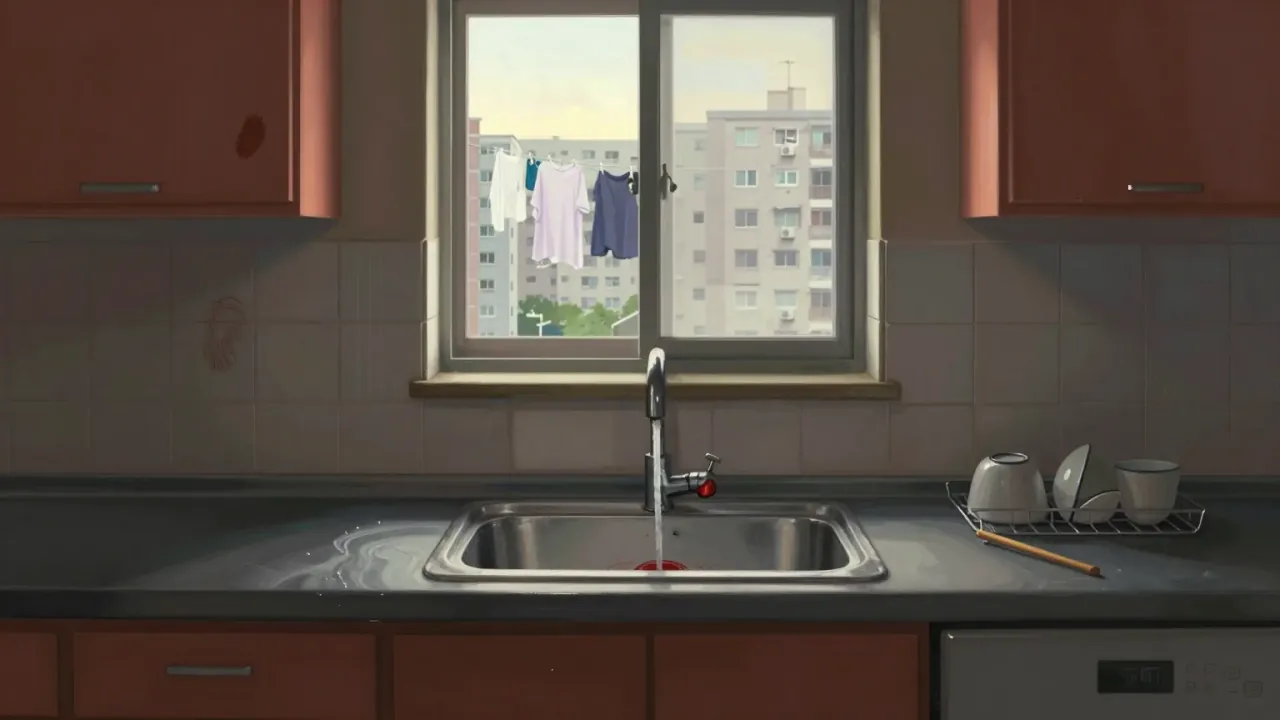
What lands is the suffocating weight of consequence. Every decision in Thirst compounds: Sang-hyun’s initial volunteerism, his hesitation before killing Kang-woo, his failure to stop Tae-ju’s spree — each is rendered with forensic clarity, so that the final immolation feels less like climax than arithmetic. The film’s moral architecture holds: there is no redemption arc, only escalating compromise. The domestic setting — cramped apartments, humid kitchens, sunless stairwells — makes the horror intimate, not remote. Mrs. Ra’s silent witnessing, her paralysis both physical and ethical, becomes the film’s most resonant counterpoint to the protagonists’ frenzy. The rooftop chase works because it is not choreographed spectacle but two people running out of options, their movements clumsy, desperate, unheroic. The final image — ash on car metal, a mother’s face in the rearview — lands precisely because it refuses catharsis. It is not shocking, but settled: the logic of the film’s world has been followed to its terminus, and the result is quiet, absolute, and unsparing.
The limits of the experiment
What does not land is the Emmanuel Virus premise. Its scientific vagueness undermines the film’s otherwise grounded approach: if the virus is fictional, why anchor it in real-world medical ethics? The research lab scenes feel perfunctory, the director’s exposition thin. The film’s American co-production status leaves faint but awkward traces — occasional English dialogue that sits uneasily in Korean domestic space, a few line readings that lack the texture of the rest. The third-act pivot, where Sang-hyun pretends to kill a friend to protect Tae-ju, strains credulity without sufficient setup; the character’s capacity for deception arrives too late. Some viewers may find the pacing inert in the middle stretch, particularly during Sang-hyun’s solitary blood thefts — scenes that aim for existential weariness but risk monotony without stronger variation in rhythm or tone. The film’s restraint, usually a virtue, occasionally reads as withholding: we are shown Sang-hyun’s torment but rarely granted access to his theological reckoning beyond surface-level despair.
The institutions that hold and break
The themes that matter are complicity, contagion, and the illusion of control. Thirst treats vampirism as a metaphor not for sexuality alone — though that is present — but for any irreversible dependency that reshapes identity: addiction, grief, ideological possession. Sang-hyun’s priesthood and Tae-ju’s marriage are both institutions that promise structure but deliver constraint; vampirism does not liberate them but exposes how thoroughly they were already bound. The film interrogates moral responsibility when biology overrides volition: is Sang-hyun guilty of murder if his body demands blood, or only of failing to contain that demand? Mrs. Ra embodies passive culpability — her silence enables abuse, then witnesses atrocity without intervening. The film’s religious framework is not doctrinal but architectural: confession, communion, resurrection — all are inverted, made literal and lethal. There is no divine mercy here, only physics and consequence. The central irony is structural: the vampire, traditionally undead, becomes the most human figure in the film — flawed, inconsistent, tragically self-aware.
Who the film trusts with silence
This film is for viewers who value moral density over momentum, who find tension in stillness and horror in implication. It suits those accustomed to Park’s earlier work — Oldboy’s ferocity, Lady Vengeance’s symmetry — and willing to sit with discomfort without narrative payoff. It is not for viewers seeking visceral scares, genre thrills, or narrative resolution; the ending offers no revelation, only termination. Those who require clear villainy, redemptive arcs, or even coherent world-building will find it withholding. It also assumes patience with longueurs: a scene of Sang-hyun washing blood from his hands lasts nearly ninety seconds without cut or music. A viewer who prefers psychological realism anchored in social context over metaphysical conceit may resist its premise. But for those who believe horror should unsettle the conscience before the skin, Thirst remains one of the most rigorously argued vampire films ever made — its power lies not in what it shows, but in what it refuses to excuse.
The discipline of the dusk
Yes, it is worth your evening — provided you watch it whole, undistracted, and accept its pace as part of its argument. Its 133 minutes do not pass quickly, but they accumulate with precision: every shot, pause and silence serves the erosion of certainty. It rewards attention to gesture, to light, to the weight of a glance held too long. Those who dismiss it as ‘slow’ miss that its slowness is its subject — the grinding inevitability of consequence. Viewers expecting genre conventions will leave dissatisfied; those open to horror as sustained ethical inquiry will find it unusually rigorous. It is not entertainment in the transactional sense, but it is deeply absorbing on its own terms. A second viewing clarifies its architecture: the early mahjong game, the repeated motif of locked cabinets, the way sunlight moves across walls — all are calibrated. To call it ‘unhurried’ is not faint praise. It is the film’s method, and its integrity.